
Early findings suggest a secretome hair treatment may support processes involved in hair growth, but the clinical evidence is still too limited to show how reliably it works or establish its long-term safety. One review reported three clinical studies on stem-cell secretions or secretome as a potential treatment for alopecia, alongside preclinical research.
If you’re considering a secretome hair treatment, it’s reasonable to want more than encouraging laboratory results. You need to understand what has been observed in people, what remains uncertain, and how this regenerative approach differs from established treatments.
This article explains how secretome may influence hair follicles, what human studies and safety reports have found, and how secretome may compare with or complement options such as PRP and medication. It also considers why the cause and extent of hair thinning matter when weighing a personalized treatment plan.
Key Takeaways
- Separate promising laboratory findings from the still-limited evidence in people to understand what secretome research can, and can’t, tell you.
- Learn how secretome signals may interact with hair-follicle cells, and why exosomes are only one part of the picture.
- Review what safety reports have observed and why the length and size of studies matter when weighing those findings.
- Compare regenerative approaches with PRP and medication by considering your pattern of hair loss, scalp health, and treatment goals.
- See how a personalized scalp assessment can help shape a nonsurgical plan around the underlying cause of thinning.
Combining secretome with other hair-loss treatments
A treatment plan may combine approaches that address different aspects of hair loss. For example, a clinician might consider secretome alongside minoxidil, finasteride, or platelet-rich plasma (PRP). These options work differently, and evidence for one treatment doesn’t establish that combining it with secretome improves results.
Hair loss has multiple possible causes, including androgen-related changes, genetics, hormonal shifts, stress, and some medical conditions. Identifying the pattern and likely cause helps determine which treatment approaches may be relevant.
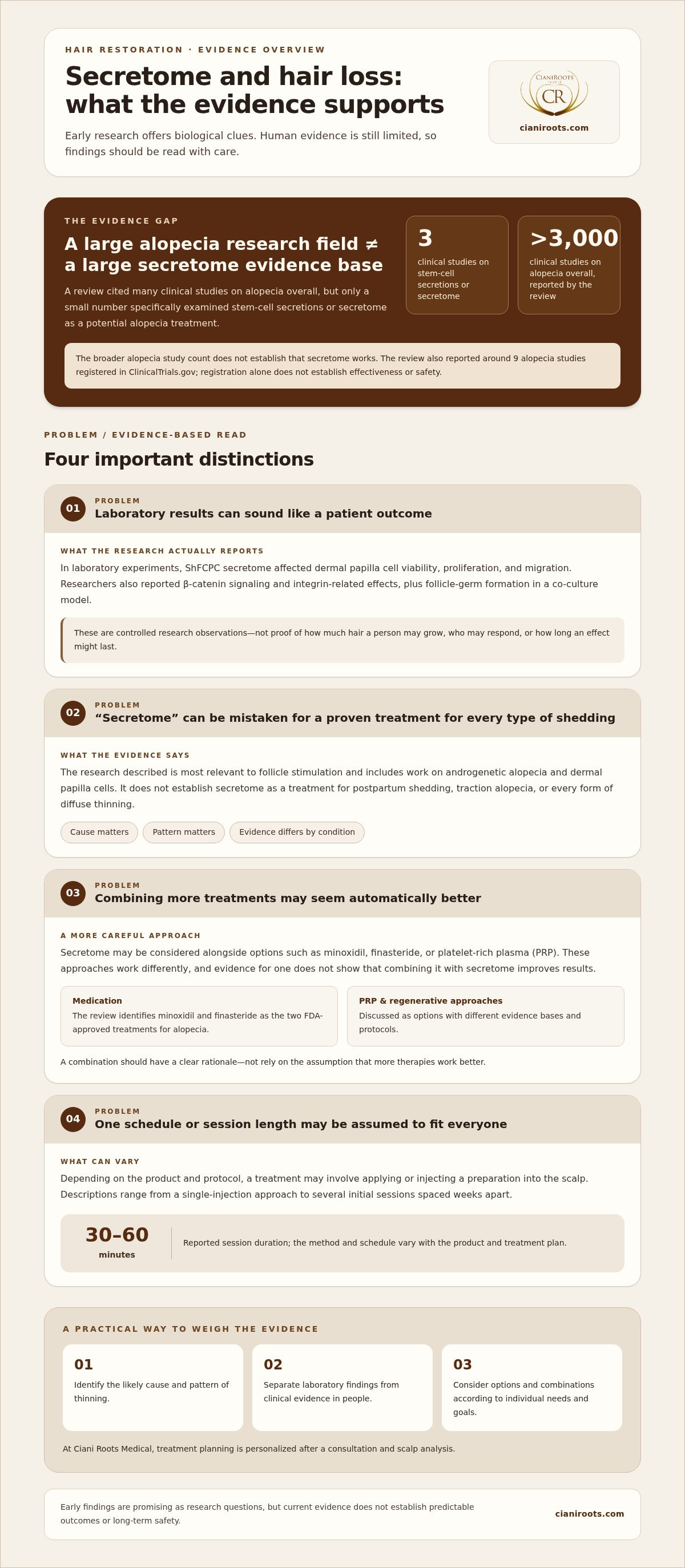
Secretome research is most relevant to follicle stimulation, not every cause of shedding. Studies have examined androgenetic alopecia and pathways involving dermal papilla cells, which help regulate hair growth. Evidence doesn’t establish secretome as a treatment for postpartum shedding, traction alopecia, or every form of diffuse thinning.
A secretome hair treatment may involve applying or injecting a preparation into the scalp, depending on the protocol. Some descriptions present a single-injection approach; others describe several initial sessions spaced weeks apart. Sessions typically last 30 to 60 minutes, but the method and schedule vary with the product and treatment plan.
In the United States, cost depends on the case and treatment plan; it’s provided after a quote request. Factors include the treatment method, the number of sessions, and whether other therapies are part of the plan.
Headlines about “breakthroughs” can blur the difference between laboratory findings, animal research, and clinical evidence in people. One review reports more than 3,000 clinical studies published on alopecia overall, but only three clinical studies on stem-cell secretions or secretome as a potential alopecia treatment. The broader number doesn’t prove secretome works.
The research review reports around nine alopecia studies registered in ClinicalTrials.gov. That count doesn’t establish effectiveness or safety. The review identifies minoxidil and finasteride as the two FDA-approved treatments for alopecia. PRP and regenerative approaches are also discussed, but have different evidence bases and protocols.
For androgen-related hair loss, options may include medication, PRP, or regenerative approaches, chosen according to the pattern and progression. Secretome signals, including exosomes and other extracellular components, are being studied for their effects on follicle-cell activity and proliferation. Combining treatments should serve a clear goal, rather than rely on the assumption that more therapies work better.
How Can the Secretome Influence Hair Growth?
Secretome describes signaling substances released by cells, rather than living stem cells themselves. These substances can include proteins and other biological signals that interact with nearby cells. In hair research, the central question is whether these signals affect follicle-supporting cells and their growth-related activity. Findings involving ShFCPC, or secretome from human fetal cartilage progenitor cells, offer one example. They suggest possible biological pathways, not predictable hair growth in patients.
Dermal papilla cells sit at the base of hair follicles and help regulate follicle activity. In laboratory experiments, ShFCPC enhanced their viability, proliferation, and migration. Researchers also observed these effects under testosterone-induced apoptosis, a model of cell stress relevant to androgen-related hair-loss research. This suggests secretome signals can influence cell behavior in a controlled setting. It doesn’t establish that the same effect occurs in a person’s scalp after treatment.
One reported pathway involves β-catenin, a protein central to Wnt signaling. In ShFCPC experiments, treatment restored β-catenin signaling in dermal papilla cells. The findings also described restored integrin-mediated interactions with the extracellular matrix, the supporting material surrounding cells. These interactions matter because follicles rely on communication between cells and their surrounding structure. The findings connect secretome signals with follicle-supporting biology, but don’t establish a clinical outcome.
TGF-β is another signaling pathway discussed in hair-follicle biology. However, it should not be treated as a proven secretome mechanism based on the ShFCPC findings described here. Those findings specifically report β-catenin and integrin-related effects. A pathway’s role in follicle biology doesn’t demonstrate that a secretome product changes that pathway, or that such a change improves hair growth.
A co-culture model adds another step to the evidence chain. In that laboratory setting, ShFCPC promoted hair-follicle germ formation and improved trichogenic marker expression and cell organization. Hair-follicle germs are early structures used to study follicle development. These results help researchers examine how cell-to-cell signals might support organized follicle formation. However, cultured-cell models differ from a living scalp, where hormones, tissue conditions, and the hair-growth cycle also matter.
For patients, the practical takeaway is to distinguish biological plausibility from clinical evidence. Increased proliferation in a dish, restored β-catenin signaling, and follicle-germ formation are research observations. None alone shows how much hair a person will grow, which diagnosis might respond, or how long an effect would last. Those questions require human clinical evidence, alongside an accurate understanding of the individual’s hair-loss pattern and underlying cause.
Exosomes and extracellular vesicles
Secretome and exosomes are related terms, but describe different biological material. Understanding the distinction helps readers interpret how regenerative products are described for hair restoration.
Secretome and Exosome Definitions
A secretome is the collection of substances cells release, while extracellular vesicles are small membrane-bound particles released by cells. Exosomes are one type of extracellular vesicle, typically 50-200 nm in size. Some descriptions characterize secretome as a cell-free solution containing growth factors and cytokines from donor bone marrow stem cells. These terms describe biological contents, not a proven treatment outcome.
For someone researching alopecia, terminology matters because product labels may emphasize different components. A description focused on exosomes refers to vesicles; a secretome description may refer to a broader mixture of released substances. Knowing which term is used helps distinguish what a preparation contains from what researchers hope it may do.
Secretome and Exosome Differences
Secretome refers to a broader collection of cell-released substances, while exosomes are a specific vesicle component within that collection. The terms are not interchangeable. A secretome may include extracellular vesicles alongside soluble molecules, such as cytokines and growth factors. Evidence about one component cannot automatically establish the effects of the entire mixture, or of another preparation described in similar terms.
Cell source and preparation also shape what a product description means. For example, a research preparation derived from bone marrow stem cells may differ from one derived from another cell type. The word “exosome” alone doesn’t identify the source, contents, or intended use. To interpret claims accurately, distinguish the named component from the biological material surrounding it.
Exosomes and Growth Factors
Growth factors are signaling proteins, while exosomes are membrane-bound particles that may carry biological messages between cells. They are related concepts, not synonyms. Cytokines are another class of signaling molecules often discussed alongside growth factors. A claim about growth factors doesn’t necessarily describe exosomes, and an exosome-focused claim doesn’t establish which signals a preparation contains.
In hair research, scientists examine whether cell-derived signals could influence follicle environments and growth-related activity. That biological rationale doesn’t prove a particular preparation promotes hair growth in patients with genetic alopecia. Product composition, source cells, and clinical evidence all affect how a claim should be understood. A label naming exosomes or growth factors alone cannot establish efficacy, safety, or suitability for an individual.
Reported safety and adverse reactions
Safety findings for regenerative hair treatments depend on the product, delivery method, and study design. Research on secretome-based hair-loss treatments includes laboratory research, animal experiments, and small human trials. These findings provide early observations, not a complete picture of cellular effects or long-term safety. For patients considering treatment for androgenetic alopecia, follow-up duration matters as much as whether researchers reported immediate reactions.
There is no FDA-approved umbilical-cord mesenchymal stem cell secretome product for treating hair loss in the United States. Secretome is a nonstandardized product category, rather than a standardized pharmaceutical product. The term alone doesn’t establish a product’s regulatory status, composition, or safety.
Animal findings offer limited context. A study of ShFCPC reported no toxicity in treated animals, while examining biological effects such as follicle formation. Those results apply to the preparation and conditions studied. They don’t establish how another product, dose, or scalp-delivery method may affect people. Animal studies can identify signals for further research, but cannot replace human safety follow-up.
In a human study lasting three months, researchers reported no treatment-related adverse reactions. Early human studies of secretome-related hair-loss treatments generally followed participants for weeks to months, and available studies are small and relatively short. Uncommon reactions and later effects may not be captured. No reported reactions during a short study period is not proof of long-term safety.
Safety also depends on the treatment being considered. The research review describes PRP made from a patient’s own platelets as carrying minimal risk of infection, immune reactions, and side effects. That observation concerns PRP, not secretome. Minoxidil and finasteride have different safety considerations, including potential systemic side effects reported for finasteride. Consider each treatment’s evidence and risks separately.
When evaluating a clinic offering this treatment, look for a clear explanation of the product’s source, preparation, intended use, and evidence. A responsible discussion distinguishes human findings from animal results, explains the limits of short follow-up, and reviews your health history and hair-loss pattern. It should also describe how possible reactions are monitored, rather than presenting laboratory findings as proof of clinical benefit.
These distinctions help frame suitability. Someone with progressive androgenetic alopecia may need a different plan from someone experiencing temporary shedding. An assessment of scalp health, diagnosis, medications, and treatment goals helps determine whether regenerative care belongs in the plan. The evidence supports careful interpretation, not broad claims that one approach can stimulate hair growth for every patient.
Nonsurgical hair restoration options
Nonsurgical options differ in what they target and how their evidence is measured. Medication addresses hair-loss pathways, PRP uses a patient’s own platelets, and regenerative approaches study cell-derived signals. The useful comparison isn’t simply which sounds newest. It’s whether the approach matches the hair-loss pattern, available evidence, and person’s treatment goals.
For androgenetic alopecia, minoxidil and finasteride are established medication options. A review identifies these as the two FDA-approved treatments for alopecia. Minoxidil’s benefits are described as modest and can wane after discontinuation. Finasteride can carry systemic side-effect risks, including sexual dysfunction and depression. These differences shape discussions about continued use, monitoring, and individual suitability.
PRP is prepared from a blood sample: platelets are concentrated through centrifugation, then used in scalp treatment. The research review describes PRP protocols as requiring at least 6 sessions a year. That recurring schedule differs from secretome protocols, which may involve several initial sessions spaced weeks apart. A treatment schedule alone doesn’t establish efficacy; study design and measured outcomes matter too.
Clinical evidence for cell-derived approaches includes distinct methods, not one interchangeable therapy. A study of adipose-derived stem cells involving 1,000 people reported an increase in total hair shafts. A separate human study involving 22 people reported an increase in hair number. Another randomized, multicenter study included 71 men and women with early androgenetic alopecia and evaluated fat grafts enriched with adipose-derived regenerative cells. These approaches involve different materials and procedures, so their results don’t directly prove secretome efficacy.
One study of stem-cell conditioned media assigned 15 patients to treatment and 15 to placebo. Topical treatment was applied weekly for 12 weeks, alongside a single fractional laser session. A media quotation described an increase of 14 hairs per cm², compared with two hairs per cm² in the placebo group. A separate human study of umbilical-cord MSC secretome lasted three months and reported increased hair density and average hair diameter. These findings are promising observations, not head-to-head comparisons across therapies.
In practice, the cause of thinning helps narrow the options. Gradual patterned loss calls for a different discussion from temporary shedding after stress or hormonal change. A scalp assessment, medical history, and review of current medications help connect treatment choices with the hair follicles and underlying pattern. Treatments intended to promote regenerative activity don’t replace diagnosing the cause first.
To compare nonsurgical approaches against your goals, EXPLORE YOUR OPTIONS.
Ciani Roots Medical: CR signature with regenerative hair loss treatments
Ciani Roots Medical serves patients in Vacaville and Alamo who are exploring personalized, nonsurgical care for hair thinning or shedding. Its CR Signature Protocol™ is a personalized combination approach designed for patients who may benefit from addressing hair loss through multiple treatment modalities.
For patients considering secretome, Ciani Roots Medical offers Regenerative Therapy with Stem Cells, using personalized secretome derived from the patient’s own hair-follicle stem cells. Other hair restoration options include KeraLase® Hair Therapy and Bio-Enhanced PRP. The appropriate approach depends on the hair-loss pattern, scalp health, and treatment goals. Not every patient receives or needs every treatment.
To discuss your concerns and possible next steps, contact Ciani Roots Medical.
Choose a Next Step That Fits Your Hair Goals
Before choosing a regenerative approach, define what you want to address: a widening part, reduced density, or ongoing shedding. Bring a clear timeline of changes and relevant health or medication history to your consultation. These details help connect your concerns with an individualized assessment and a practical plan.
A secretome hair treatment may be one option to discuss, but the right next step depends on your diagnosis, scalp health, and priorities. Because research and treatment responses vary, results aren’t guaranteed. A thoughtful conversation can help you weigh regenerative care alongside other nonsurgical approaches without relying on headline claims.
Ciani Roots Medical offers personalized hair-loss care, including its CR signature with regenerative treatments and Acorn Secretome, created from your own stored cells and biology. If you’re ready to discuss your concerns and possible next steps, EXPLORE YOUR OPTIONS.
With clear information and individualized guidance, you can move forward with greater confidence.
Frequently Asked Questions
Clinical & Preclinical Evidence: Does Stem Cell Therapy for Hair Loss Actually Work?
Research shows biological activity and early human findings, but it doesn’t establish that every stem-cell-related therapy reliably treats hair loss. “Stem cell therapy” covers different approaches, including cells, conditioned media, and secretome products. A retrospective analysis of adipose-derived stem-cell exosome treatment included 39 patients, but that study type alone can’t establish cause and effect. Separate evidence is needed for each product, method, and hair-loss diagnosis.
How long before I see results?
Visible changes may take several weeks to appear and are more likely to be noticed after three to six months. Hair grows in cycles, so day-to-day appearance can hide gradual changes. For a more useful comparison, take scalp photos from the same angles, with similar lighting and part placement. Track shedding and density alongside photographs rather than judging progress from a single day.
Is it painful?
Comfort depends on how treatment is delivered. A topical application feels different from an injection or a procedure that uses scalp microchannels. Injection-based methods can involve brief needle sensations, while other approaches may cause pressure or temporary sensitivity. Ask what sensations are typical for the specific method and what comfort measures are used. Your scalp sensitivity and previous treatment experiences are also relevant.
What is a secretome hair treatment, and how does it work?
A secretome hair treatment uses cell-released biological signals rather than living stem cells. Depending on the product and protocol, it may be applied topically or delivered into the scalp. Researchers study whether those signals influence follicle-supporting cells. The term covers varied preparations, so it doesn’t identify one standardized formula or a single treatment method.
What ingredients or growth factors are in secretome hair treatments?
Secretome preparations can contain cell-released signaling substances, including growth factors and cytokines, alongside other biological material. Their composition depends on the source cells and preparation method. Exosomes are one possible component, not another name for the entire secretome. A general ingredient description isn’t a complete formula for every product; the source and composition determine what a specific preparation contains.
What does clinical research say about secretome treatment for hair growth?
Human research includes small studies with short follow-up, alongside laboratory and animal findings. A human clinical study of umbilical-cord mesenchymal stem-cell secretome lasted three months and reported increased hair density and average hair diameter. These observations are useful starting points, but don’t establish how long changes persist or how well findings apply across different causes of thinning.
How does secretome treatment compare with PRP, exosomes, and minoxidil?
These approaches differ in both material and evidence. PRP uses platelets processed from the patient’s blood; exosomes are vesicles, while secretome refers to a broader collection of cell-released substances. Minoxidil is a medication with a different mechanism and treatment routine. Begin comparisons with the diagnosis and goal, such as managing patterned thinning or considering a regenerative approach, rather than assuming the options are interchangeable.
How long does it take to see results, and how long do they last?
Visible changes may emerge over several weeks, with changes more likely to be noticed after three to six months. Research follow-up for secretome-related hair-loss treatments ranges from weeks to months, so it doesn’t establish how long observed changes last after treatment. Ask how progress will be assessed and whether follow-up photographs or density measurements will be used to compare changes over time.
Article by
Adriane McDonald BSN,RN
Adriane McDonald, BSN, RN, is a hair restoration specialist with nearly 40 years of experience working with men and women experiencing hair loss and thinning. As the Founder and Practice Director of Ciani Roots Medical, she works alongside the practice’s Medical Director to provide personalized hair restoration, scalp health, regenerative therapies, and advanced skin rejuvenation.
Her approach combines extensive hands-on experience with detailed scalp analysis, medical collaboration, and individualized treatment planning. Adriane is currently completing advanced training toward certification in trichology, further expanding her expertise in hair and scalp health.
Disclaimer
This content is provided for general educational and informational purposes only and is not intended to serve as medical advice, diagnosis, or treatment. Individual needs, treatment recommendations, and results vary. A consultation and appropriate evaluation are necessary to determine which treatment options may be suitable for you. Viewing or interacting with this content does not establish a healthcare professional-patient relationship with Ciani Roots Medical.
Individual results may vary, and no specific outcome can be guaranteed. Before-and-after images, testimonials, or treatment experiences represent individual results and should not be considered a guarantee of similar results.


