
When you’re considering KeraLase hair therapy, it helps to understand what the treatment involves and whether it fits your scalp and pattern of thinning. KeraLase pairs the LASEmd Ultra laser, which creates microscopic channels in the scalp, with topical KeraFactor MD applied afterward. Each component has a distinct role, but the treatment is not a universal solution or a promise of regrowth.
This article explains the process, what may shape a personalized treatment plan, and why identifying the cause and pattern of hair loss matters. At Ciani Roots Medical, KeraLase is considered as part of medically directed hair-restoration care, informed by a detailed scalp analysis and your individual needs. If you’re exploring care in Vacaville or Alamo, a consultation can help you understand how this approach may fit alongside other options.
Key Takeaways
- KeraLase hair therapy combines laser-assisted delivery with topical KeraFactor MD, and each component has a different role.
- The treatment plan is personalized, so the sequence and recommendations should not be assumed to be identical for everyone.
- Hair thinning and shedding can have different causes. An individual evaluation helps determine whether KeraLase may be appropriate to consider.
- Your goals and scalp health are important parts of a clinical discussion, not a checklist for choosing a treatment on your own.
- Ciani Roots Medical’s complimentary consultation and detailed scalp analysis help inform personalized hair-restoration planning in Vacaville and Alamo.
What Is KeraLase Hair Therapy? Understand Its Two Main Components
Hair thinning or shedding can raise questions, especially when a treatment involves technology and unfamiliar terminology. KeraLase hair therapy combines LASEmd Ultra laser treatment with topical KeraFactor MD. These are separate components used in sequence, not interchangeable treatments.
KeraLase is a laser-assisted topical treatment approach, not a guarantee of hair growth. At Ciani Roots Medical, it is part of medically directed hair-restoration care. An individual consultation and scalp analysis help determine whether it makes sense to include in a treatment plan. Understanding the process is a useful first step, but the treatment name alone cannot establish whether it suits your type of hair loss.
What does LASEmd Ultra do in KeraLase?
The LASEmd Ultra laser creates tiny channels in the scalp’s outer surface. In the KeraLase sequence, this prepares the scalp for the topical component applied afterward. The laser’s role is to create that pathway. It is not the serum, and its use alone does not determine what result an individual will experience. The treatment area and plan are considered in the context of a scalp assessment.
KeraLase’s fractional laser process is also different from Low-level laser therapy (LLLT). Both involve light-based technology, but they describe different approaches. The link provides general background on LLLT, not evidence about KeraLase specifically. Keeping the terms distinct helps avoid assuming all laser-based hair treatments work in the same way.
What is KeraFactor MD in this therapy?
KeraFactor MD is the topical component used with KeraLase at Ciani Roots Medical. It is applied after the laser has created microchannels, completing the treatment sequence. In simple terms, the laser prepares the scalp’s surface, and the serum is applied topically afterward. This describes how the components are paired, not a guaranteed clinical outcome.
That distinction matters when evaluating treatment descriptions. The device, topical product, and combined process each have a specific role; none should be treated as a promise of regrowth. Hair concerns can have different causes, so a scalp assessment helps put the treatment in context instead of relying on the name of a technology alone.
If you’re considering KeraLase, think of it as two coordinated steps: laser-assisted preparation followed by topical application. A consultation can explain how that sequence relates to your scalp and goals, and whether it belongs in a broader, individualized hair-restoration plan.
How KeraLase Hair Therapy Works: From Laser Treatment to Topical Application
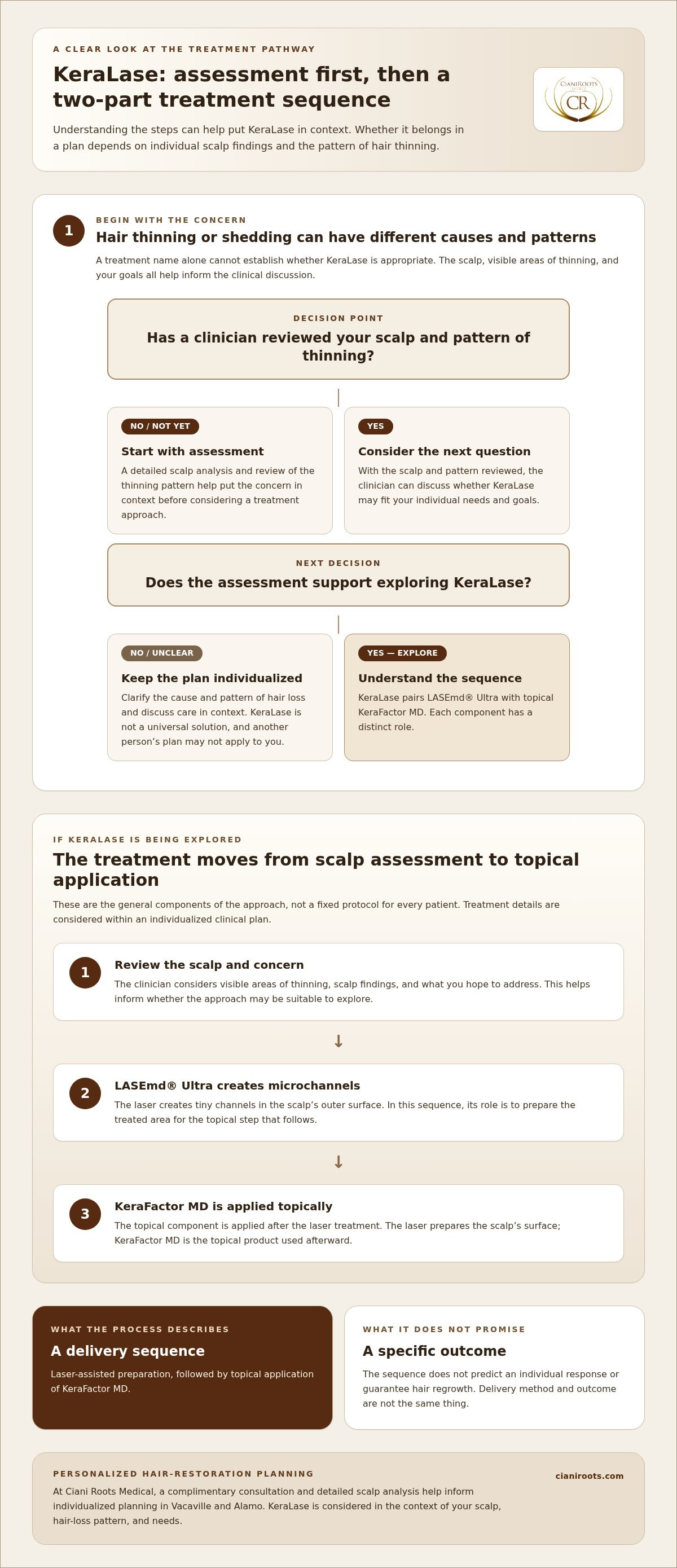
The process follows a sequence: first, the LASEmd Ultra laser treats the scalp; then KeraFactor MD is applied topically. These components work together as a delivery approach, but the sequence alone cannot predict how an individual’s hair may respond. Treatment planning depends on clinical assessment, including the person’s scalp and pattern of hair loss.
A consultation puts the steps in context. The clinician considers where thinning is visible, what the scalp looks like, and what you hope to address. These details help determine whether KeraLase is appropriate to explore and how it may fit into individualized care. The steps below describe the general approach, not a fixed protocol for every patient.
- Assess the scalp and concern. The clinician reviews areas of thinning and relevant scalp findings to inform treatment planning. This helps establish whether the approach may be suitable, rather than assuming every pattern of hair loss calls for the same treatment.
- Use the laser component. LASEmd Ultra creates microchannels in the scalp’s outer surface. In this treatment approach, they are part of the topical-delivery process and prepare the treated area for the next step.
- Apply KeraFactor MD. The topical serum is applied after the laser treatment. Together, these steps describe how the treatment is delivered, not a promise of a particular response or a substitute for assessing the cause of hair loss.
Why does the treatment use laser-assisted delivery?
The microchannels provide a pathway through the scalp’s outer surface before the topical product is applied. This is the laser’s role in the sequence: it prepares the treatment area for topical application. It does not mean the laser activates follicles or ensures a specific amount of absorption. A delivery method describes how a product is applied, not what result a particular patient will experience.
What happens during the topical application step?
After the laser component, KeraFactor MD is applied topically to the treated scalp. The serum is the second part of the process, with the laser and topical product serving distinct roles. Application details and treatment-specific instructions are part of your personalized clinical plan. Another person’s sequence or directions may not apply to you.
In short, the laser prepares the scalp’s surface, and KeraFactor MD is applied afterward as the topical component. That description explains the process without confusing its mechanics with a guaranteed outcome. If you’re considering treatment, a personalized scalp assessment can help clarify how the approach relates to your needs and goals.
What KeraLase May Address, and Why Results Should Not Be Promised
Hair thinning and shedding can look similar at first, but they do not always have the same cause or pattern. A gradual change in density, shedding that begins after a life event, and thinning concentrated in certain areas can each raise different clinical considerations. KeraLase may be discussed as one hair-restoration option, but the treatment name alone cannot establish whether it is appropriate for you.
No single treatment outcome should be assumed for every person. Suitability and expectations depend on an individual evaluation, not a blanket rule based on age, sex, or the fact that hair is thinning. A consultation and scalp analysis help connect what you’re experiencing with a plan that reflects your needs.
Why does the cause of hair loss matter?
The pattern and timing of changes can help guide an assessment. A clinician may ask when shedding began, whether it has changed over time, which areas are affected, and whether you have scalp concerns or relevant medical factors. Sudden shedding and gradual changes in density, for example, offer different details to consider. These observations do not diagnose the cause on their own, but they help shape an informed discussion.
That context matters because a treatment should be considered in relation to the concern being addressed, not chosen from a checklist. A detailed scalp analysis contributes useful information, while your history and goals help complete the picture. The aim is to determine whether KeraLase belongs in an individualized plan, not to fit every type of hair loss into one approach.
How should readers interpret claims about results?
Testimonials and promotional descriptions may reflect one person’s experience or a clinic’s perspective. They cannot predict an individual response. Photos and personal accounts may not show all the details needed to understand the treatment plan, starting point, or other factors involved. Treat them as context, not a forecast for your density, timeline, or outcome.
Ciani Roots Medical does not guarantee hair regrowth or permanent results. A treatment’s intended role is different from a promised clinical outcome: describing what an approach is designed to do does not establish that it will produce a particular change for every patient. KeraLase hair therapy should be considered within medically directed care, with expectations discussed in light of your scalp assessment and goals.
For a focused consultation, note when you first noticed a change, where it is most visible, and whether shedding or thinning has shifted. These observations support the conversation without requiring you to diagnose yourself. The clinician can review the assessment, explain how KeraLase may fit, and discuss the uncertainties that apply to your situation. A careful plan leaves room for individual differences rather than implying a universal response.
Questions to Consider Before Exploring KeraLase Hair Therapy
A useful consultation is more than a decision about whether to try a treatment. It is a chance to understand what may be contributing to your hair changes, clarify what you hope to address, and consider whether KeraLase fits within a personalized plan. You do not need to arrive with a diagnosis or a perfect timeline. A few observations and questions can make the conversation more focused.
What information can support a useful scalp assessment?
Before your appointment, think about when you first noticed shedding or thinning and how it has changed. Note where you see the most difference, whether the change has been gradual or sudden, and any scalp concerns you have noticed. Share relevant health history and current hair-care practices with your clinician, as these details can provide context for the assessment.
- When did you first notice a change, and has it continued or fluctuated?
- Which areas seem most affected, and have you noticed changes in your scalp?
- What health history or current treatments might be relevant to discuss?
- What hair-care practices or recent changes would help explain your experience?
A detailed scalp analysis adds another layer of information to this discussion. It helps inform individualized planning, but it cannot predict a guaranteed result. The goal is to understand your starting point and concerns, not to treat a checklist as a diagnosis.
What should a personalized treatment plan clarify?
Ask the clinician to explain the intended role of KeraLase in your care and how the proposed sequence relates to your scalp assessment. It is also reasonable to discuss how progress will be reviewed, what expectations are realistic, and what uncertainties apply to your situation. Clear answers can help you weigh the approach without assuming a particular outcome.
- What concern is this treatment intended to address in my case?
- How does the proposed sequence connect to my scalp assessment and goals?
- How will we review progress and decide whether the plan remains appropriate?
- What individual concerns or relevant health factors should we consider?
Session scheduling and any maintenance recommendations should come from your individualized plan, rather than being assumed from another person’s experience or a general online schedule. If a recommendation is unclear, ask how it was shaped by your assessment and what factors could lead to changes. Understanding the reasoning matters as much as knowing the steps.
These conversations can help you make a considered decision, whether you proceed with KeraLase or discuss other elements of medically directed hair-restoration care. Explore your options through a personalized consultation and scalp assessment.
Explore KeraLase Hair Therapy with Ciani Roots in Vacaville or Alamo
Deciding whether to explore a hair-restoration treatment can feel personal, especially when thinning or shedding affects your confidence. At Ciani Roots Medical, care begins with a complimentary consultation and detailed scalp analysis, so the conversation starts with your concerns rather than a predetermined treatment choice. The medically directed practice serves patients in Vacaville and Alamo, with individualized planning shaped by each person’s assessment and goals.
How does scalp analysis inform KeraLase planning?
A detailed scalp assessment helps establish an informed starting point. Along with your description of the changes you’ve noticed, it allows the clinician to consider areas of concern and discuss whether KeraLase with LASEmd Ultra and KeraFactor MD may fit your treatment plan. Your goals matter, too. You may want to address a particular area of thinning or better understand a change in overall density.
The analysis supports clinical discussion, but it cannot predict exactly how you’ll respond to treatment. Instead, it helps connect observed findings and personal priorities with appropriate options. This keeps planning grounded in your circumstances, not assumptions based on a general description of KeraLase hair therapy.
What does personalized, medically directed hair care mean?
Personalized care means recommendations follow a consultation and scalp analysis, with the treatment’s role and its place in your broader hair-restoration plan explained clearly. Care at Ciani Roots operates under dedicated medical director oversight. Founder Adriane McDonald, BSN, RN, brings nearly 40 years of hair-restoration experience to a practice centered on attentive, individualized care.
A consultation is also a time to share relevant health context, ask what the assessment suggests, and discuss your expectations or concerns. If KeraLase is considered, the plan can clarify why it is being discussed and how the approach relates to your needs. Other relevant considerations can also be part of the conversation. The aim is a medically directed plan that reflects you, rather than treating a technology as the answer for every pattern of hair loss.
Ciani Roots Medical serves patients exploring hair restoration in Vacaville and Alamo, as well as Fairfield, Dixon, Suisun City, Benicia, Vallejo, Napa, Winters, Davis, Woodland, Solano County, Yolo County, Napa Valley, Danville, Walnut Creek, San Ramon, Blackhawk, and Lafayette. A measured first step is a conversation about your scalp and goals, with treatment options considered through an individualized assessment.
Take a Thoughtful Next Step for Your Hair Health
Choosing whether to explore KeraLase hair therapy does not mean committing to treatment before you understand your options. Consider what you hope to address and what would help you feel informed and comfortable moving forward. A focused conversation can turn general questions into a clearer discussion of your priorities and possible next steps.
You might begin by writing down the changes you’ve noticed and the questions you want answered. Bring up concerns about the approach, your expectations, or how treatment planning would fit your circumstances. The goal is a medically informed decision that feels considered, not rushed, and reflects your needs rather than a promised outcome.
At Ciani Roots Medical, explore your hair-restoration options through a personalized consultation. Schedule a complimentary consultation to discuss your scalp, goals, and whether KeraLase may fit your individualized care plan.
Frequently Asked Questions
Can KeraLase treat every type of hair loss?
No. KeraLase should not be assumed to suit every cause or pattern of hair loss. Gradual changes in one area and sudden shedding, for example, are different histories to discuss, not diagnoses to make from a general treatment description. A clinician can review your health history, scalp condition, and goals before considering whether KeraLase belongs in a personalized plan. Share what you’ve noticed and when it began.
How many KeraLase sessions will I need?
There is no session count that applies to everyone. Recommendations depend on your assessment, goals, and the clinician’s judgment. A schedule described online may reflect another practice’s approach rather than your individual plan. At Ciani Roots Medical, consultation and scalp analysis inform personalized planning for patients in Vacaville, Alamo, and surrounding communities.
Is KeraLase a guaranteed hair-regrowth treatment?
No. KeraLase does not guarantee regrowth, permanent results, or a specific increase in hair density. A treatment’s intended role is not the same as a predicted result for one person. Two people may have different patterns, histories, and goals even if both are concerned about thinning. A medically directed consultation can help set realistic expectations and discuss whether KeraLase may be appropriate for your situation.
Does KeraLase work for both men and women?
KeraLase may be discussed with people of different sexes, but that alone does not establish suitability. The pattern of thinning, possible contributing factors, scalp condition, and personal goals all matter. If you’re noticing a widening part, reduced density at the crown, or another change, describe it during an assessment rather than assuming the treatment is right based on sex alone. A clinician can help put your concern in context.
Can KeraLase be considered if my hair loss started suddenly?
Sudden or pronounced shedding calls for thoughtful clinical evaluation before assuming a cosmetic treatment is the right next step. Be ready to share roughly when the change began, whether it has continued, and any related health concerns or changes in your routine. These details can guide the conversation and help the clinician consider your situation responsibly. Do not rely on a general treatment description to identify the cause.
Is KeraLase the same as a hair transplant?
No. KeraLase uses LASEmd Ultra with topical KeraFactor MD, while a hair transplant is a surgical procedure. The methods differ, so they are not interchangeable terms. This distinction does not determine which approach is appropriate for you. If you’re comparing options, discuss your goals and clinical situation with a clinician so the conversation can focus on relevant choices and expectations.
Article by
Adriane McDonald BSN,RN
Adriane McDonald, BSN, RN, is a hair restoration specialist with nearly 40 years of experience working with men and women experiencing hair loss and thinning. As the Founder and Practice Director of Ciani Roots Medical, she works alongside the practice’s Medical Director to provide personalized hair restoration, scalp health, regenerative therapies, and advanced skin rejuvenation.
Her approach combines extensive hands-on experience with detailed scalp analysis, medical collaboration, and individualized treatment planning. Adriane is currently completing advanced training toward certification in trichology, further expanding her expertise in hair and scalp health.
Disclaimer
This content is provided for general educational and informational purposes only and is not intended to serve as medical advice, diagnosis, or treatment. Individual needs, treatment recommendations, and results vary. A consultation and appropriate evaluation are necessary to determine which treatment options may be suitable for you. Viewing or interacting with this content does not establish a healthcare professional-patient relationship with Ciani Roots Medical.
Individual results may vary, and no specific outcome can be guaranteed. Before-and-after images, testimonials, or treatment experiences represent individual results and should not be considered a guarantee of similar results.


