
Could PRP help with hair loss without being a guaranteed fix? It may support improvement for some people, but results aren’t certain, and research varies in quality and approach. If you’re weighing PRP for hair loss, it’s understandable to want clear answers about what the evidence supports, how treatment works, and what to ask before deciding.
PRP uses platelets prepared from a sample of your blood and is administered to the scalp. The preparation, treatment plan, and outcomes can differ depending on the protocol and your hair-loss pattern. Questions about discomfort, safety, and cost matter too, especially because results can’t be promised.
This article explains the basic science and treatment process, what current research can and can’t tell us, and why PRP may be more appropriate for some people than others. You’ll also learn what to discuss during a consultation and how scalp analysis can inform an individualized plan. At Ciani Roots Medical, Bio-Enhanced PRP is considered within a broader approach to hair restoration, not as a one-size-fits-all answer.
Key Takeaways
- PRP for hair loss uses a preparation made from your own blood, but treatment protocols can vary.
- Research findings can help frame expectations, but study results don’t predict how an individual will respond.
- Suitability depends on the cause and pattern of hair loss, so a clinical assessment matters before considering treatment.
- A detailed scalp analysis can help inform a personalized discussion of treatment options and next steps.
- Bio-Enhanced PRP is one option within individualized hair restoration care, not a universal solution.
What Is PRP for Hair Loss, and How Is It Used?
Considering an injectable treatment can bring hope, along with understandable questions: What goes into it? Why might it be used for thinning hair? And is it suitable for your situation? Platelet-rich plasma, or PRP, is a preparation made from a patient’s own blood. It’s being studied as an approach to hair loss, but that doesn’t mean it will produce regrowth for every person. Hair thinning can have different causes, so understanding the pattern and context is an important first step.
What does platelet-rich plasma mean?
Blood contains several components. Plasma is its liquid portion, and platelets are small cell fragments best known for helping the body form clots. Platelets also release growth factors, signaling proteins involved in tissue processes. The name Platelet-rich plasma (PRP) describes a preparation in which platelets are separated and concentrated from a blood sample, with plasma retained as part of the preparation.
In broad terms, processing separates blood components, often through centrifugation, so a platelet-rich portion can be collected. The details matter: preparation systems and protocols can differ, and the resulting product may not have the same platelet concentration or composition in every case. “PRP” is a general term, not a guarantee that every preparation is identical.
Why is PRP considered for hair thinning?
The proposed rationale is that platelet-related growth factors may send signals to cells in scalp tissue and influence the environment around hair follicles. Researchers study whether these signals could support follicle activity or hair characteristics. These are proposed biological explanations, however, not proof that a particular patient will experience thicker hair or renewed growth. A plausible mechanism alone can’t predict an individual outcome.
That distinction is useful when weighing PRP for hair loss. A clinician first considers what may be driving the thinning and how it appears. Gradual changes in a patterned area, diffuse shedding, and loss associated with tension or a health-related trigger can point to different considerations. PRP shouldn’t be treated as a universal answer or a substitute for understanding the underlying concern.
A consultation and scalp analysis can help organize that picture: where thinning is occurring, how it has changed, and what other factors may be relevant. The goal is to discuss whether PRP belongs in an individualized plan or whether another approach to hair-loss management may be more appropriate. That conversation sets the context for reviewing the treatment process and evidence without assuming one option fits everyone.
How Does PRP Treatment for Hair Loss Work?
A PRP visit involves two related but distinct parts: preparing the platelet-rich portion from a blood sample, then deciding how the clinician will use it for your scalp. The first part follows a general treatment concept. The second depends on clinical judgment, the preparation being used, and your individual assessment. A research protocol describes what happened in a study, not a standard plan for every patient.
What generally happens during a PRP session?
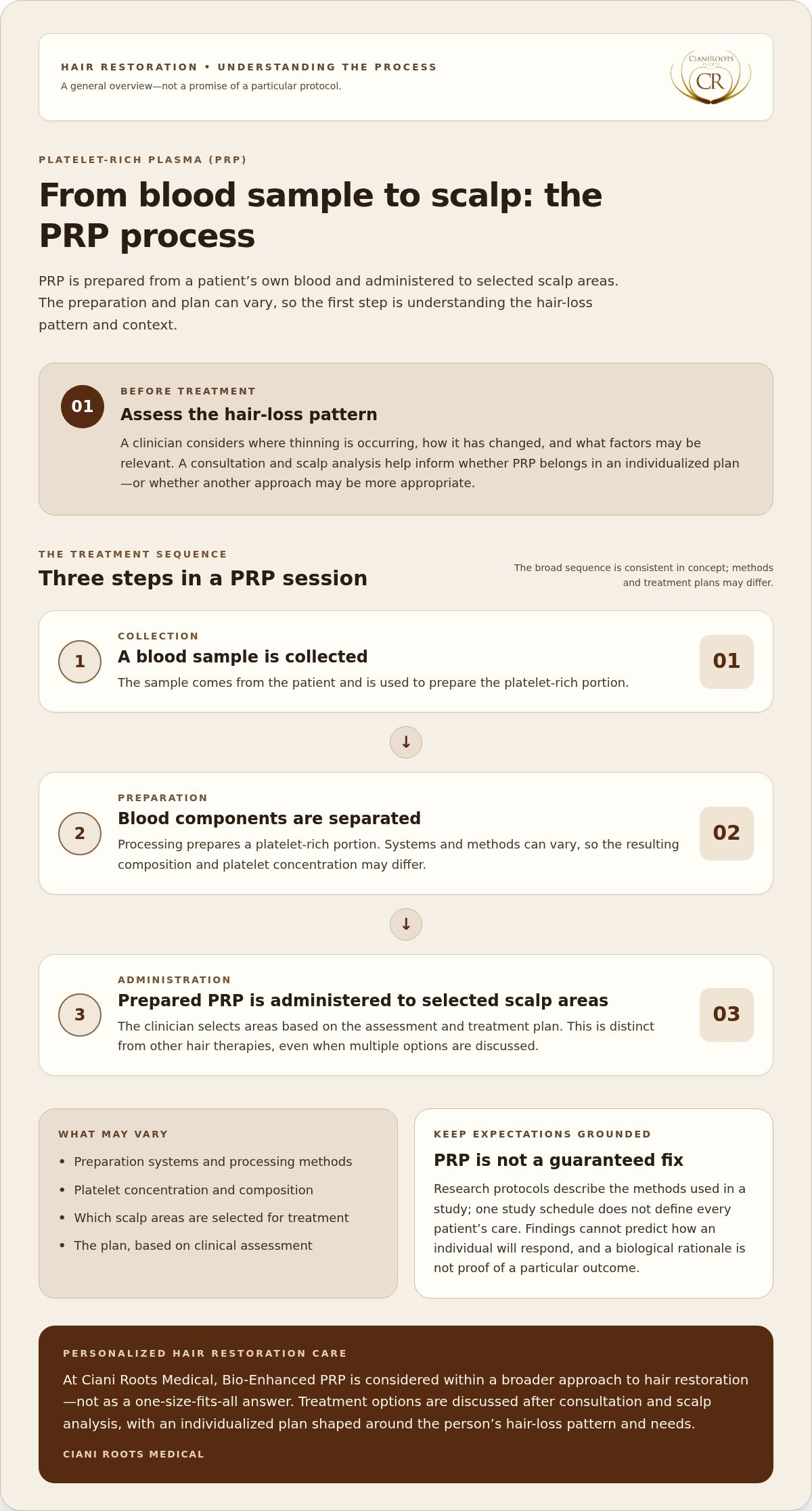
The broad process can be understood in three steps. The exact methods and treatment plan may differ, so this overview isn’t a promise of a particular protocol.
- Blood is collected. A sample is drawn from the patient for preparation.
- The sample is processed. Blood components are separated so the platelet-rich portion can be prepared. Systems and methods can vary, which means preparations may differ in composition and platelet concentration.
- The prepared PRP is administered to selected scalp areas. A clinician determines the areas to treat based on the assessment and plan. PRP administration is distinct from other hair therapies, even when a clinician discusses more than one option as part of broader care.
This sequence is an overview, not a detailed procedural guide. It doesn’t specify how a particular clinic processes a sample, how the prepared portion is administered, or what care instructions may apply. Your clinician can explain the steps and instructions relevant to your treatment.
Why can PRP protocols differ?
PRP isn’t one uniform preparation. Processing methods can affect the resulting platelet concentration and composition, while the treatment approach may vary according to the clinician’s assessment and the patient’s goals. Research studies also use defined protocols so investigators can evaluate a particular approach. Their schedules describe that study, not a universal recommendation.
PRP protocols vary, so one study schedule does not define every patient’s care. For example, a published study might use a set interval between treatments to keep its methods consistent. That schedule alone doesn’t establish what another person should receive. A clinician considers the pattern and possible cause of hair loss, the scalp assessment, and the treatment plan before discussing whether PRP is appropriate and how it might fit into care.
If you’re considering PRP for hair loss, useful questions include what preparation is being used, how the proposed plan relates to your assessment, and how progress will be reviewed. These questions can clarify both the general process and the decisions specific to your care. A personalized hair restoration consultation can help you explore those details alongside scalp analysis and other treatment considerations.
Does PRP for Hair Loss Work? Understanding Evidence and Limits
The evidence offers reasons to study PRP, but it can’t promise that an individual will see thicker hair or less shedding. Research findings describe results in particular groups under particular conditions. They’re useful for understanding potential, not a guarantee or a forecast for your own outcome.
What can the randomized trial tell us?
A 2015 randomized, placebo-controlled study examined PRP in 20 men with androgenetic alopecia, a common pattern of hair loss. It used a split-scalp design: one area received PRP, while a comparison area received placebo. Participants received three treatments at 30-day intervals. The researchers reported improvement in hair measures in the PRP-treated area compared with the placebo area.
That finding is encouraging, but its scope is specific. The study’s design helps compare treated and untreated areas within the participants, while the small, male-only group limits how broadly the results can be applied. It doesn’t establish the same outcome for women, for other causes of shedding, or for a different PRP preparation or treatment plan. The study schedule describes the researchers’ protocol, not a universal recommendation.
Why do individual results remain uncertain?
Hair loss isn’t one diagnosis. Pattern hair loss, temporary shedding, hormonal changes, and other causes may involve different factors. Baseline scalp health and the condition of the hair follicles also differ from person to person. PRP preparations can vary as well, so a result from one study protocol may not transfer directly to another.
Study findings also depend on what researchers measure and when they measure it. A change in hair count or density under study conditions doesn’t tell a clinician exactly how a particular person will respond, or whether a similar change will occur in everyday practice. Other research may use different participants, preparation methods, treatment schedules, or comparison groups. Studies can inform a careful discussion, but they don’t erase those differences.
Research can show what happened in a study group; it can’t guarantee what will happen for an individual patient. That’s why a clinician considers the pattern and possible cause of hair loss, reviews scalp health, and discusses expectations before deciding whether PRP belongs in a personalized plan. If you’re exploring the option, a scalp analysis and hair restoration consultation can help connect the evidence to your own circumstances.
Who Might Consider PRP, and What Should They Weigh?
PRP may be worth discussing as one possible part of hair restoration care, but suitability isn’t determined by interest in the treatment alone. The cause and pattern of hair loss, scalp findings, health history, and personal goals all matter. A careful assessment helps determine whether PRP could fit the broader plan or whether another next step deserves attention first.
What factors can shape a suitability discussion?
A clinician may consider when the thinning began, whether it’s changing, where it’s most noticeable, and what the scalp analysis shows. Your history and goals also help shape the discussion. For example, someone concerned about gradual patterned thinning may need a different assessment from someone experiencing more sudden or widespread shedding. PRP shouldn’t replace efforts to understand why hair is changing.
Medication management may also be part of care when clinically appropriate. The clinician considers whether PRP fits alongside other options or whether the plan should focus elsewhere. No single treatment is right for every sex, diagnosis, or stage of hair loss, and an assessment isn’t a promise that PRP will be recommended.
What questions help clarify expectations?
Use the consultation to connect general information to your circumstances. These questions can help make the conversation specific and practical:
- What possible causes best fit my hair-loss pattern and history?
- How closely does the available PRP research apply to my situation?
- What would we track to assess progress, and when would we review the plan?
- How might PRP relate to other medically appropriate options for me?
It’s also reasonable to discuss what remains uncertain. Ask what outcomes would count as meaningful progress for your goals, what factors could affect the assessment, and how the plan might change if your hair or scalp findings change. These questions don’t require you to choose a treatment in advance. They help clarify the reasoning behind a recommendation and leave room to consider alternatives.
At Ciani Roots Medical, a complimentary consultation and detailed scalp analysis inform individualized hair restoration planning, including consideration of Bio-Enhanced PRP and medication support when appropriate. The aim is to understand your concern and discuss options in context, rather than assume one approach fits everyone. To begin a personalized discussion, explore your options.
How Ciani Roots Approaches PRP and Personalized Hair Restoration
Choosing a hair restoration approach begins with understanding the concern, not assuming that one treatment fits everyone. At Ciani Roots Medical, Bio-Enhanced PRP is one option within medically directed, individualized care. A complimentary consultation and detailed scalp analysis help inform a discussion of hair-loss patterns, personal history, and goals before treatment planning. The aim is to consider PRP in context, not present it as a guaranteed outcome or a standalone answer for every cause of thinning.
Where does Bio-Enhanced PRP fit in a care plan?
The discussion starts with your experience of hair changes: where thinning is noticeable, how it has developed, and what you hope to address. Scalp analysis adds information about the areas involved and helps guide a conversation about possible patterns. These details matter because a treatment decision should reflect your individual concern rather than rely on a general description of PRP.
From there, Bio-Enhanced PRP may be considered alongside other appropriate elements of a personalized plan. Medication management may also be discussed when clinically appropriate. The goal is to make decisions based on your history, assessment, and priorities, while being clear about what is known and what remains uncertain. A recommendation is individualized, and PRP isn’t assumed to be the right fit for every person.
It can be helpful to share what matters most to you. You may be focused on visible thinning, changes in shedding, or understanding why your hair has changed. Explaining these concerns gives the clinician a clearer basis for discussing potential options and how they relate to your goals. A thoughtful plan should make room for your questions.
What is a thoughtful next step?
A complimentary consultation is an opportunity to discuss your concerns, review scalp analysis, and explore an individualized approach to hair restoration. You can ask how Bio-Enhanced PRP might fit your situation, whether medication management may be relevant, and what considerations shape the plan. The discussion focuses on your needs, without assuming a particular treatment in advance.
For people considering hair restoration in Vacaville or Alamo, Ciani Roots Medical offers a local setting for a personalized conversation. The practice serves people in Fairfield, Dixon, Suisun City, Benicia, Vallejo, Napa, Winters, Davis, Woodland, Solano County, Yolo County, and Napa Valley, as well as Danville, Walnut Creek, San Ramon, Blackhawk, and Lafayette. Understanding the options is a meaningful first step, whether you’re ready to discuss PRP or still gathering information.
Move Forward With a Plan That Fits You
Choosing whether to explore PRP for hair loss is a personal decision. You don’t need to arrive with a treatment choice already made. Consider what you hope to understand or change, and bring the questions that would help you feel informed about possible next steps. A useful discussion should leave space for your priorities, uncertainties, and preferences.
At Ciani Roots Medical, hair restoration care is guided by founder Adriane McDonald, BSN, RN, who brings nearly 40 years of experience, with dedicated medical director oversight. Your own circumstances remain central to any treatment conversation and individualized plan.
Whether you’re ready to explore a specific option or simply want a clearer direction, the next step can begin with an open conversation. Schedule a complimentary consultation with Ciani Roots Medical to discuss your concerns and explore a plan that fits your needs.
Frequently Asked Questions
Is PRP for hair loss painful?
Some discomfort is possible because PRP is administered by injection, but the experience varies from person to person. You may feel pressure or tenderness during or after treatment. If you’re concerned about sensitivity, mention it before the session so the clinician can explain what to expect and discuss appropriate comfort considerations. Your health history and individual needs should guide that conversation.
Can PRP stop hair loss completely?
No, PRP can’t be relied on to stop hair loss completely. Hair changes may continue if the underlying cause remains active, and response to treatment differs. For example, ongoing hormonal or genetic influences may need to be considered as part of a broader plan. A clinician can help clarify what may be contributing to your hair loss and discuss realistic goals, follow-up, and other appropriate care.
How long does it take to see results from PRP for hair loss?
There isn’t a dependable timeline that applies to everyone. Hair changes are gradual, and an early impression may not show whether a treatment is helping. Ask how progress will be assessed and what observations matter, such as changes in shedding or visible coverage. Consistent follow-up and a clear review plan can help distinguish a meaningful change from normal variation in how hair looks day to day.
How many PRP sessions are needed for hair loss?
There’s no single session count that suits every person. The proposed plan depends on the clinician’s assessment, the preparation and approach being used, and your goals. A schedule reported in a research study shouldn’t automatically be treated as a personal recommendation. Before starting, ask how the number and spacing of sessions are determined, what would prompt a plan review, and how progress will inform next steps.
Can women consider PRP for hair loss?
Women can discuss PRP as a possible option, but suitability depends on the cause and pattern of hair changes. For instance, diffuse shedding after pregnancy or changes around menopause may call for a different assessment than gradual patterned thinning. A clinician can review your history and scalp findings, then explain how the evidence relates to your circumstances. The goal is an informed, individualized discussion, not an assumption that one treatment fits all.
Can PRP be combined with medication management?
It may be considered alongside medication management when clinically appropriate. The right approach depends on your diagnosis, health history, current medications, and treatment goals. Share a complete list of medicines and supplements with the clinician, and don’t start, stop, or change a prescribed medication based only on a discussion of PRP. A coordinated plan can clarify each option’s role and how the overall approach will be reviewed.
Is PRP the same as stem cell therapy?
No. PRP and stem cell-derived regenerative approaches are distinct. PRP is prepared from a blood sample and centers on its platelet-rich portion. Ciani Roots also offers personalized Acorn Secretome therapy, created from a patient’s own stored cells or biology. The approaches differ, so a consultation can clarify what each involves and whether either is relevant to your care. Neither should be understood as a guaranteed solution for hair loss.
Article by
Adriane McDonald BSN,RN
Adriane McDonald, BSN, RN, is a hair restoration specialist with nearly 40 years of experience working with men and women experiencing hair loss and thinning. As the Founder and Practice Director of Ciani Roots Medical, she works alongside the practice’s Medical Director to provide personalized hair restoration, scalp health, regenerative therapies, and advanced skin rejuvenation.
Her approach combines extensive hands-on experience with detailed scalp analysis, medical collaboration, and individualized treatment planning. Adriane is currently completing advanced training toward certification in trichology, further expanding her expertise in hair and scalp health.
Disclaimer
This content is provided for general educational and informational purposes only and is not intended to serve as medical advice, diagnosis, or treatment. Individual needs, treatment recommendations, and results vary. A consultation and appropriate evaluation are necessary to determine which treatment options may be suitable for you. Viewing or interacting with this content does not establish a healthcare professional-patient relationship with Ciani Roots Medical.
Individual results may vary, and no specific outcome can be guaranteed. Before-and-after images, testimonials, or treatment experiences represent individual results and should not be considered a guarantee of similar results.


