
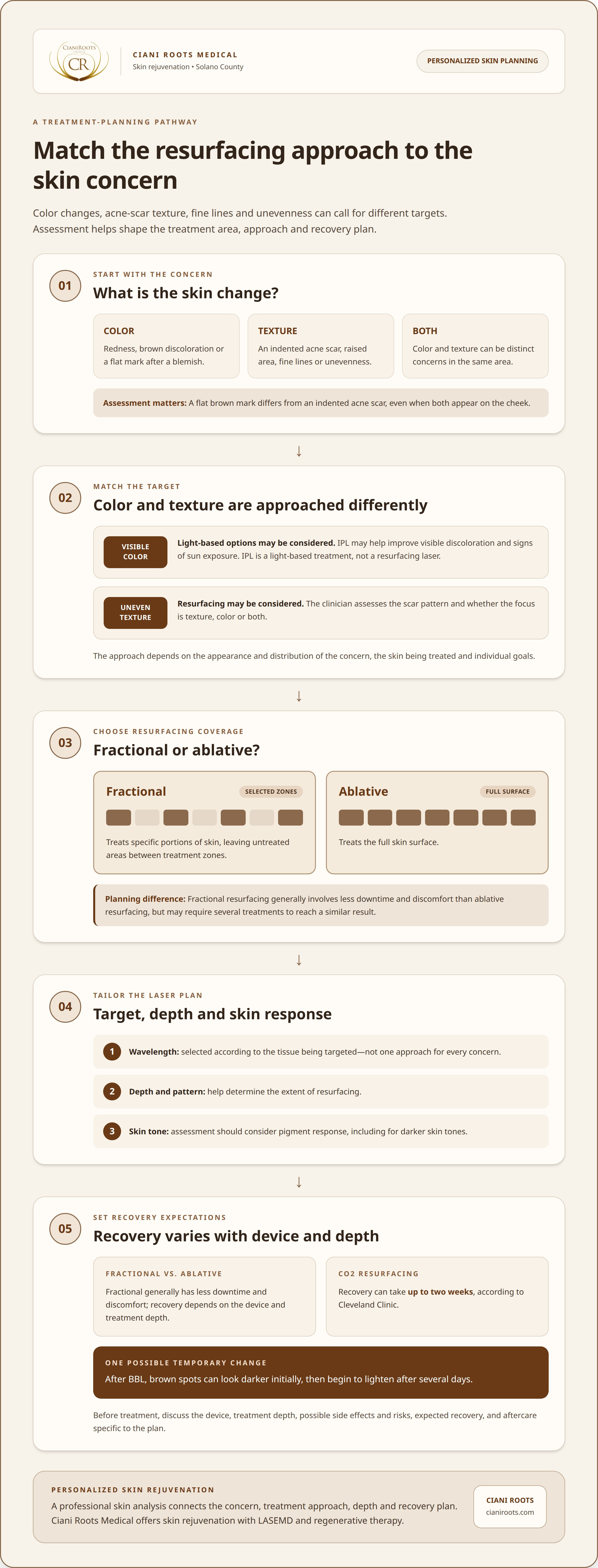
Fine lines and uneven texture don’t always call for the same resurfacing approach. Laser skin rejuvenation in Solano County can include fractional or ablative resurfacing, with the wavelength and treatment depth selected for the concern. Fractional treatments target specific portions of the skin, while ablative resurfacing treats the full surface.
It’s understandable to want clearer, smoother-looking skin while also knowing what treatment involves and how recovery may fit your routine. The right approach depends on concerns such as acne scarring, pigmentation, fine lines, and uneven texture, along with your skin and goals.
This article explains how resurfacing works, how laser wavelengths are chosen for different targets, and how treatments can be tailored to specific concerns. You’ll also learn what shapes treatment planning and why a professional skin analysis is an important starting point.
Key Takeaways
- Fractional resurfacing treats selected areas of skin, while ablative resurfacing treats the full surface; that distinction can shape treatment planning and recovery.
- Acne scars and pigmentation call for different targeting strategies, so the skin concern matters when selecting a treatment.
- Laser wavelength is chosen according to the tissue being targeted, rather than using one approach for every skin concern.
- Fine lines and uneven texture can be assessed as part of a personalized resurfacing plan, with treatment depth matched to the skin and goals.
- A professional skin analysis can help clarify which rejuvenation approach fits your concerns; Ciani Roots Medical offers skin rejuvenation with LASEMD and regenerative therapy.
Fractional skin resurfacing and collagen remodeling
Fractional resurfacing creates controlled treatment zones rather than treating the entire skin surface. Untreated areas remain between those zones, providing surrounding tissue as the skin begins its healing response. This approach can address fine lines, acne-scar texture, and unevenness by prompting repair and collagen development. Treatment depth and pattern determine the extent of resurfacing.
Collagen remodeling is part of the skin’s response to controlled injury. Treatment creates targeted changes, and the body’s healing process supports new collagen development. Results and recovery depend on the laser and treatment depth. Fractional resurfacing generally involves less downtime and discomfort than ablative resurfacing, but may require several treatments to reach a similar result. Ablative resurfacing, by contrast, treats the full skin surface.
In Solano County, the relevant providers to look for are dermatology clinics and medically directed skin practices that perform fractional resurfacing. Treatment offerings differ, so the consultation should identify the device, treatment depth, skin concern, and expected recovery before a plan is chosen.
Preparation begins with a consultation and skin assessment. The clinician reviews the treatment area, the concern, and the proposed approach. Before treatment, you’ll receive instructions tailored to your plan, including what to expect during recovery and which aftercare steps to follow. Follow the clinician’s directions rather than a general routine, because fractional and ablative treatments affect different amounts of skin.
Recovery varies with treatment depth and device. Fractional resurfacing generally has less downtime and discomfort than ablative treatment, while recovery after CO2 laser resurfacing can take up to two weeks, according to Cleveland Clinic. Discomfort and downtime are among the considerations to discuss; the consultation should also explain possible side effects and risks specific to the planned treatment.
A suitable candidate has a skin concern that aligns with the treatment goal, such as uneven texture or the appearance of acne scars, and can follow the personalized aftercare plan. Skin tone also matters: for darker skin tones, the clinician should assess the skin and consider pigment response when selecting an approach. A skin analysis helps connect the concern, treatment depth, and recovery plan before resurfacing begins.
Controlled skin injury during resurfacing can trigger healing and stimulate collagen development. This describes a possible response, not a separate step that can be judged in isolation from the treatment plan. The injury and the healing response belong to the same process: resurfacing establishes the controlled change, and healing may then contribute to collagen development. Keeping that connection clear helps frame what the procedure is intended to do. It is not simply a matter of naming collagen as the goal; the relevant point is that controlled injury can prompt the body’s repair response. In discussing a plan, the clinician and patient can keep attention on this relationship between the treatment and the response it may encourage, rather than treating collagen development as detached from the resurfacing process.
Acne scar and pigmentation care
Acne marks can involve changes in color, texture, or both. A flat brown mark after a blemish differs from an indented acne scar, even when both appear on the cheek. That distinction guides treatment planning: light-based treatments may target visible color, while resurfacing aims to address uneven texture. During assessment, the clinician examines the area and identifies the main concern.
For red, brown, or splotchy skin, intense pulsed light (IPL) may help improve visible discoloration and signs of sun exposure. IPL is a light-based treatment, not a resurfacing laser. A photofacial may also be considered. The appropriate approach depends on the pigment’s appearance and distribution, the skin being treated, and your goals.
Brown spots can look darker initially after broadband light (BBL) treatment, then begin to lighten after several days. It’s useful to know this before treatment, especially if you’re preparing for an event or concerned about a temporary color change. The clinician can explain what changes may occur in the treated area and how follow-up fits your individual plan.
Acne scarring needs its own assessment. A shallow depression, a raised area, and lingering redness are distinct features, so one treatment may not suit every mark. The clinician can examine the scar pattern and determine whether the main goal is improving color, texture, or both. Resurfacing may be considered when texture is the focus, while light-based options may be considered for visible redness or brown discoloration.
Before selecting a treatment, the consultation should establish the concern, treatment area, and suitable approach. Helpful details include whether marks are flat or indented and whether discoloration is red or brown. Skin analysis can then inform a personalized plan instead of treating every spot as the same issue. Ciani Roots Medical’s Pigment, Tone, Texture & Skin Renewal Treatments are designed around distinct skin concerns.
After treatment, follow the specific aftercare instructions for the procedure you receive. IPL, BBL, and resurfacing are different approaches, and the expected response varies. If a brown spot darkens after BBL, remember that this initial change may precede lightening over several days. Discuss treatment timing and any concerns about visible recovery during your consultation.
A measured plan starts by identifying what each mark represents, then matching the treatment to that concern. A flat brown spot and a depressed acne scar, for example, may call for different strategies, even on the same facial area. Skin analysis can help shape the discussion and clarify which treatment goal should come first.
Fine lines and uneven skin texture
Fine lines and rough texture can appear together, but they are different surface concerns. A fine line is a visible crease; uneven texture may look like small irregularities or shallow marks. During assessment, the clinician identifies which feature matters most to you. That distinction helps shape the goal, whether it’s softening the appearance of lines or creating a more even-looking surface.
For example, lines around the mouth may be more noticeable during expression, while roughness across the cheeks remains visible at rest. These patterns give the clinician practical details to consider when planning resurfacing. The consultation should also establish the treatment area and the degree of change you hope to see. Treatment is tailored to those priorities rather than to a general label such as “aging skin.”
Laser selection depends on the tissue being targeted. Different wavelengths may be absorbed by water, color, or connective tissue, so the clinician considers both the skin concern and treatment area. A plan for surface texture may differ from one focused on visible pigment. This distinction matters when fine lines, unevenness, and discoloration overlap on the same cheek or forehead.
Resurfacing works through controlled treatment of skin, followed by the body’s healing response and collagen development. The treatment pattern and depth influence how much skin is addressed. Fractional approaches leave untreated areas between treatment zones; a gentle resurfacing laser may improve appearance with minimal downtime. Gentle resurfacing lasers can also be used on the hands and chest, where texture concerns may differ from facial concerns.
Discuss downtime alongside the treatment goal. A gentle approach may suit someone prioritizing minimal downtime, while more intensive resurfacing involves different recovery considerations. There isn’t one schedule for every device and skin concern. The clinician explains the expected recovery for the selected treatment and aligns the plan with the area and your preferences.
A useful planning sequence is straightforward: identify the main concern, examine the treatment area, select a suitable approach, and review recovery instructions. For instance, a patient concerned about cheek roughness may prioritize texture, while someone focused on lines may discuss those areas specifically. The consultation turns these observations into an individualized plan.
Assess progress against the original goal, not an abstract idea of perfect skin. The clinician can evaluate whether texture appears more even or fine lines look less prominent, then discuss whether the plan should continue or change. Personalized skin analysis supports this measured approach, keeping treatment focused on your concerns and the skin’s response.
Laser wavelengths and targeted tissue
Laser wavelength affects which tissue absorbs treatment energy. Depending on the wavelength, energy may be absorbed by water, color, or connective tissue. The clinician selects a device based on your skin and the concern being addressed. The treatment area and primary goal also guide planning. Visible discoloration and uneven texture, for example, require different targeting considerations.
Ablative, non-ablative, fractional, and IPL treatments describe different approaches. Ablative resurfacing treats the entire skin surface; non-ablative treatments work without removing the outer skin in the same way. Fractional treatments target selected zones, while IPL uses broad-spectrum light and isn’t a laser. These distinctions affect treatment depth and planning.
There isn’t one treatment that’s best for every wrinkle, sun-damaged area, acne scar, or pigment concern. The clinician considers the tissue being targeted and your skin type, then matches the approach to the main goal. Resurfacing may be considered for texture and wrinkles, while IPL may help improve red, brown, or splotchy skin and visible effects of sun exposure.
Session planning depends on the treatment type. Non-ablative, non-fractionated laser treatments require four to six sessions for very moderate effects, according to Thieme Medical Publishers. For BBL, treatments are spaced one month apart in a series of several treatments. Those schedules describe the named approaches, not every laser or skin concern.
Skin assessment informs treatment planning. The practitioner considers the patient’s condition, skin type, treatment area, and intended target before selecting a device. The discussion also addresses treatment depth, expected recovery, and the plan’s purpose. In California, this patient-specific process helps keep the selected treatment aligned with the concern, rather than applying one device or approach to every complexion.
Consultations allow patients to discuss the skin concern, proposed approach, and recovery plan. Financing and package arrangements vary by practice. The treatment discussion can clarify which options address the patient’s goals and what the plan involves, without treating payment arrangements as a measure of clinical suitability.
A person with both brown discoloration and acne-scar texture, for example, presents two different targets. The clinician’s assessment distinguishes those concerns and guides an approach based on your skin and condition. It also supports a discussion about which concern to address first and how the treatment plan relates to your priorities.
Wavelength is only one part of the decision. Skin type, treatment depth, and the distinction between color and texture also shape the plan. A consultation connects those factors to the proposed approach and explains what the treatment is intended to address.
What types of laser skin rejuvenation treatments are available in Solano County, California?
Options for laser skin rejuvenation in Solano County include ablative and non-ablative lasers, fractional resurfacing, and light-based photofacials. Skin resurfacing may also involve chemical peels or microdermabrasion. These approaches differ in how they address the skin, so treatment selection starts with the concern and the patient’s goals.
An erbium YAG laser can remove a skin layer precisely without bleeding. The body then replaces damaged skin with a fresh layer. This is one resurfacing option; the device and treatment plan depend on the condition being addressed and your skin.
Non-ablative, non-fractionated laser treatments require four to six sessions for very moderate effects, according to Thieme Medical Publishers. That schedule applies to this treatment category, not every rejuvenation plan. The number and spacing of treatments depend on the approach selected and the goal being addressed.
Photofacials offer a light-based option. IPL therapy may help improve red, brown, or splotchy skin and visible effects of sun exposure. Someone concerned about discoloration may discuss IPL, while someone focused on surface texture may consider resurfacing. A clinician’s assessment helps distinguish these goals.
A consultation can clarify whether a laser, photofacial, chemical peel, or microdermabrasion aligns with your skin concern. The discussion can also cover the treatment’s purpose, expected recovery, and how the plan is tailored to your skin type and treatment area. These details help you understand the proposed approach before deciding.
For an individualized discussion of skin renewal options, EXPLORE YOUR OPTIONS and consider how your main concern, such as pigmentation or uneven texture, may shape your treatment plan.
When reviewing options, patients can ask how much of the skin surface a proposed resurfacing approach treats. Ablative laser resurfacing treats the entire skin surface (100%). That coverage is one detail to discuss when comparing a laser treatment with a photofacial, chemical peels, or microdermabrasion. Skin resurfacing may be performed using laser treatment, photofacial, chemical peels, or microdermabrasion. The available choices make it useful to describe the main concern clearly and ask how the recommended option relates to it. A consultation can also help clarify which treatment is being proposed and what area the plan addresses. An erbium YAG laser removes a layer of skin precisely without bleeding, after which the body replaces damaged skin with a fresh layer. Patients considering that approach can ask the clinician to explain how it fits the concern and the proposed plan.
Understanding the differences among available approaches helps avoid treating all skin rejuvenation options as interchangeable. If you’re comparing resurfacing with a light-based photofacial, ask the clinician to explain the option being considered and its intended treatment area. If you’re weighing a chemical peel or microdermabrasion, discuss how it relates to your concern. The conversation can cover your goals, skin type, treatment area, recovery expectations, and the purpose of the proposed treatment. A consultation gives you the opportunity to review the options and understand the reasoning behind a recommendation. Clear explanations of the method and treatment area can help you make an informed decision.
Ciani Roots Medical
Ciani Roots Medical helps patients assess skin concerns and explore personalized rejuvenation options at its Vacaville and Alamo clinics. If acne-scar texture, pigmentation, or fine lines are prompting questions about skin rejuvenation with LASEMD, a skin analysis can help clarify which goals to prioritize and guide an individualized treatment plan.
Skin rejuvenation with LASEMD and regenerative therapy are among the options available. The approach is tailored to the patient’s skin and concerns, rather than assuming one treatment suits everyone. The AURA 3D Skin Analyzer supports a detailed discussion of skin tone and texture. Skin Scans are free for a limited time.
Schedule a complimentary consultation with Ciani Roots Medical to discuss your skin concerns and next steps.
Take the Next Step Toward a Personalized Skin Plan
Choosing laser skin rejuvenation in Solano County can begin with a focused conversation about what you’d like to address. Bring your priorities, such as a smoother-looking surface or more even tone, and discuss how they fit your skin’s needs. A thoughtful plan should explain what the treatment is intended to address and what the process involves.
At Ciani Roots Medical, a skin analysis and consultation can help turn those priorities into an individualized discussion. You can ask how a proposed approach aligns with your concerns, what recovery may involve, and how the plan can be tailored to your skin. There’s no need to decide on a treatment before understanding your options.
If you’re ready to talk through a next step, schedule a complimentary consultation. A clear conversation can help you move forward with greater confidence and a plan that feels right for you.
Article by
Adriane McDonald BSN,RN
Adriane McDonald, BSN, RN, is a hair restoration specialist with nearly 40 years of experience working with men and women experiencing hair loss and thinning. As the Founder and Practice Director of Ciani Roots Medical, she works alongside the practice’s Medical Director to provide personalized hair restoration, scalp health, regenerative therapies, and advanced skin rejuvenation.
Her approach combines extensive hands-on experience with detailed scalp analysis, medical collaboration, and individualized treatment planning. Adriane is currently completing advanced training toward certification in trichology, further expanding her expertise in hair and scalp health.
Disclaimer
This content is provided for general educational and informational purposes only and is not intended to serve as medical advice, diagnosis, or treatment. Individual needs, treatment recommendations, and results vary. A consultation and appropriate evaluation are necessary to determine which treatment options may be suitable for you. Viewing or interacting with this content does not establish a healthcare professional-patient relationship with Ciani Roots Medical.
Individual results may vary, and no specific outcome can be guaranteed. Before-and-after images, testimonials, or treatment experiences represent individual results and should not be considered a guarantee of similar results.


