
Laser resurfacing can be combined with regenerative therapies to create a controlled skin-repair response while complementary treatments support renewal. In regenerative skin rejuvenation, this approach aims to improve wrinkles and texture over time by stimulating processes that can prompt fibroblasts to produce collagen. The methods work differently, so the right combination depends on your skin concern and treatment plan.
It’s understandable to want smoother, firmer-looking skin without expecting an overnight transformation. Changes in texture and fine lines typically develop gradually over weeks to months. The outcome depends on the treatment, your skin condition, and how your skin responds as it heals.
This article explains how laser treatments and regenerative therapies may complement each other, how stem-cell-related signals are discussed in relation to collagen production, and what changes you might notice in wrinkles and skin texture. It also outlines differences between laser resurfacing approaches, helping you understand how treatment choices affect recovery and expected results.
Key Takeaways
- Laser resurfacing and regenerative therapies work in different ways, and a tailored plan can determine how they may complement each other.
- Understand how treatment intensity and fractional delivery can shape the resurfacing approach and recovery experience.
- Learn why stem cells and fibroblasts matter to collagen production, and why changes develop gradually.
- Set realistic expectations for wrinkles and skin texture by considering the treatment method and your skin’s response over time.
- A skin analysis can help match your concerns with an individualized rejuvenation plan.
Meaning and treatment families of regenerative skin rejuvenation
Regenerative skin rejuvenation refers to aesthetic treatments intended to support the skin’s repair processes while addressing visible concerns such as wrinkles and uneven texture. Depending on the concern and tissue involved, an approach may include microneedling, laser energy, or regenerative therapy.
Meaning of Regenerative Skin Rejuvenation
Regenerative skin rejuvenation describes aesthetic treatments intended to support the skin’s repair processes, including signals that influence collagen-producing fibroblasts. If you’re concerned about fine lines, texture, or firmness, the aim is to support tissue renewal rather than create only an immediate surface change. The approach and expected changes depend on the treatment and your skin’s response.
Treatment Families and Combinations
Treatment families include platelet-rich plasma (PRP), microneedling, laser resurfacing, exosome products, and cell-based approaches. PRP is prepared from a patient’s blood to concentrate platelets and growth factors; microneedling creates controlled channels, while lasers deliver energy to skin tissue. These methods may be combined, such as applying PRP after microneedling or pairing a laser with a regenerative therapy. PRP, microneedling, exosomes, and stem cell treatments are not interchangeable: each uses a different method, and evidence and regulatory status vary by product and use. Mesenchymal stem cell (MSC) approaches focus on cell-related signaling, while conventional aesthetic treatments more directly target visible concerns and may need top-ups every 1–3 months.
Matching Treatments to Skin Concerns
Choosing a treatment means considering both the visible concern and the tissue involved. Resurfacing or microneedling may be discussed for fine lines or uneven texture, while energy-based treatment or regenerative therapy may be considered to support collagen. The treatment area, skin condition, and desired change all shape the choice; no single method addresses every concern equally.
In the United States, “regenerative” is not a single FDA approval category, so regulatory status depends on the specific product and its use. As of 2026, specific exosome products had not been FDA-approved for cosmetic use.
In the United States, treatment cost depends on the method, treatment area, number of sessions, and whether therapies are combined; pricing is provided after a quote request.
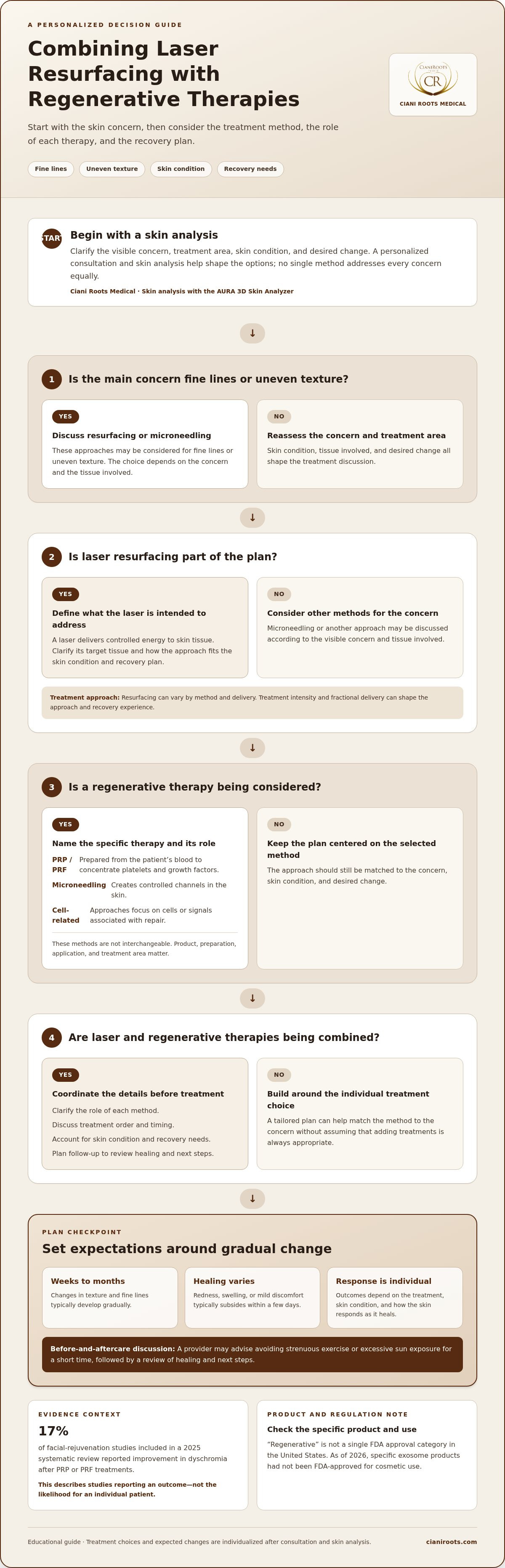
A consultation and skin analysis help clarify your concerns, review options, and build an individualized plan. Redness, swelling, or mild discomfort after treatment typically subsides within a few days. You may be advised to avoid strenuous exercise or excessive sun exposure for a short time, then attend follow-up to review healing and discuss next steps.
How Can You Combine Laser Treatments with Regenerative Therapies?
Laser treatments and regenerative therapies can address different aspects of a skin concern. A laser delivers controlled energy to tissue, while a complementary therapy may provide biological signals associated with repair. Their suitability and sequence depend on the treatment, skin condition, and recovery plan.
Skin Stem-Cell Biomarkers and Therapies
Skin stem-cell biomarkers are measurable features researchers use to identify cells involved in tissue renewal. Harvard Stem Cell Institute scientists have identified biomarkers for key skin-regeneration cells and are developing strategies to enrich and activate them. This research helps explain how skin repair may be guided, but it does not establish a standard cosmetic treatment or a predictable result for an individual patient.
Stem Cell Therapy for Skin Rejuvenation
Stem-cell therapy for skin rejuvenation refers to approaches that use cells or cell-related signals to support repair processes. In a combined plan, a laser may create a controlled treatment response, while a regenerative therapy is considered as a separate or complementary technique. These approaches are not interchangeable, and the specific product, preparation, application, and treatment area matter when assessing what the therapy involves.
PRP and PRF are other combination options. Both begin with the patient’s blood, which is processed to concentrate platelets and growth factors; the resulting material may be applied to skin or injected. A provider may combine PRP or PRF with microneedling or laser resurfacing, but timing matters. Treatment should account for skin condition and the recovery needs of the energy-based procedure.
Evidence findings also need careful interpretation. According to the Authors of the 2025 systematic review, 17% of included facial-rejuvenation studies reported improvement in dyschromia after PRP and PRF treatments. That figure describes studies reporting a particular outcome, not the likelihood that an individual patient will experience it.
Exosome therapy and Ariessence PDGF+ growth factor therapy are distinct terms in regenerative aesthetics. Exosomes are cell-derived signaling particles; as of 2026, the FDA had not approved specific exosome products for cosmetic use. Ariessence PDGF+ is identified as a platelet-derived growth factor therapy, but the name alone does not establish its formulation, regulatory status, or suitability for a particular laser protocol.
For a combined approach, the consultation should clarify your primary concern, the laser’s target tissue, and each therapy’s role. The plan should also explain treatment order, expected recovery, and follow-up. These details help you assess whether a combination addresses your goals or adds steps without a clear purpose.
Stem cells and collagen production
Collagen supports the skin’s structure, while elastin helps it recoil after movement. Fibroblasts, cells in the dermis, produce these proteins as part of normal tissue maintenance. Stem-cell approaches are discussed because cell-related signals may activate fibroblasts and support collagen production. This describes a biological pathway, not an instant change: collagen-stimulator effects develop gradually over several months as the body builds new collagen.
Stem cells and fibroblasts have distinct roles. Stem cells are associated with repair signaling; fibroblasts produce collagen and other components of the skin’s supporting structure. When discussing regenerative treatments, the key question is how a therapy is intended to influence those signals. This distinction helps explain why “stem cell” and “collagen treatment” do not necessarily describe the same process.
Sculptra is a collagen-stimulating injectable, not a treatment that simply adds immediate volume. Its intended effect is associated with the body’s gradual collagen response, so changes develop over time rather than appearing as a completed result during the appointment. The treatment area, skin condition, and desired change determine whether a collagen-stimulating injectable is relevant. A consultation can distinguish this approach from treatments aimed primarily at surface texture.
Collagen and elastin are also targets of energy-based techniques. Sofwave™ and radiofrequency technologies deliver energy into the dermal layer, where fibroblasts produce collagen and elastin. Controlled energy prompts a wound-healing response, and the resulting tissue response is part of the intended stimulation. The device, treatment area, energy delivery, and skin concern determine how this approach might fit into a plan.
Timing matters. Long-term regenerative benefits develop over 4–12 weeks, while full skin regeneration after stem-cell injections can take 2–3 months. These timelines describe gradual biological change, not a fixed appointment-to-result schedule. For patients comparing treatments, the practical distinction is between immediate visible effects and changes that rely on tissue response and collagen growth.
Collagen-stimulating injectables and cell-based approaches address different parts of the process. One may prompt a collagen response, while another focuses on cell-related signals; neither description alone predicts how an individual’s skin will change. During a consultation, a clinician considers the skin concern, tissue layer, treatment history, and whether an injectable, energy-based technique, or regenerative approach best matches the goal.
Ciani Roots Medical offers personalized regenerative therapy with stem cells, using a secretome derived from the patient’s own hair-follicle stem cells. This is a personalized option, not a promise of a particular collagen response. A skin analysis helps connect concerns such as texture or firmness with an individualized plan and appropriate follow-up.
Ablative, non-ablative, and fractional laser resurfacing
Laser resurfacing differs by how energy interacts with the skin’s surface and deeper tissue. Ablative CO2 and erbium lasers remove targeted skin layers, while non-ablative techniques heat tissue without removing the surface. Fractional delivery treats selected columns rather than the entire area. These distinctions affect the treatment’s purpose, healing process, and recovery planning.
Ablative resurfacing may suit concerns that call for more intensive surface renewal, but it involves a more substantial healing period. Recovery after ablative CO2 and erbium laser resurfacing may require one to two weeks. During consultation, the treatment area, skin condition, and ability to follow aftercare all inform whether this approach fits. A stronger procedure is not automatically the right procedure.
Non-ablative lasers deliver heat into skin tissue while leaving the surface intact. This energy can prompt a wound-healing response that encourages fibroblasts to produce collagen. This differs from ablative resurfacing, which removes tissue as part of treatment. The right approach depends on the concern and the desired balance between surface change and recovery.
Fractional CO2 is a specific example of fractional resurfacing. It can ablate about 100 μm of skin and create an additional 50 to 300 μm of adjacent thermal damage. Those measurements describe the treatment’s tissue effects, not a guaranteed cosmetic result. Fractional treatment creates a pattern of treated and untreated areas, so the amount of coverage and energy used matter to the overall plan.
Skin texture, fine lines, and uneven tone may lead to a discussion about resurfacing. Loss of volume is different: a laser’s role in tissue renewal should not be confused with replacing volume. Separating these goals helps clarify which procedures address texture and which concerns may call for another treatment category.
Combining a laser with regenerative therapy requires attention to sequence and healing. The laser creates a controlled response, and a complementary therapy may be considered to support the skin’s repair environment. More than one regenerative skin treatment session may be needed to achieve optimal outcomes. Timing should account for the laser type, treated area, skin response, and follow-up plan.
A personalized plan starts by identifying your primary concern, then matching the laser approach to the tissue target and recovery needs. For example, a clinician may compare fractional treatment with non-ablative energy when texture is the focus. Skin analysis and consultation help define the procedure’s purpose, while follow-up assesses healing and informs next steps. The same technique does not suit every cosmetic concern.
Expected changes in wrinkles and skin texture
Changes after skin treatments tend to emerge gradually over weeks to months, rather than all at once. What you may notice depends on the treatment, your skin concern, and your tissue response.
Changes in Wrinkles
Wrinkle changes refer to shifts in the appearance of lines as skin structure and collagen support respond over time. According to the Authors of the 2025 systematic review, 40% of included studies reported wrinkle improvement after PRP and PRF treatments. This percentage describes the share of studies reporting that outcome, not the chance of improvement for an individual patient.
Collagen-related changes develop gradually, so compare the same areas under similar lighting rather than judging day-to-day differences. Fine lines and deeper folds can respond differently because they reflect different skin structures. Your treatment plan should clarify which wrinkles are being addressed and when follow-up will assess them.
Changes in Skin Texture
Skin texture describes the visible and touchable surface, including roughness, unevenness, and the appearance of pores. The Authors of the 2025 systematic review found that 33% of included studies reported better skin texture after PRP and PRF treatments. That finding offers context, but it doesn’t predict an individual patient’s result.
Texture may look more even as skin renews, while changes in thickness and elasticity reflect different outcomes. According to the Authors of the 2025 systematic review, 80% of included studies reported improved skin thickness, and 75% reported improved skin elasticity after PRP and PRF treatments. These are study-level findings, not guarantees of a particular change.
Those measures matter because a youthful appearance involves more than fewer lines. Skin thickness relates to the supporting tissue, elasticity to its ability to stretch and recoil, and texture to the surface. One treatment may affect these features differently, so the intended outcome should be clear before treatment begins.
For a practical comparison, first note your main concern: a line at rest, uneven texture, or reduced firmness. Assess that same feature at follow-up alongside the healing response. This can help distinguish temporary post-treatment effects from gradual changes that develop over weeks to months.
Expectations should reflect the limits of the evidence. A percentage of studies reporting improvement is not the percentage of patients who improve, and study findings do not establish identical outcomes across treatments. Skin condition, treatment choice, and individual response all influence visible changes. A personalized skin analysis can help connect your concern with an appropriate treatment discussion.
Choose a plan that fits your skin goals
Start by identifying the skin change you most want to address, such as uneven tone, texture, or fine lines. A personalized skin analysis can help clarify whether regenerative skin rejuvenation fits your goals and which approach may be appropriate.
Ciani Roots Medical offers Skin Rejuvination with LASEMD and regenerative therapy, with treatment planning shaped around your skin concerns. Patients in Vacaville and Alamo can also explore the AURA 3D Skin Analyzer as part of a skin assessment.
If you’d like to discuss your goals and possible next steps, schedule a complimentary consultation. A thoughtful conversation can help you decide what feels right for your skin.
Frequently Asked Questions
Regenerative Skin Treatments in 2026: What’s Actually Worth It?
A treatment is worth considering when its intended effect matches your main concern and the evidence supports realistic expectations. For example, someone focused on uneven texture might compare resurfacing with a regenerative approach, while concerns about volume call for a different discussion. Consider the treatment mechanism, recovery needs, follow-up plan, and evidence for the specific outcome rather than choosing based only on a “regenerative” label.
How Do Exosomes Improve Skin Quality at the Cellular Level?
Exosomes are cell-derived particles that carry signaling molecules and participate in communication between cells. Their proposed aesthetic role is to influence repair-related signaling, rather than become new skin tissue themselves. This mechanism does not establish a predictable change in collagen, fine lines, or texture. The formulation and use matter, so the term “exosome” alone does not tell you what a cosmetic treatment can achieve.
How Do Regenerative Treatments Differ from Traditional Anti-Aging Procedures?
Traditional aesthetic procedures often target a visible feature directly, such as adding volume or smoothing a line. Regenerative approaches focus on supporting skin repair signals and tissue response. This difference can shape the treatment experience and timeline for change. A useful comparison starts with your priority: immediate correction, gradual skin renewal, or a combination. The treatment category should match that goal.
How Many Sessions Are Needed for Visible Results?
For PRP, a typical plan is a series of 3–4 sessions, often spaced 4–6 weeks apart. That schedule applies to PRP, not every laser or regenerative therapy. The method, treatment area, skin concern, and response guide the plan. Before beginning, clarify the purpose of each session and how progress will be assessed, so the treatment schedule has a defined goal.
What Does Regenerative Skin Rejuvenation Involve?
Regenerative skin rejuvenation involves aesthetic treatments intended to support skin repair and renewal. Depending on the plan, a laser can create a controlled response, while a regenerative treatment can contribute signaling molecules associated with tissue processes. These methods work through different mechanisms. Identify the concern first, then select a technique aimed at it rather than choosing by treatment name alone.
Which Treatments Use Regenerative Approaches?
Commonly discussed options include PRP or PRF, microneedling, laser resurfacing, exosome products, and cell-based approaches. They differ in how they interact with skin and in the evidence available for specific uses. A combination might pair microneedling with a regenerative treatment or include laser resurfacing in a broader plan. Not every patient receives or needs every treatment; the concern and skin analysis help guide selection.
What Skin Concerns Can These Treatments Address, and Who May Be a Candidate?
These approaches may be considered for fine lines, uneven tone, pigmentation, sun damage, and rough texture. A suitable candidate has a clear treatment goal and can follow the recommended healing and aftercare plan. Skin condition, treatment history, and the area being addressed also matter. A skin analysis helps distinguish surface concerns from changes involving deeper tissue, which may call for different approaches.
How Many Sessions Are Needed, and How Long Do Results Last?
Session needs depend on the treatment method: PRP is commonly planned as a series, while laser protocols use their own schedules. Results from regenerative treatments often last 6 months to over a year, and maintenance sessions every 6–12 months may help sustain them. These timelines are broad planning guides, not a fixed schedule for every treatment. The treatment goal and skin response inform follow-up.
Article by
Adriane McDonald BSN,RN
Adriane McDonald, BSN, RN, is a hair restoration specialist with nearly 40 years of experience working with men and women experiencing hair loss and thinning. As the Founder and Practice Director of Ciani Roots Medical, she works alongside the practice’s Medical Director to provide personalized hair restoration, scalp health, regenerative therapies, and advanced skin rejuvenation.
Her approach combines extensive hands-on experience with detailed scalp analysis, medical collaboration, and individualized treatment planning. Adriane is currently completing advanced training toward certification in trichology, further expanding her expertise in hair and scalp health.
Disclaimer
This content is provided for general educational and informational purposes only and is not intended to serve as medical advice, diagnosis, or treatment. Individual needs, treatment recommendations, and results vary. A consultation and appropriate evaluation are necessary to determine which treatment options may be suitable for you. Viewing or interacting with this content does not establish a healthcare professional-patient relationship with Ciani Roots Medical.
Individual results may vary, and no specific outcome can be guaranteed. Before-and-after images, testimonials, or treatment experiences represent individual results and should not be considered a guarantee of similar results.


