
A non-surgical hair treatment is not a transplant: FUE and FUT move follicles, while scalp reduction removes a section of scalp. For hair restoration in Solano County, the right approach depends on the type and pattern of hair loss, scalp condition, and what you hope to improve. Non-surgical therapies may support hair improvement, but they do not relocate follicles.
It is understandable to want a clear answer about whether treatment can help hair grow. Surgical methods redistribute existing follicles; non-surgical care focuses on supporting the scalp and hair through a personalized plan.
This article explains how FUE, FUT, and scalp reduction differ, what factors can shape candidacy, and what to consider about results and session timing. It also explains how to compare non-surgical options and when a detailed scalp assessment can clarify a suitable next step.
Key Takeaways
- Compare FUE, FUT, and scalp reduction by how each approach uses or changes the scalp, rather than assuming they are interchangeable.
- Assess candidacy through hair-loss pattern, scalp health, and the available donor area.
- Plan around the fact that treatment sessions and visible changes follow different timelines.
- Explore how a personalized scalp assessment can help clarify whether regenerative hair care fits your goals.
- Learn what to consider when seeking hair restoration care in Vacaville and across Solano County.
FUE compared with FUT and scalp reduction
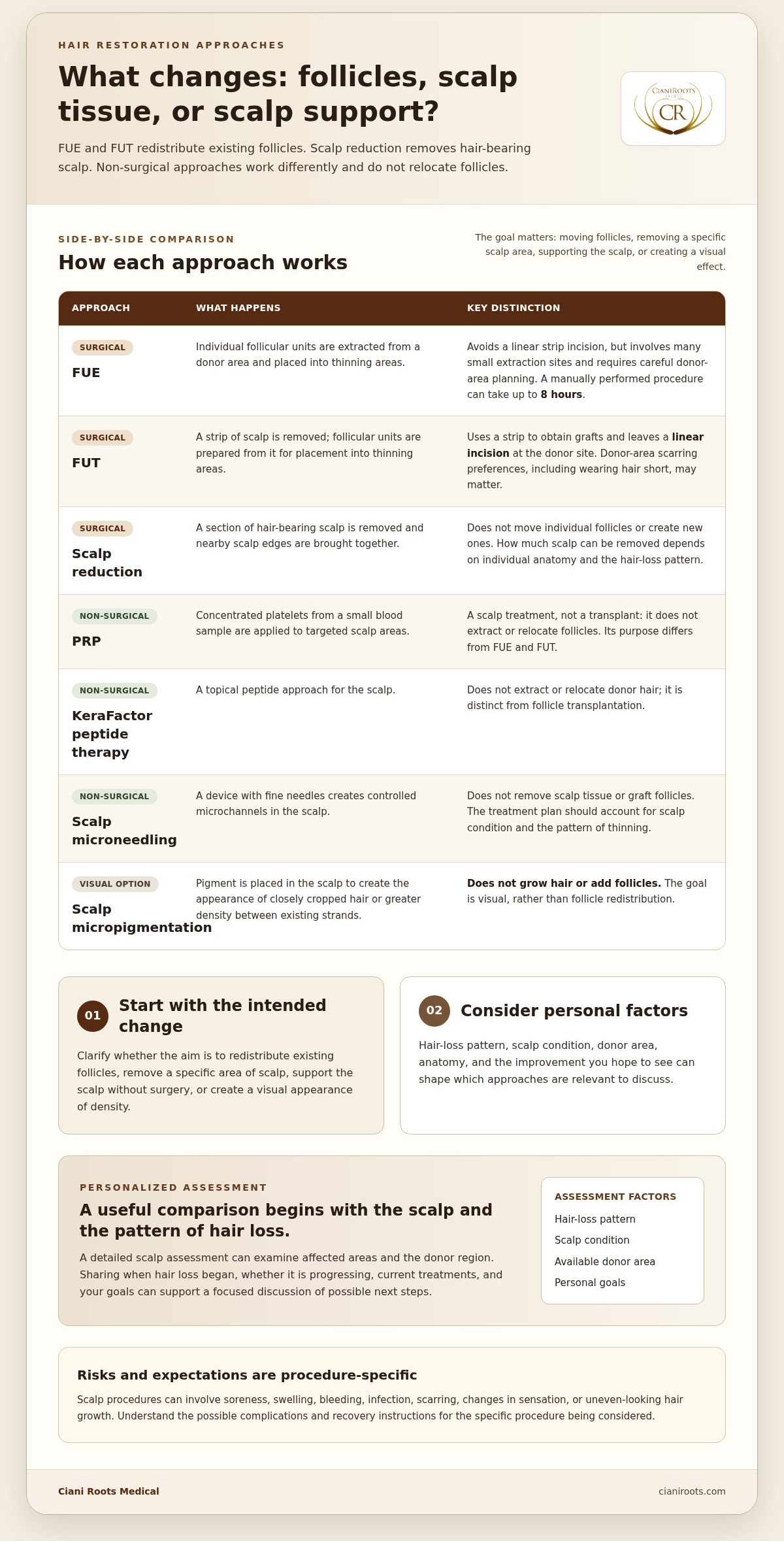
FUE, FUT, and scalp reduction are surgical approaches that differ in how they use scalp tissue and donor hair. Follicular unit extraction (FUE) removes individual follicular units from a donor area and places them into thinning areas. Follicular unit transplantation (FUT) removes a strip of scalp, from which follicular units are prepared for placement. Scalp reduction removes a section of hair-bearing scalp and brings the nearby edges together.
With FUE, extraction happens follicle by follicle, rather than through a strip incision. A manually performed FUE procedure can take up to 8 hours. The method avoids a linear strip incision, but still involves many small extraction sites and requires careful donor-area planning. FUT uses a strip of scalp to obtain grafts, leaving a linear incision at the donor site. That difference can matter for people who wear their hair short or have preferences about donor-area scarring.
Scalp reduction works differently from both grafting methods. Rather than moving individual follicles to a new area, the procedure removes scalp tissue where hair is sparse. For example, someone with a limited bald area may discuss how tissue removal and scalp flexibility affect the remaining hairline. It does not create new follicles, and the amount of scalp that can be removed depends on individual anatomy and the pattern of hair loss.
These procedures aren’t interchangeable with non-surgical options. A useful comparison starts by identifying the goal: redistribute existing follicles, remove a specific area of scalp, or support the scalp without surgery. In California, that distinction helps keep discussions of hair restoration focused on the actual method, not simply the word “restoration.”
KeraFactor peptide scalp therapy is a topical approach, not a follicle transplant. Its role is distinct from FUE or FUT: it doesn’t extract or relocate donor hair. Scalp microneedling also differs from surgery. It uses a device with fine needles to create controlled microchannels in the scalp, rather than removing tissue or grafting follicles. The treatment plan should account for scalp condition and the pattern of thinning.
Aesthetic medical scalp micropigmentation offers another visual option. A practitioner places pigment in the scalp to create the appearance of closely cropped hair or greater density between existing strands. It does not grow hair or add follicles. Someone seeking a shaved look with added pigment has a different goal from someone seeking follicle redistribution. Clarifying that goal is a practical first step before considering a personalized approach.
Dr. Jennifer Fu completed a fellowship in Mohs Micrographic Surgery and Procedural Dermatology at the University of California, San Francisco. When comparing these approaches, the central distinction is what happens to scalp tissue and follicles: FUE and FUT move donor follicles, while scalp reduction removes hair-bearing scalp. The discussion can focus on the intended change and how the individual’s anatomy and hair-loss pattern affect the approach.
Hair restoration services for Bay Area patients
For people considering hair restoration in Solano County, the first distinction is between surgical transplantation and non-surgical care. Transplants move existing follicles; regenerative approaches focus on scalp treatment without transplanting hair. People from Vacaville, Napa, and nearby East Bay communities can compare options by their goals, hair-loss pattern, and comfort with procedures. Start by identifying what you want to change, such as visible thinning or reduced density.
California insurance coverage for hair restoration or transplant surgery depends on the individual plan’s terms and the medical indication. Elective treatment is not automatically covered, so review the policy’s coverage criteria and exclusions before planning care.
Procedures involving the scalp can carry risks, including soreness, swelling, bleeding, infection, scarring, or changes in sensation. Hair growth may also look uneven. The specific procedure matters: a transplant involves extraction and placement, while a scalp treatment uses a different technique. Understand possible complications and recovery instructions before consenting.
For a non-surgical option, platelet-rich plasma (PRP) uses concentrated platelets from a small blood sample, applied to targeted scalp areas. This approach does not transplant follicles, so its purpose differs from FUE or FUT. When comparing PRP with surgery, consider how each method relates to the pattern of hair loss and treatment goals. This distinction helps set realistic expectations about what each approach does.
A useful first step is to document where thinning appears and how it has changed. A widening part, reduced density at the crown, or recession at the temples gives a clinician specific areas to assess. Scalp analysis can examine affected areas and the donor region, while a medical history helps identify relevant factors. Together, these details guide a personalized discussion of treatment options.
Patients can prepare by noting when hair loss began, whether it is progressing, and any recent changes in health or medication. Bring a list of current treatments and describe what improvement would look like, such as fuller coverage in a particular area. These details support a focused consultation rather than a one-size-fits-all recommendation. A personalized scalp assessment can help organize the next steps and clarify which questions matter most for your situation.
Consultation questions can focus on how the proposed approach matches the areas of concern, what changes would count as meaningful progress, and what risks or recovery instructions apply to that procedure. Ask what information from your scalp assessment and medical history informs the recommendation. Notes about the pattern and timing of hair loss can keep the discussion specific to your goals.
Regenerate iV Bar & Aesthetics says PRP hair restoration uses concentrated platelets from a small blood sample, which are injected into targeted scalp areas. Patients considering this option can ask how it differs from a transplant in purpose and technique, and how the clinician would relate it to their stated goals. Discussing expectations before consenting can help patients compare approaches without assuming that one option is appropriate for every pattern of hair loss.
Candidate suitability and donor hair
Hair transplant candidacy depends on the relationship between the thinning area and available donor hair. FUE and FUT redistribute follicles, so neither method creates a new supply. A consultation should map hair loss across the scalp, assess donor density, and clarify the coverage you are seeking. Restoring a small area near the temples, for example, requires a different plan from addressing broader thinning across the crown.
Average adult male donor-area density is estimated at approximately 200 hairs per square centimeter. That estimate describes density, not the number of grafts suitable for removal. Donor hair also needs assessment for distribution, thickness, and characteristics compared with hair around the recipient area. A dense-looking patch alone doesn’t establish how much can be used while preserving a balanced appearance.
The pattern and progression of hair loss matter, too. A receding hairline, a widening part, and diffuse thinning across the top present different planning challenges. Transplant design should account for surrounding hair, since continued thinning can change how the result looks over time. Someone seeking a low hairline needs a plan that considers both current coverage and available donor supply.
Scalp and hair assessment should also consider visible irritation, scarring, and the condition of the donor region. A consultation can review your health history, medications, previous procedures, and hair-loss timeline. Bring examples of changes you have noticed, such as a part that appears wider in recent photographs. These details help distinguish a localized pattern from broader thinning and shape a personalized discussion.
- Map the pattern: Identify where thinning appears and whether it affects the hairline, crown, or wider scalp.
- Review donor areas: Compare density and hair characteristics across potential extraction regions.
- Set a coverage goal: Describe the area you want addressed, such as temple recession or crown thinning.
- Discuss the timeline: Explain when hair loss began and how its pattern has changed.
These steps help determine whether surgery fits the goal and available donor supply. If donor hair is limited or thinning is diffuse, a transplant design has less flexibility. A consultation should explain how the proposed recipient area relates to donor capacity, rather than focusing only on graft numbers. That balance is central to planning coverage suited to the individual scalp.
Candidacy is not defined by age alone or by one density estimate. Key considerations include the cause and pattern of hair loss, donor-area characteristics, scalp condition, and expectations for coverage. Someone prioritizing a modest change at the hairline may have a different plan from someone seeking density across a larger area. These factors give the consultation a practical focus.
Expected results and session timing
A hair transplant consultation and treatment involve assessment, planning, the procedure, and recovery. The consultation reviews your goals and hair-loss history, examines the scalp, and discusses an appropriate approach. Before treatment, clarify the plan, aftercare instructions, and how progress will be assessed. This sequence distinguishes the appointment itself from the longer process of seeing changes.
Procedure length depends on the technique and planned work. A typical manually performed FUE procedure can take up to 8 hours, so patients should plan the day around the clinic’s instructions. Session timing is separate from healing and hair growth. Ask what the treatment day involves, what arrangements to make afterward, and which aftercare steps apply.
Recovery varies. Most hair-transplant patients can resume normal activities within a few days, though recovery time varies. Follow the specific instructions for caring for the treated scalp and returning to usual routines. For example, avoid filling the first days with plans that could conflict with the clinic’s recovery guidance. Your own treatment instructions should guide those decisions.
Newly transplanted hair begins to grow in 2-3 months following hair restoration with NeoGraft. This timing applies specifically to NeoGraft, and visible change develops gradually. A patient may not see the same density across every area at once. Keep expectations tied to the treated area and the stage of growth, rather than judging progress from one early observation.
Final hair-transplant results usually appear within 6 to 12 months as transplanted hair grows and blends with existing hair. Consistent photographs can help you compare appearance across the process. Use the same lighting, angle, and hairstyle when taking them. That simple record makes changes easier to review during follow-up discussions with the clinic.
Before setting your schedule, ask about these practical details:
- Procedure day: What should you plan for before and after the session?
- Aftercare: Which scalp-care instructions apply during recovery?
- Progress tracking: How will you document changes in coverage and density?
- Follow-up: What should you bring or discuss at progress reviews?
These questions help you plan work, home responsibilities, and follow-up around treatment. They also provide a shared reference for discussing changes over time. If growth appears uneven, record what you notice and raise it at a follow-up. A clear timeline can make each stage easier to understand and keep expectations grounded in the treatment plan.
Hair restoration services for Vacaville and Solano County
For Solano County patients, the first decision is whether the goal calls for surgery or non-surgical hair care. Compare the technique, treatment area, donor-hair needs, and follow-up plan before choosing a direction.
Procedure Options Near Solano County
FUE and FUT are surgical transplant techniques that relocate follicles from a donor area. PRP uses concentrated platelets from a blood sample, while medication support addresses hair loss without transplanting follicles. These options serve different purposes. A useful comparison considers the thinning pattern, scalp condition, donor supply, and whether the goal is redistributed hair or ongoing hair-loss management.
The cost of hair transplant surgery depends on the individual case and is provided after a quote request. Factors include technique, graft plan, donor supply, and treatment area. For patients comparing options around Fairfield, Vacaville, or Vallejo, the treatment plan matters more than a simple procedure label. A transplant consultation should clarify planned coverage and how the selected technique uses donor hair.
Services for Vacaville Patients
Patients in Vacaville can consider surgical consultation for FUE or FUT, or discuss non-surgical options such as PRP and medication management. The central question is how the approach fits the cause and pattern of hair loss. A scalp assessment can document thinning and hair density, helping connect treatment goals with an appropriate care plan.
Board certification and surgical experience belong to the individual surgeon performing a transplant; they can’t be inferred from a clinic’s name or general hair-loss services. For a local surgical procedure, identify who performs it and assess that surgeon’s stated credentials and relevant experience. This distinction matters because nonsurgical hair-loss care and transplant surgery are different services.
Across Solano County, location is only one practical consideration. Patients traveling from Vacaville, Fairfield, or Benicia should also understand how follow-up fits the selected technique. Transplants involve donor and recipient areas, while PRP and medication support follow different treatment plans. Asking how progress is assessed helps compare care pathways, not just appointment locations.
Hair density goals should be specific. For example, someone concerned about a widening part has a different treatment area from someone focused on temple recession. Describe the area, when thinning became noticeable, and any changes in its pattern. Those details help a clinician discuss whether surgery or a nonsurgical approach aligns with the concern.
To explore a personalized hair-loss plan in the region, EXPLORE YOUR OPTIONS and consider how scalp analysis, treatment goals, and follow-up needs fit together.
Ciani Roots Medical: CR signature with regenerative hair loss treatments
Ciani Roots Medical can help patients explore non-surgical options when thinning, scalp health, or treatment goals need a personalized review. Its CR signature regenerative hair-loss treatments, KeraLase® hair therapy with LaseMD® Ultra and KeraFactor, and medical hair-loss management offer distinct paths for consideration. A scalp analysis helps shape an individualized plan rather than assuming one approach suits everyone.
Acorn Secretome is a personalized regenerative product created using a patient’s own stored cells and biology. It can be discussed as part of a broader treatment plan, without promising a specific regrowth outcome. Patients can also explore skin rejuvenation with LaseMD and regenerative therapy for separate skin concerns.
If you’d like to discuss your hair concerns and possible next steps, contact Ciani Roots Medical or visit cianiroots.com.
Take the Next Step With a Clear Goal
Before choosing a path, consider what would make a meaningful difference in your daily life. You might want to address a specific area of thinning, understand changes in your scalp, or learn which options align with your priorities. Bringing that goal to a consultation can make the next step more focused.
For hair restoration in Solano County, a personalized assessment can connect your concerns with a treatment plan suited to your scalp and hair-loss pattern. It also gives you space to discuss questions and understand what care may involve, without rushing into a decision.
If you’re ready to talk through your goals and possible next steps, EXPLORE YOUR OPTIONS. A thoughtful conversation can be a useful beginning as you consider what feels right for you.
Frequently Asked Questions
Does a non-surgical hair transplant really grow hair?
Non-surgical treatments may support existing hair, but they do not transplant follicles. Whether someone notices improved growth or less shedding depends on factors such as the cause of hair loss, scalp condition, and chosen care plan. Track changes with consistent photos and notes about shedding or coverage. This gives you a clearer basis for discussing progress than relying on memory alone.
What causes hair loss?
Hair loss can stem from genetics, hormonal shifts, stress, postpartum changes, or repeated tension from hairstyles, and these causes may show different patterns. Traction can affect areas under repeated pulling, while inherited thinning may develop gradually across the scalp. Noting when shedding began, where it appears, and any recent health or routine changes can make an evaluation more informative.
What hair restoration clinics serve Solano County, California?
Ciani Roots Medical serves Solano County from its Vacaville clinic and has another physical location in Alamo. For those elsewhere in the county, the Vacaville clinic offers a local point of access. Consider which location works for appointments and follow-up, then discuss your goals and concerns during an evaluation.
Where can Solano County residents find hair restoration clinics in Fairfield, Vacaville, Vallejo, or nearby areas?
Residents can look to Vacaville for a clinic serving nearby Fairfield and Vallejo, or consider the Alamo location depending on where they live and travel. Ciani Roots Medical has physical clinics in Vacaville and Alamo, California. Before arranging care, consider which location is practical for attending appointments and follow-up conversations as your plan progresses.
Article by
Adriane McDonald BSN,RN
Adriane McDonald, BSN, RN, is a hair restoration specialist with nearly 40 years of experience working with men and women experiencing hair loss and thinning. As the Founder and Practice Director of Ciani Roots Medical, she works alongside the practice’s Medical Director to provide personalized hair restoration, scalp health, regenerative therapies, and advanced skin rejuvenation.
Her approach combines extensive hands-on experience with detailed scalp analysis, medical collaboration, and individualized treatment planning. Adriane is currently completing advanced training toward certification in trichology, further expanding her expertise in hair and scalp health.
Disclaimer
This content is provided for general educational and informational purposes only and is not intended to serve as medical advice, diagnosis, or treatment. Individual needs, treatment recommendations, and results vary. A consultation and appropriate evaluation are necessary to determine which treatment options may be suitable for you. Viewing or interacting with this content does not establish a healthcare professional-patient relationship with Ciani Roots Medical.
Individual results may vary, and no specific outcome can be guaranteed. Before-and-after images, testimonials, or treatment experiences represent individual results and should not be considered a guarantee of similar results.


