
Hair restoration treatment risks depend on the method. Transplant surgery can involve infection, scarring, uneven growth, and grafts that don’t survive. Donor-area density, blood supply in the recipient scalp, and graft handling can all affect the outcome. Regenerative approaches raise different questions about how they work and what they can and cannot do.
It’s understandable to worry that a treatment intended to restore hair could produce an unexpected result. Risks vary by method and scalp condition. Knowing what affects graft survival can help you compare options and understand which concerns apply to surgery.
This article explains how donor density and over-harvesting can affect the donor area, why blood supply matters after graft placement, and how stem-cell-based methods fit into the discussion. You’ll also learn which concerns are specific to transplant surgery and why careful, individualized treatment planning matters.
Key Takeaways
- Donor hair is a limited resource; density and harvesting decisions can affect both coverage and the appearance of the donor area.
- Grafts rely on the surrounding scalp for oxygen and nutrients, so recipient-area blood supply and careful aftercare matter.
- Stem-cell-based approaches are not all the same; learn how the method is prepared and what its evidence can and cannot show.
- A thoughtful treatment plan considers the cause and pattern of hair loss, scalp condition, and the risks of surgery or medication.
- Personalized scalp analysis can help clarify whether regenerative options such as Bio-Enhanced PRP fit your hair-restoration goals.
Donor-area density and over-harvesting
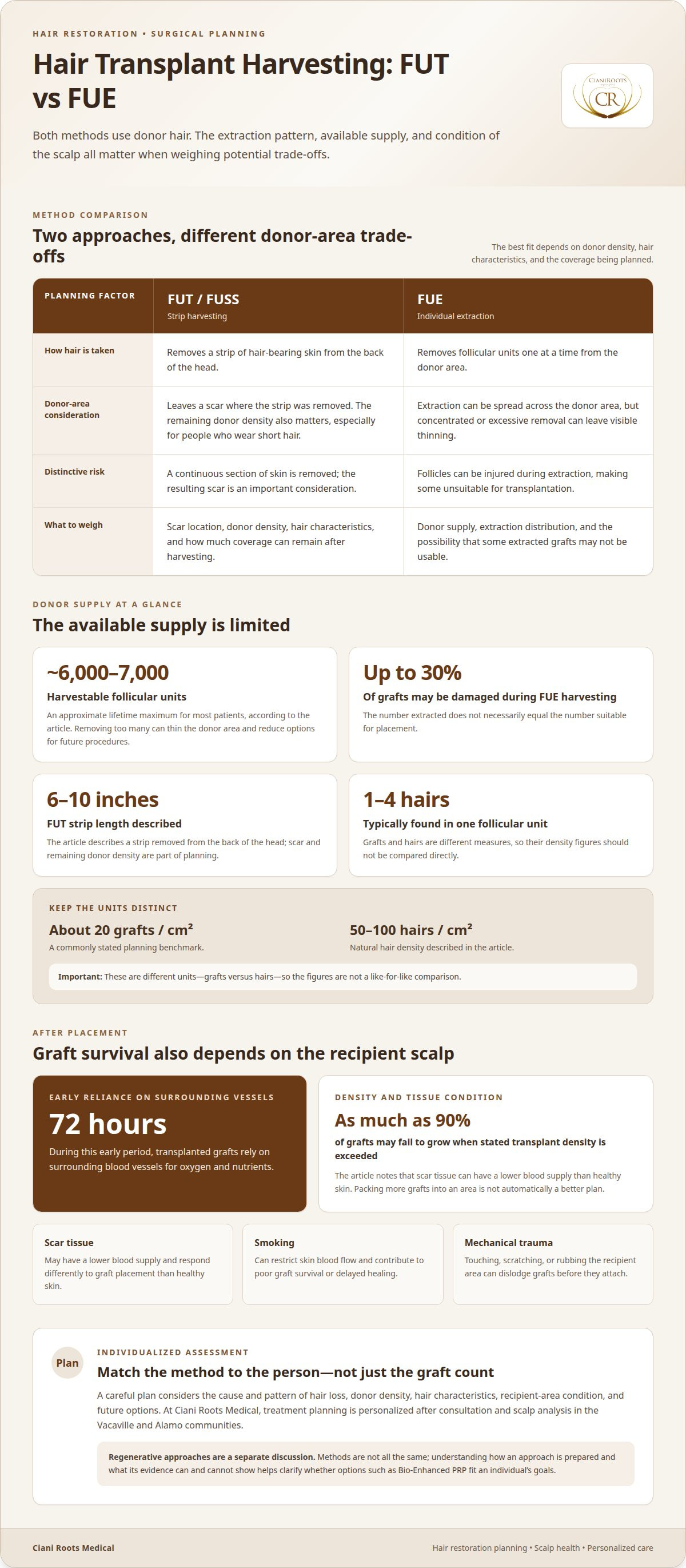
Donor density sets a limit on how many follicular units can be removed while preserving coverage. A commonly stated planning benchmark is about 20 grafts per square centimeter, compared with natural hair density of 50 to 100 hairs per square centimeter. Understanding hair restoration treatment risks starts with recognizing that these figures measure different things.
Donor supply limits
Donor supply is the number of transplantable follicular units available in areas such as the back of the scalp. Most patients have a lifetime maximum of approximately 6,000 to 7,000 harvestable follicular units. This matters because removing too many can leave visible thinning where hair was taken and reduce options for future procedures as the hair-loss pattern changes.
Grafts and hairs are different units: a follicular unit typically contains one to four hairs. So, comparing 20 grafts per square centimeter directly with 50 to 100 hairs per square centimeter can be misleading. The figures describe different measures. A clinical plan considers existing donor density, hair characteristics, and how much coverage can remain after harvesting.
Over-harvesting happens when too many follicles are removed, or extraction is concentrated in a limited donor zone. For example, thinning a small patch at the back of the scalp may leave it noticeably sparse, even if transplanted grafts add coverage elsewhere. The goal isn’t simply to remove as many grafts as possible. Their distribution matters because surrounding hair can make uneven extraction visible.
FUT and FUE harvesting risks
FUT, also called FUSS, removes a strip of hair-bearing skin from the back of the head. FUE removes follicular units individually. Both use donor hair, but their harvesting patterns differ. FUT leaves a scar where the strip was removed, while FUE can damage follicles during extraction, making them unsuitable for transplantation.
FUSS surgery removes a strip measuring 6 to 10 inches from the back of the head. The scar and remaining donor density are relevant considerations, especially for someone who wears short hair. FUT harvesting also removes a continuous section of skin rather than selecting individual follicles.
With FUE, individual extraction can spread harvesting across the donor area, but it doesn’t eliminate injury risk. Up to 30% of grafts may be damaged during FUE harvesting. A damaged follicle may be incapable of transplantation, so the number extracted doesn’t necessarily equal the number usable for placement. These are important hair restoration treatment risks to understand when discussing technique and donor supply.
These differences matter when discussing coverage and future options. Someone with limited donor density may have fewer viable follicles to work with, regardless of method. A careful plan considers recipient-area needs and the appearance of the donor area, rather than treating a high graft count as the only measure of success.
Scalp blood supply and graft survival
Blood supply helps determine whether newly placed grafts receive oxygen and nutrients. During the first 72 hours after a hair restoration procedure, transplanted grafts rely on surrounding blood vessels, making the recipient scalp’s condition important to early survival.
Scar tissue can complicate graft placement because it often has a lower blood supply than healthy skin. This may matter after a scalp injury or surgery, as scarred areas can respond differently from nearby tissue. In some cases, a test procedure may be recommended to assess how scarred skin responds to graft placement.
Density also matters. Exceeding the stated transplant density can cause as much as 90% of grafts to fail to grow. That risk illustrates why packing more grafts into a limited area isn’t automatically a better plan: nearby blood vessels must support the placed follicles. The balance depends on the recipient area, including whether it contains healthy skin or scar tissue.
Smoking can restrict blood flow to the skin and contribute to poor graft survival or delayed healing after restoration. Mechanical trauma is another concern: touching, scratching, or rubbing the recipient area can dislodge grafts before they attach to the scalp’s blood supply. These are separate factors, but both can interfere with healing around newly placed follicles.
Scalp reduction and flap surgery
Scalp reduction and flap surgery are surgical approaches that reposition or remove scalp tissue, rather than relying only on individually placed grafts. Suitability depends on the area being treated and the condition of the surrounding tissue. Where scarring is present, reduced blood supply can affect planning and graft response.
These are surgical procedures, not ways to bypass scalp biology. Previous surgery can leave scar tissue, and scarred recipient areas may have less blood supply than healthy skin. The condition of the tissue is therefore an important consideration when assessing possible graft placement.
Scalp micropigmentation as an alternative
Scalp micropigmentation uses specialized pigments to create the appearance of a closely shaved head or fuller hair. It changes visual appearance rather than transplanting follicles, so graft survival isn’t the outcome being assessed. For someone considering an alternative to graft placement, the distinction helps clarify what the technique can address.
Poorly performed scalp micropigmentation can lead some patients to seek correction. It also raises different considerations from surgery: pigment placement affects appearance, while blood supply and graft attachment matter for transplanted follicles. Scalp analysis can help assess tissue condition and hair-loss pattern as part of an individualized discussion.
Stem-cell-based hair regeneration
“Stem-cell hair restoration” refers to different approaches, not one standardized treatment. Some methods use cells or cell-derived products, while hair cloning aims to create new follicles. The procedure, evidence, and potential risks can differ. A treatment label alone doesn’t explain what is performed or whether it involves a transplant.
One described approach uses adipose-derived stem cells collected from a patient, processed, and injected into the recipient site during a hair transplant. This combines cell-based treatment with surgery and graft placement. It is different from non-surgical care and from moving existing follicles from one scalp area to another.
Research into cell-based regeneration covers several approaches. A literature review reported success using adult and perinatal mesenchymal stem cells as mesotherapy for hair regrowth. Other studies have examined direct scalp injections to support new follicle growth in males and females with alopecia. These findings describe areas of research, not proof that every product or protocol works the same way.
Exosome-based treatments are another distinct category. As of 2026, MSC-derived exosomes are not FDA-approved for hair loss. That fact is important when evaluating claims about a treatment’s regulatory status. It also means “stem-cell-based” should not be treated as proof of approval, effectiveness, or suitability for a particular pattern of thinning.
Hair cloning remains experimental. The concept is to create follicles instead of relying only on existing donor supply, but it is not an established replacement for a conventional hair transplant. When considering regenerative methods, distinguish procedures currently performed from future possibilities, especially if marketing language suggests permanent growth or a predictable outcome.
For a clear discussion, identify the method: whether it uses cells, cell-derived material, or another regenerative approach; where the material comes from; and whether treatment is performed alongside surgery. These details help clarify what happens to the scalp and which risks belong to the procedure. Injections and transplant surgery involve different steps, even when both are described as regenerative.
Stem-cell terminology alone can’t show how a treatment relates to your follicles or the cause of hair loss. Assess the specific method, its evidence, and whether it involves surgery as separate questions. A personalized scalp assessment can put regenerative options in context and distinguish current treatments from experimental hair cloning.
How can patients reduce risks when choosing a hair restoration provider in the United States?
Start with a diagnosis, not a graft estimate. Hair thinning can reflect genetic pattern loss, medication effects, hormonal changes, or scalp conditions, and these causes may call for different approaches. A clinical assessment should review the pattern of loss, scalp health, medical history, and goals before discussing surgery or regenerative care. Without that context, a treatment may address appearance without considering why hair is thinning.
Next, understand the proposed method. FUE extracts follicles individually, while FUT removes a strip of hair-bearing skin. Each has different donor-area considerations, and neither eliminates the need to assess density and future hair loss. A clear discussion explains how extraction affects the donor area, what the procedure involves, and which risks apply, such as scarring, infection, uneven growth, or a possible follow-up procedure.
Look for an individualized plan that explains why each option is recommended. For example, diffuse thinning may call for a different evaluation than a stable area of loss with a suitable donor zone. The plan should distinguish transplantation from non-surgical care, identify the treatment area, and explain how progress will be assessed.
- Diagnosis: The assessment identifies the hair-loss pattern and considers relevant medical history.
- Method: The explanation distinguishes FUE, FUT, and non-surgical approaches.
- Donor planning: The plan accounts for existing density and the visual effect of harvesting.
- Risk discussion: The clinician explains relevant risks, including scarring, infection, or uneven growth.
- Follow-up: The care plan describes how healing and hair changes will be monitored.
Clear communication matters. A treatment discussion should explain what an option can and cannot address. A transplant relocates follicles; it doesn’t prevent genetic hair loss from progressing in untreated areas. Understanding that distinction helps clarify why ongoing assessment or medical management may be discussed alongside restoration.
For people in Vacaville, Alamo, Fairfield, Dixon, Suisun City, Benicia, Vallejo, Napa, Winters, Davis, Woodland, Solano County, Yolo County, Napa Valley, Danville, Walnut Creek, San Ramon, Blackhawk, and Lafayette, scalp analysis can document thinning and scalp condition before treatment decisions. At Ciani Roots Medical, clinicians connect those findings with your goals, medical history, and preferred level of intervention. The focus is suitability and informed choice, not a promised graft count or a single method.
Realistic expectations are essential for a proper appraisal of results. Hair transplants have been performed in the United States since the 1950s; ask whether robotic techniques suit your case, as they can reduce human error and minimize scarring.
Who should avoid hair transplant surgery or hair loss medications?
Hair transplant surgery isn’t suitable for every pattern of hair loss. Men with pattern hair loss are generally advised to wait until age 30 or later before surgery. Younger patients may continue losing hair in areas that currently appear healthy. If transplanted follicles remain while surrounding hair thins, the result can become uneven over time.
Donor supply and recipient-area condition also shape surgical suitability. Women with post-menopausal or genetic diffuse thinning often aren’t candidates for transplantation; the stated estimate is 80%. Diffuse thinning affects a broader area, which can make it harder to identify a stable donor zone and a clearly defined recipient area. Hair loss type matters as much as age.
Surgery carries risks such as infection, scarring, and reactions to anesthesia. These deserve particular attention when a health condition may affect healing or anesthesia safety. A medical history review helps identify relevant concerns before considering a procedure. Decisions should account for hair-loss pattern, scalp condition, donor supply, and other health factors.
Medication considerations
Hair-loss medications also require careful consideration. Finasteride is prescription-only and isn’t typically recommended for women of childbearing age; it’s also not recommended for premenopausal women. These distinctions matter when discussing treatment for female hair loss, including genetic or hormonal thinning.
For men, finasteride’s risks should be part of an informed medication discussion. In October 2025, the U.S. FDA added a label update for finasteride regarding the risk of suicidal ideation. This makes mental health history and changes in mood relevant to medication management. Patients should understand the potential side effects associated with traditional medications before choosing a treatment plan.
Medication decisions should reflect the cause of shedding. Sudden hair changes after a medication or health change, for example, may call for a different assessment than gradual genetic pattern loss. Treating the wrong cause can delay appropriate care. A medical review can consider timing, pattern, health history, and current medications together.
When surgery or a particular medication isn’t appropriate, the reason matters. Age, ongoing loss, diffuse thinning, donor availability, health factors, and medication concerns can all affect options. Medical hair-loss management may include medication support where appropriate, alongside other approaches suited to the scalp and hair-loss pattern. The aim is a plan that addresses the situation, not simply a procedure or prescription.
For a personalized discussion of hair-loss patterns, surgical suitability, and medication considerations, EXPLORE YOUR OPTIONS.
Ciani Roots Medical: Bio-enhanced prp hair restoration
Ciani Roots Medical offers Bio-Enhanced PRP hair restoration as a regenerative option to discuss when considering non-surgical care. PRP generally involves drawing a patient’s blood, processing it to concentrate platelets, and delivering the prepared plasma to the scalp. Whether it fits depends on the hair-loss pattern, scalp condition, and treatment goals.
A consultation and scalp analysis help connect these factors to an individualized plan. The discussion can clarify how PRP differs from transplant surgery and whether other regenerative options are relevant. The focus is understanding your options, not promising a particular result.
If you’d like to discuss whether Bio-Enhanced PRP may suit your needs, contact Ciani Roots Medical to start a conversation.
Choose a next step that fits your goals
Understanding hair restoration treatment risks can help you prepare for a consultation with clearer priorities. Connect your goals with your scalp condition, hair-loss pattern, and suitable approaches. A personalized discussion can distinguish regenerative care from surgery and explain what each option involves.
Ciani Roots Medical offers the CR Signature Protocol™, a personalized combination approach designed for patients who may benefit from addressing hair loss through multiple treatment modalities. Plans may include personalized regenerative therapy with a secretome derived from your own hair-follicle stem cells, or Bio-Enhanced PRP. Not every patient receives or needs every treatment.
If you’re ready to explore a thoughtful plan for your hair and scalp, EXPLORE YOUR OPTIONS. A clear conversation is a meaningful place to begin.
Frequently Asked Questions
What are the rare but serious risks of hair restoration treatments?
Rare serious complications may require prompt medical assessment, particularly if symptoms are severe or rapidly worsening. After treatment, contact the treating team about unexpected changes rather than waiting for a routine review. Increasing pain or an area that looks markedly different from the surrounding scalp deserves attention. Keep post-treatment instructions available so you can describe the procedure, timing, and symptoms clearly.
What complications can occur with FUE versus FUT hair transplant procedures?
Some complications can occur after either harvesting method. Folliculitis may develop around the time new hair begins to grow. Shock loss, or temporary shedding after a transplant, is usually not permanent. Scalp numbness or tingling can also occur and usually resolves within a few months. These changes don’t identify which harvesting method was used; report concerns during follow-up.
What are the risks and side effects of minoxidil for hair loss?
A key consideration with minoxidil is the ongoing routine: daily application is needed indefinitely to maintain treatment results. Consistent use can be difficult if your schedule changes or topical application is inconvenient. Discuss unwanted symptoms or changes after starting it with the clinician managing your hair-loss care. They can review how you use it and whether it remains appropriate for your plan.
What are the risks and side effects of finasteride for hair loss?
Pay attention to mood changes while taking finasteride, and tell the prescribing clinician promptly about concerning symptoms. If you feel at risk of harming yourself, seek emergency help immediately. Keep medication discussions specific: mention when symptoms began, any dose changes, and other medicines you take. This information helps the clinician assess the concern and guide next steps without guesswork.
What symptoms after hair restoration treatment require urgent medical care?
Seek urgent care for uncontrolled bleeding, difficulty breathing, or symptoms that worsen quickly after a procedure. Increasing redness, warmth, or drainage from a treated area can also warrant prompt medical attention because infection is a possible complication. For less urgent concerns, contact the treating team rather than picking at the scalp or applying unapproved products. Describe when treatment occurred and how symptoms have changed.
Article by
Adriane McDonald BSN,RN
Adriane McDonald, BSN, RN, is a hair restoration specialist with nearly 40 years of experience working with men and women experiencing hair loss and thinning. As the Founder and Practice Director of Ciani Roots Medical, she works alongside the practice’s Medical Director to provide personalized hair restoration, scalp health, regenerative therapies, and advanced skin rejuvenation.
Her approach combines extensive hands-on experience with detailed scalp analysis, medical collaboration, and individualized treatment planning. Adriane is currently completing advanced training toward certification in trichology, further expanding her expertise in hair and scalp health.
Disclaimer
This content is provided for general educational and informational purposes only and is not intended to serve as medical advice, diagnosis, or treatment. Individual needs, treatment recommendations, and results vary. A consultation and appropriate evaluation are necessary to determine which treatment options may be suitable for you. Viewing or interacting with this content does not establish a healthcare professional-patient relationship with Ciani Roots Medical.
Individual results may vary, and no specific outcome can be guaranteed. Before-and-after images, testimonials, or treatment experiences represent individual results and should not be considered a guarantee of similar results.


