
Hair restoration surgery is generally suited to permanent, inherited baldness, rather than hair loss from conditions such as alopecia areata. Understanding what to expect from hair restoration also means knowing that shedding may occur before new growth becomes visible, and that recovery and regrowth timelines vary by treatment.
It’s understandable to want clear answers before considering care, especially when hair loss affects how you feel about your appearance. This guide explains which conditions may be addressed, what recovery can feel like, how aftercare supports healing, and when shedding and regrowth may happen. You’ll also learn why identifying the cause of hair loss matters when considering treatment options.
Key Takeaways
- Hair restoration surgery is generally intended for permanent, inherited hair loss; identifying the cause helps clarify which approaches may be appropriate.
- Recovery care can affect how you protect the scalp, wash your hair, and return to exercise or wearing hats.
- Transplanted hairs may shed before new growth appears, so early shedding doesn’t tell the whole story of progress.
- Swelling, soreness, and scabbing can occur during healing; knowing what to expect can make recovery feel more manageable.
- A scalp assessment can help match your concerns with a personalized plan, including whether Bio-Enhanced PRP hair restoration may be relevant.
Exercise, sun exposure, and hats during recovery
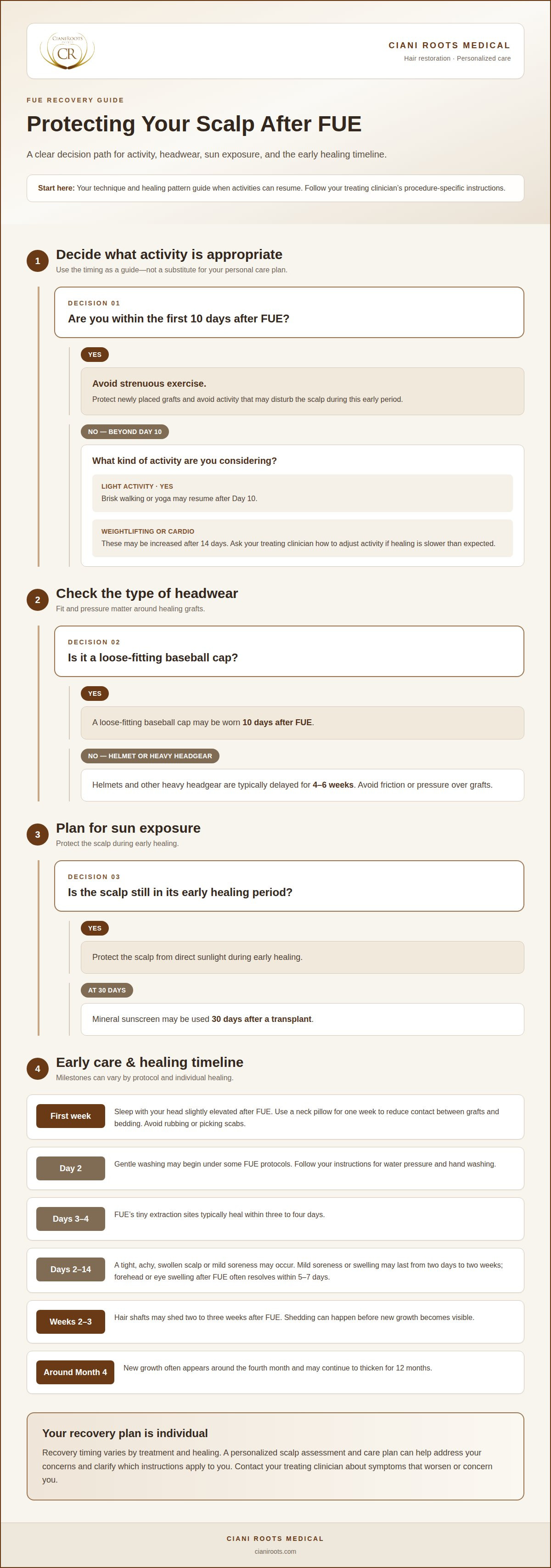
After follicular unit extraction (FUE), protecting newly placed grafts is central to early recovery. Exercise, direct sunlight, and pressure from hats may risk disturbing the scalp, so follow the procedure-specific care plan. The technique and your healing pattern guide when activities can resume.
For FUE, light activity such as brisk walking or yoga may resume after Day 10. Weightlifting and cardio may be increased after 14 days, while strenuous exercise is generally avoided during the first 10 days. These milestones aren’t interchangeable: lifting raises exertion more than a walk. Ask the treating clinician how to adjust activity if healing is slower than expected.
Hat timing depends on fit and headwear type. A loose-fitting baseball cap may be worn 10 days after FUE, while helmets and other heavy headgear are typically delayed for 4-6 weeks. Avoid friction or pressure over grafts. Protect the scalp from direct sun during early healing; mineral sunscreen may be used 30 days after a transplant.
Sleep with the head slightly elevated after FUE, and use a neck pillow for one week to reduce contact between grafts and bedding. Gentle washing may begin on Day 2 under some FUE protocols. Avoid picking scabs, and follow the care instructions for water pressure and hand washing. These small steps help limit accidental rubbing during the fragile early period.
Recovery symptoms can include a tight, achy, swollen scalp, temporary scabbing, and forehead swelling. Mild soreness or swelling may last from two days to two weeks; forehead or eye swelling after FUE often resolves within 5-7 days. Contact the treating clinician about symptoms that worsen or concern you, rather than changing care instructions yourself.
FUE removes follicular units individually, while follicular unit transplantation (FUT) removes a strip of scalp that is divided into grafts. In FUE, tiny extraction sites typically heal within three to four days; FUT involves a donor incision and a different recovery pattern. Hair shafts may shed two to three weeks after FUE, with new growth often appearing around the fourth month and continuing to thicken for 12 months.
In the United States, transplant costs vary with the extent of hair loss, technique, and treatment plan. Graft needs and donor-area characteristics also affect an individualized estimate, so a general figure may not reflect a specific case.
Recovery guidance focuses on protecting the scalp. Questions about maintaining or supporting hair growth can be discussed separately with the treating clinician. Nonsurgical options listed include minoxidil foam or lotion and medicines such as finasteride and anti-androgens, according to healthdirect. Whether any option is appropriate depends on individual circumstances. Don’t start, stop, or change treatment based only on general information. Keep follow-up discussions focused on both healing and treatment goals so each question receives the right guidance.
Post-procedure care and hair washing
After a hair transplant, care includes protecting the treated scalp, following wound-care instructions, and attending follow-up visits. Specific instructions depend on the technique and your healing.
Nonsurgical options include minoxidil foam or lotion and medicines such as finasteride and anti-androgens, according to healthdirect. Unlike surgery, these options don’t move hair follicles. They use medication to address hair loss, and suitability depends on the person’s circumstances.
Insurance coverage depends on your policy and plan terms. Review your benefits for information about hair restoration and discuss coverage questions with your insurer before scheduling care.
First-Week Healing and Scalp Care
During the first week, protect the recipient and donor areas as the surgical sites begin healing. Rubbing, picking, or applying unapproved products can interfere with delicate skin and grafts. If bandages are used, they’re usually removed one day after surgery; follow your care team’s directions for handling them.
Keep your hands and combs away from grafts, and don’t pick scabs as they form. Use only the cleansing products and method specified in your written instructions. If you’re unsure whether a product is suitable, pause use and contact your treating team rather than trying it on healing skin.
After FUT, non-dissolvable stitches are usually removed 10-14 days after the operation. Haircuts also require attention to the treated areas: a scissor haircut in the donor area may be possible after two weeks, while clippers in the recipient area should wait at least three months. The technique affects which instructions apply.
For FUE, patients typically use a non-narcotic pain reliever for 1-3 days, following the clinician’s directions. Don’t add medication or change a prescribed dose without clinical guidance. Keep written instructions nearby so that anyone helping with your care can follow the same precautions.
Follow-Up Care and Warning Signs
Follow-up visits allow the care team to review healing and progress after surgery. The team can assess donor and recipient areas and clarify care as recovery changes. Several follow-up visits may be scheduled during the first month.
Contact your care team if pain, swelling, bruising, or drainage concerns you. Describe when it began and how it has changed to help the clinician assess what you’re seeing. Don’t remove stitches yourself, pick scabs, or alter wound care while waiting for guidance.
Hair-care instructions may change as healing progresses. Preferred shampoo and conditioner may be used 30 days after a transplant, and a scissor haircut in both donor and recipient areas may also be possible then. A scalp analysis can help discuss hair-loss concerns and non-surgical care alongside transplant aftercare. Personalized scalp analysis can support that conversation.
Hair shedding and regrowth timeline
After a transplant, visible shedding can occur before new hair growth appears. Knowing the usual sequence can help distinguish an expected transition from changes that need clinical review.
Temporary Hair Shedding
Temporary shedding is the loss of transplanted hair shafts after grafts are placed, while the follicles remain beneath the scalp. This early shedding doesn’t indicate the final outcome. Transplanted hairs often fall out within two to three weeks after surgery, and short shafts may continue shedding for up to one month.
During this phase, the scalp may look similar to its pre-procedure appearance, even though the grafts have been performed and healing continues. A doctor considers timing, the areas affected, and the extraction method when reviewing concerns. Monthly photographs for 12 months provide a consistent way to observe changes rather than relying on a single day’s appearance.
Regrowth and Shock Loss
Regrowth is the gradual return of visible hair from transplanted follicles; shock loss is temporary thinning in hair-bearing areas near the transplant. Shedding can affect both newly transplanted shafts and existing hair. Temporary thinning in treated areas has been reported for several months after the procedure.
Note which areas appear thinner and when the change began, then share the timeline at follow-up. A clinician can assess whether the pattern fits post-procedure shedding or needs further evaluation. Don’t assume every change is permanent hair loss; its location and timing provide useful context.
Regrowth follows a gradual timeline. Early new growth typically starts around months 3-4, while noticeable changes commonly appear around months 4-6. Hair density often builds during that period, but individual follicles don’t all enter visible growth together. Early strands may look fine or uneven before additional growth improves coverage.
Progress continues beyond the first signs of growth. More complete transplant results are typically seen by 9-12 months, and subtle improvements may continue for up to 18 months. Crown growth can take about 18-20 months to look settled, so results in that area may mature later than changes at the front.
Hair loss outside the transplanted area follows its own course, since extraction relocates selected follicles rather than changing every hair-bearing region. The treatment plan should account for the underlying pattern and the donor area. Track photographs under similar lighting and angles across 12 months, and bring them to follow-up discussions with your doctor.
Swelling, soreness, numbness, and scabbing
During healing after a hair transplant, scalp sensations and visible changes can shift. Their timing, location, and progression can help you describe recovery clearly at follow-up.
Postoperative Discomfort and Swelling
Postoperative discomfort includes temporary soreness, tightness, or swelling around treated areas. Knowing the usual pattern helps you describe changes and avoid judging healing from one moment. A tight, achy scalp can last a few days, while mild swelling or soreness may last from two days to two weeks. Forehead and eye swelling after FUE typically resolves within 5-7 days.
Swelling often peaks around days 2-3, so compare symptoms across several days rather than expecting a steady decline immediately. If the hairline or forehead looks puffy, note when it appeared and whether it changes. A treating clinician can interpret that timeline alongside the technique and area treated.
Bruising and Drainage
Before surgery, discuss possible bruising and drainage with the surgeon. Knowing these changes may occur can help you report what you observe without disturbing grafts or the donor area. Describe their location, appearance, and timing, and follow the provided dressing-care instructions.
Share changes that feel unexpected or concerning with your treating team. While waiting for guidance, avoid pressing or rubbing the scalp and don’t apply unapproved products. This helps protect the follicles and gives the clinician a clearer view of the area.
Scabbing can temporarily form where hair was transplanted, with crusts visible across the recipient area. Don’t pick or pull them off, as this adds unnecessary contact to healing skin. Follow the washing method provided after the procedure. Gentle cleaning allows loose crusts to shed naturally without scraping.
Sleep positioning can help reduce accidental contact during the first few nights. After FUE, keep your head slightly elevated, using two pillows or a recliner if advised. A neck pillow for one week can help limit rubbing against bedding. If your usual position presses on the treated area, use the instructed alternative until your care plan allows a change.
Pay attention to numbness rather than guessing what it means. If you notice reduced sensation, record where it occurs, when it began, and whether it changes. Share those details at follow-up, especially if the area includes the donor site or recipient hairline. Don’t massage numb areas or change wound care unless your treating clinician directs you.
During recovery, track symptoms once daily and note changes in swelling, soreness, scabbing, or sensation. The technique and treated area can affect what you notice, so a brief record helps connect each change with its timing. Contact your treating team about concerning symptoms, and follow their guidance before resuming scalp products or usual activities.
Conditions treated by hair restoration
Hair restoration can mean surgical transplantation or nonsurgical care, and those approaches don’t address every cause of hair loss in the same way. Understanding what to expect from hair restoration starts with identifying the pattern and likely cause before discussing options.
During a consultation, the clinician reviews when thinning began, where it appears, and how it has changed. A scalp examination and discussion of health history, medications, and family patterns help inform the assessment. For example, widening along the part differs from a defined receding hairline, and each pattern provides useful context.
A hair transplant is generally suited to permanent, inherited baldness, rather than other types of hair loss such as alopecia areata. The distinction matters: transplanting follicles doesn’t identify why hair is falling out, so the underlying condition must be considered before choosing an approach.
Hair loss can also occur with hormonal changes, postpartum shedding, stress, or traction. These examples don’t automatically make transplantation appropriate. An assessment considers timing, distribution, scalp condition, and whether hair loss is continuing. Sudden shedding after a major life or health change calls for a different assessment from gradual family-pattern thinning.
Nonsurgical care may be considered when the goal is to manage hair loss rather than transplant follicles. According to healthdirect, options include minoxidil foam or lotion and medicines such as finasteride and anti-androgens. Which approach fits depends on the cause, the person’s health history, and the pattern seen during assessment.
A person considered for transplantation typically has permanent, inherited baldness and a pattern that can be assessed for surgical planning. The consultation also considers donor and recipient areas, personal goals, and whether another type of hair loss may be involved. The clinician explains how the diagnosis informs the proposed approach rather than assuming a transplant suits every concern.
Ask how the assessment relates to the proposed approach: which condition is being addressed, why that option fits, and what alternatives may suit the pattern. Scalp analysis can organize those observations and inform an individualized treatment discussion. This can be useful when thinning is diffuse or several possible causes overlap.
Your questions are a useful starting point for a more informed conversation about care.
A hair transplant is generally suited to people with permanent, inherited baldness, rather than other types of hair loss such as alopecia areata. This distinction is central when weighing a proposed procedure: hair loss alone doesn’t establish that transplantation is appropriate. The discussion should focus on whether the pattern falls within the condition the procedure is intended to address, rather than treating all thinning as the same.
When the pattern or cause is uncertain, an assessment can clarify what is being considered before choosing an option. Ask the clinician to explain how the observed hair loss relates to permanent, inherited baldness and whether the proposed care addresses that concern. Connecting the diagnosis to the treatment rationale can clarify why transplantation may suit one situation but not another.
Frequently Asked Questions
What conditions does hair restoration surgery treat?
Hair transplantation is generally used for permanent, inherited baldness, not every type of hair loss. It’s usually unsuitable for alopecia areata, so identifying the cause matters before considering surgery. For example, a defined inherited pattern differs from sudden or diffuse shedding. A consultation can assess the pattern and scalp, then clarify whether transplantation or another type of hair-loss management better fits the concern.
How Long Does it Take For New Hair to Grow?
New growth commonly begins around months 3-4, while more complete transplant results are typically seen by 9-12 months. The early shed can make progress difficult to judge, so keep dated photographs in consistent lighting and compare them over time. Crown growth may mature more slowly, with results taking about 18-20 months to look settled. Hair shafts and follicles don’t follow an identical visible schedule.
How is grafting performed?
Grafting moves follicular units from a donor area into areas selected for coverage. With FUE, the clinician extracts units individually using micro-punches less than 1 millimeter in diameter. FUT instead removes a strip of scalp, which is divided into small grafts; a strip may measure 6-10 inches and yield 500-2,000 grafts. A graft can contain one to four hairs, depending on the unit.
How long does it take to recover from a hair transplant?
Visible scalp healing typically takes 7-14 days, while many patients return to work and light activity after several days. These milestones describe different parts of recovery: feeling ready for routine tasks doesn’t mean every area has finished healing. The donor site and recipient area may recover differently, especially after FUE versus FUT. Follow the treating clinician’s care plan for washing, activity, and follow-up.
When do hair transplant results become visible, and how long do they last?
Early growth often becomes noticeable around months 4-6, with more complete results typically visible by 9-12 months. Crown areas can take about 18-20 months to look settled. How long results last depends partly on the ongoing pattern of hair loss and which follicles were transplanted. A transplant timeline describes developing growth, not a fixed lifespan for every person’s result.
What are the risks and side effects of hair restoration surgery?
Possible recovery effects include a tight or achy scalp, swelling, redness, temporary scabbing, and shedding of transplanted hairs. Bruising or drainage are also possibilities to discuss with the surgeon before treatment. Note where symptoms occur and how they change, rather than picking scabs or changing wound care. Contact your treating team about worsening discomfort, concerning swelling, or unexpected drainage for personalized guidance.
Article by
Adriane McDonald BSN,RN
Adriane McDonald, BSN, RN, is a hair restoration specialist with nearly 40 years of experience working with men and women experiencing hair loss and thinning. As the Founder and Practice Director of Ciani Roots Medical, she works alongside the practice’s Medical Director to provide personalized hair restoration, scalp health, regenerative therapies, and advanced skin rejuvenation.
Her approach combines extensive hands-on experience with detailed scalp analysis, medical collaboration, and individualized treatment planning. Adriane is currently completing advanced training toward certification in trichology, further expanding her expertise in hair and scalp health.
Disclaimer
This content is provided for general educational and informational purposes only and is not intended to serve as medical advice, diagnosis, or treatment. Individual needs, treatment recommendations, and results vary. A consultation and appropriate evaluation are necessary to determine which treatment options may be suitable for you. Viewing or interacting with this content does not establish a healthcare professional-patient relationship with Ciani Roots Medical.
Individual results may vary, and no specific outcome can be guaranteed. Before-and-after images, testimonials, or treatment experiences represent individual results and should not be considered a guarantee of similar results.


