
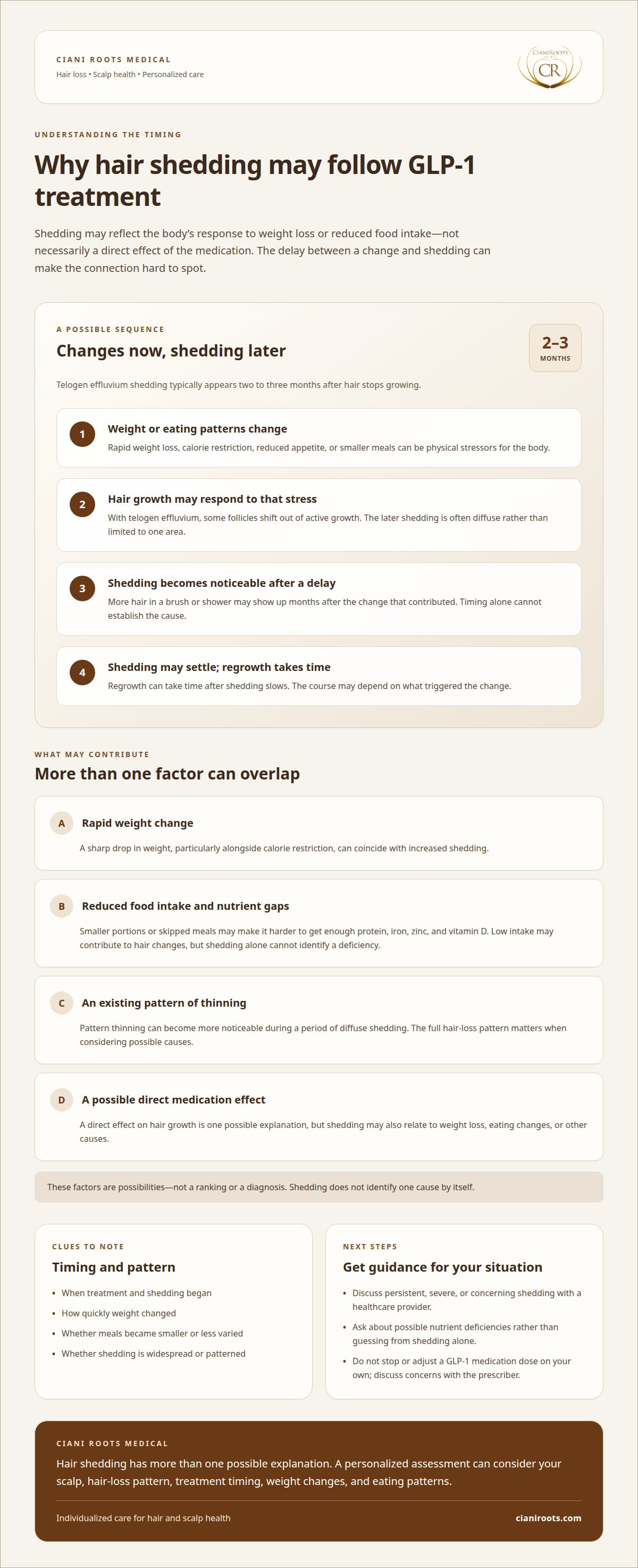
Hair loss during GLP-1 treatment may be less about the medication itself and more about the body responding to weight loss or reduced food intake. This kind of shedding, called telogen effluvium, often begins a few months after a change and is usually temporary.
Seeing more hair in your brush or shower can feel unsettling, especially when you’re working toward better health. GLP-1 hair loss doesn’t necessarily mean your hair follicles are permanently damaged, but changes in appetite and nutrition may affect the support they receive.
This article explains what may contribute to shedding, how regrowth can unfold, and what people taking GLP-1 medications report. You’ll also learn why shedding may take months to settle, what signs deserve medical attention, and how a closer look at your scalp and overall hair-loss pattern can help guide next steps.
Key Takeaways
- Shedding during GLP-1 treatment may relate to weight loss and the body’s response to change, rather than the medication alone.
- Reduced appetite can make it harder to get enough protein and key nutrients that support healthy hair.
- Notice when shedding began and whether it is diffuse or patterned; these clues can help distinguish temporary shedding from other causes.
- Regrowth can take time after shedding slows, and the timeline may depend on what triggered the change.
- If shedding is persistent or concerning, a professional assessment can help identify possible causes and guide appropriate next steps.
Is the GLP-1 Causing My Hair Loss?
Hair shedding during GLP-1 treatment may follow rapid weight loss or reduced food intake, rather than medication alone. Timing and the pattern of shedding help clarify what may be contributing.
Weight Loss Speed and Hair Shedding
Rapid weight loss can place stress on the body, and hair growth may respond to that change. A sharp drop in weight, especially alongside calorie restriction, can coincide with increased shedding.
Is GLP-1-related hair loss caused by rapid weight loss or nutritional deficiencies? Either may contribute: rapid weight change can act as a physical stressor, while reduced intake can leave the body short of nutrients hair follicles need. These factors may overlap, so shedding doesn’t identify one cause by itself.
For people prone to thinning, gradual weight loss may reduce the stress associated with rapid change. Avoiding severe calorie restriction and eating nourishing meals can support overall health, but neither guarantees that shedding will be prevented. The amount and pace of weight loss, appetite changes, and existing hair thinning all matter.
Telogen Effluvium After Rapid Weight Loss
Telogen effluvium is temporary, diffuse shedding that can follow a physical stressor, including substantial weight loss. Hair follicles shift out of active growth, and affected hairs shed later rather than immediately.
With telogen effluvium, hair typically sheds two to three months after it stops growing. That delay can make the connection to recent weight loss or eating less easy to miss. Shedding may appear widespread, with more hair collecting in a brush or shower, rather than limited thinning in one area.
Hair shedding associated with GLP-1 use or substantial weight loss is often noticed a few months after starting treatment or losing weight. Existing pattern thinning can also become more noticeable during this period. If shedding is persistent, severe, or accompanied by other changes, a healthcare provider can assess possible causes, including nutritional deficiencies.
Hair Loss Timing and Medication Decisions
Hair loss may begin a few months after starting a GLP-1 medication, as delayed shedding follows changes in weight or food intake. The timing alone can’t establish that the medication directly caused it.
Should you stop or change your GLP-1 medication because of hair loss? Don’t stop or adjust the dose on your own. Discuss the shedding and its timing with the prescribing healthcare provider, who can consider weight changes, eating patterns, other possible causes, and the medication plan.
A lower dose or slower weight loss may reduce hair-loss risk for some people, but dose changes require individualized medical guidance. A useful discussion covers when treatment began, when shedding started, how quickly weight changed, and whether meals became smaller or less varied. These details can help distinguish a temporary response from another hair-loss pattern and guide next steps.
Possible effects of reduced food intake on hair nutrients
Reduced appetite during GLP-1 treatment can shrink meal portions and limit protein, iron, zinc, and vitamin D. Hair follicles need these nutrients to stay healthy, so consistently low intake may contribute to shedding. The effect depends on what a person eats, not simply on taking smaller meals.
Foods someone once ate regularly may become less appealing. For example, a person who skips breakfast and eats only a small evening meal may struggle to get enough protein and varied nutrients. This pattern deserves attention, especially when increased shedding coincides with a major change in appetite.
How nutrient intake relates to hair health
Protein provides building blocks for hair, while iron, zinc, and vitamin D support follicle health. Low intake of these nutrients can contribute to hair changes, but shedding alone cannot identify a deficiency. Other causes may also be involved, so the full health and hair-loss picture matters.
Eating enough protein and including foods that provide iron, zinc, and biotin can support hair health, but these steps don’t guarantee that shedding will stop or prevent hair loss. Supplements aren’t interchangeable: more of one nutrient won’t address every possible gap, and a supplement plan should reflect individual needs.
Protein and nutrient checks
A practical first step is to describe recent appetite and eating changes to a healthcare provider. Mention skipped meals, smaller portions, or difficulty eating protein-rich foods. A provider can assess possible nutrient deficiencies and may connect patients with a nutrition specialist or registered dietitian.
That assessment can help distinguish a possible nutrient gap from other contributors. Rather than guessing from shedding alone, discuss diet, treatment timing, weight changes, and other symptoms. A nutrition specialist can help create a realistic eating plan that accounts for reduced appetite and individual needs.
If you are considering a multivitamin or other supplement during GLP-1 treatment, discuss it with a healthcare provider. A multivitamin doesn’t replace adequate meals or establish that a deficiency caused shedding. A provider can help determine whether a supplement fits your health needs, particularly before adding supplements or changing an existing routine.
Persistent or extreme shedding, concern about other causes, or questions about nutrient deficiencies are reasons to seek medical guidance. A discussion of food intake and possible deficiencies can clarify what support may be appropriate. For hair changes that continue despite attention to nutrition, a personalized hair-loss assessment can help evaluate the broader pattern.
Possible direct effects of GLP-1 drugs on hair growth
GLP-1 drugs may directly affect hair and trigger follicles to stop growing, but this is only one possible explanation for shedding. A direct drug effect differs from hair changes that follow rapid weight loss or reduced food intake. Separating these possibilities matters because the same timing can have more than one explanation.
Hair changes reported during treatment don’t, by themselves, show that a medication acted directly on the follicle. For example, someone taking a GLP-1 medication may also be eating less or losing weight quickly. Those changes can occur together, making it difficult to identify one cause from timing alone. A clinician considers the treatment timeline alongside nutrition, weight changes, and the hair-loss pattern.
The FDA does not list hair loss as an official side effect of GLP-1 medications. That fact doesn’t rule out a possible direct effect in some people; it puts an individual report in context. A person’s experience still deserves attention, particularly if shedding is persistent, pronounced, or accompanied by other changes in health.
Notice how the hair is changing, not only how much comes out. Diffuse shedding across the scalp differs from gradual thinning in a patterned area. A widening part or reduced density near the temples, for example, may suggest a different pattern from an overall increase in loose hairs. These observations can guide an assessment, but they don’t establish the cause.
A useful next step is to make a simple timeline. Note when GLP-1 treatment began, when hair changes appeared, and whether appetite, food intake, or weight changed around the same time. Include any recent illness, major stress, or other medication changes. This record gives a healthcare provider concrete details to consider instead of relying on the assumption that the drug caused the shedding.
If hair loss continues, a medical evaluation can assess whether the pattern fits a temporary shedding response or another form of hair loss. The clinician may also review nutrition and other health factors before recommending a plan. Don’t stop or change a prescribed GLP-1 medication without discussing the decision with its prescriber. Identifying the likely contributors is more useful than treating every case as a direct medication reaction.
Expected hair regrowth
Weight-loss-related telogen effluvium is usually temporary, but visible recovery takes time. After shedding slows, hair may need several months to regain its usual fullness. Many people notice a fuller appearance within about six months to a year. These are broad expectations, not a precise schedule for everyone.
GLP1-related hair loss may ease as the body adjusts to a new weight and eating habits, or after GLP-1 medication is stopped. That doesn’t mean stopping treatment is necessary or appropriate. Medication decisions belong in a conversation with the prescribing healthcare provider, who can consider the reason for treatment and changes in weight, appetite, and hair.
New growth and restored fullness are different milestones. Short, fine hairs along a part or hairline can indicate regrowth, while overall density may take longer to look familiar. Loose hairs may continue during this transition. Visible change depends partly on how much shedding occurred and whether another hair-loss pattern is also present.
Recovery can also vary with the trigger. If reduced food intake and substantial weight change contributed, returning to more consistent nourishment and a stable weight may support the body’s adjustment. If GLP1-related hair loss continues despite those changes, or thinning is concentrated in a patterned area, other causes may need consideration. A timeline helps: record when shedding slowed and note changes in coverage over time.
Compare the same areas under similar conditions instead of relying on a single day’s hair count. For example, take a monthly photo of your part in consistent lighting and note whether more or less of the scalp is visible. This can make gradual change easier to recognize than checking the brush or shower drain each day. Photos track appearance, but don’t diagnose the cause.
Persistent or extreme shedding, or thinning that continues to progress, deserves medical attention. A healthcare provider can review medications, nutrition, weight changes, and other possible contributors. If another hair-loss condition is present alongside telogen effluvium, its course may not match the typical six-month-to-a-year fullness timeline. Identifying the difference helps set realistic expectations for regrowth.
Patience matters, but so does reassessment. If shedding has eased yet density remains reduced, or new thinning appears, share that change with a healthcare professional. They can evaluate whether recovery is progressing and whether another factor needs attention. Don’t alter a GLP-1 dose solely to accelerate hair regrowth without discussing the decision with the prescriber.
Hair loss rates reported by GLP-1 users
Reported rates vary because studies examine different populations, medications, and comparison groups. A Penn Medicine analysis of people with type 2 diabetes found GLP-1 users were 37 percent more likely to report hair loss than SGLT2i users, and 68 percent more likely than DPP4i users.
Those percentages describe relative differences between groups, not the share of every GLP-1 user who will lose hair. The analysis compared electronic health records from more than 27,000 patients against SGLT2i users, and more than 23,000 against DPP4i users. Researchers examined adults with type 2 diabetes seen between January 2019 and September 2024, with follow-up of up to five years.
The comparison matters because people taking different diabetes medications may differ in health history and other factors. Electronic health records also depend on hair loss being reported or documented during care. The findings indicate an association in this patient population; they don’t establish that GLP-1 medications directly caused each reported case or predict an individual’s risk.
Other findings look at different outcomes. A study led by Lynn Petukhova found men taking GLP-1 drugs were 7 percent more likely to experience pattern hair loss than men not taking them. Pattern hair loss differs from diffuse shedding, so this result shouldn’t be treated as the rate of every kind of hair change.
Reports also vary by medication and dose. That observation doesn’t show that dose alone explains shedding. Weight change, eating patterns, existing thinning, and other health factors can influence each person’s experience.
When interpreting any rate, check what outcome was counted. A report of hair loss may reflect patient descriptions, a clinician’s record, or a specific pattern; those measures aren’t automatically equivalent. Study populations matter too. Results among adults with type 2 diabetes may not translate directly to people taking these medications for weight loss.
Use the figures as context, not as a forecast. If you notice changes, note when they began, whether thinning is diffuse or patterned, and any changes in weight or eating. That information gives a healthcare provider a more useful starting point than a group statistic. EXPLORE YOUR OPTIONS.
Ciani Roots Medical
In Vacaville and Alamo, Ciani Roots Medical can assess ongoing shedding and distinguish temporary changes from other hair-loss patterns. Scalp analysis and a review of your treatment timeline, weight changes, and eating patterns can inform personalized next steps.
Care may include medical hair-loss management and medication support when appropriate. For patients considering regenerative options, Ciani Roots Medical also offers CR Signature regenerative hair-loss treatments and personalized Acorn Secretome therapy, created from the patient’s own stored cells or biology. Treatment planning is individualized after consultation and scalp analysis.
If shedding persists or you’re unsure what to do next, contact Ciani Roots Medical to discuss your concerns.
Choose a thoughtful next step for your hair
If hair changes during GLP-1 treatment are affecting your confidence, you deserve a plan based on your hair and health history, not a one-size-fits-all assumption. Consider what you most need clarity on: whether shedding is continuing, whether density is changing, or how to discuss medication concerns with your prescriber. Bringing that priority into a professional conversation can make the next step more focused.
Ciani Roots Medical can help assess your scalp and discuss personalized hair-restoration options. A consultation can help connect your concerns with an appropriate path forward, including whether regenerative hair care may be relevant to your goals. Any decisions about GLP-1 medication should remain part of a conversation with the clinician managing that treatment.
When you’re ready to explore a plan tailored to your concerns, EXPLORE YOUR OPTIONS. A calm, informed next step can help you move forward with greater confidence.
Frequently Asked Questions
How can GLP-1 drugs affect my skin, hair, and nails?
GLP-1 medicines can reduce appetite, which may change how much and what a person eats. If food intake drops, it can become harder to get enough protein, iron, zinc, and vitamin D, nutrients that support healthy hair. Hair shedding has been reported during treatment. Skin or nail changes should be considered in the context of weight change, nutrition, and other health factors, rather than automatically attributed to the medication.
What skin, hair, and nail risks should I know about when taking a GLP-1?
Hair shedding and reduced nutrient intake are relevant concerns during treatment, particularly when appetite changes make meals smaller or less varied. A restricted diet may make it harder to meet nutrient needs that support hair health. If you notice persistent shedding or changes in your skin or nails, record when they began and what changed in your eating or weight, then share those details with a healthcare provider.
Why should GLP-1 drug patients partner with a dermatologist?
A dermatologist can assess whether thinning is diffuse, patterned, or linked to another scalp or hair condition. That distinction matters because shedding during weight change can occur alongside pre-existing thinning. If you already have hair loss, discussing it before starting treatment can help establish a baseline. Keep the prescribing clinician informed, too, so hair concerns and medication decisions are considered together.
Will GLP-1 drugs make me look older?
Not necessarily. Weight loss can change facial fullness and how someone perceives their appearance, but that alone doesn’t show that a medication has aged the skin. Skin concerns can have several contributors, including weight changes and individual skin characteristics. If you notice new or persistent changes, describe them to a healthcare professional rather than assuming they are a direct medication effect.
Can GLP-1 medications like Ozempic, Wegovy, or Zepbound cause hair loss?
Hair shedding has been reported by people taking GLP-1 medications, including semaglutide or tirzepatide. The FDA does not list hair loss as an official side effect of GLP-1 medications. Shedding may relate to weight loss or reduced food intake rather than a direct drug effect, and the timing alone can’t identify the cause. Discuss new hair changes with your healthcare provider.
How common is hair loss with semaglutide or tirzepatide in clinical trials?
A user-reported survey found that 20% of people taking GLP-1 medications experienced hair shedding, but that is not a clinical-trial rate. Penn Medicine analyses compared reported hair loss among adults with type 2 diabetes using different medication groups; they measured relative differences, not the percentage of all semaglutide or tirzepatide users who shed hair. Those findings shouldn’t be treated as an individual prediction.
Why might people experience hair loss while taking GLP-1 medications?
Reduced appetite can mean getting less protein, iron, zinc, or vitamin D from food, while substantial weight loss can act as a physical stressor. Either may contribute to shedding, and both can occur during treatment. Hair changes can also have other causes, including an existing thinning pattern. A timeline of treatment, weight changes, eating habits, and shedding can help a healthcare provider assess the situation.
Is hair loss from GLP-1 medications temporary, and when does hair typically grow back?
Weight-loss-related telogen effluvium is usually temporary, but visible fullness may take time to return. Many people notice fuller-looking hair within about six months to a year after shedding begins to settle. The course depends on the trigger and whether another hair-loss condition is present. If shedding continues or thinning progresses, a healthcare provider can assess whether further evaluation is needed.
Article by
Adriane McDonald BSN,RN
Adriane McDonald, BSN, RN, is a hair restoration specialist with nearly 40 years of experience working with men and women experiencing hair loss and thinning. As the Founder and Practice Director of Ciani Roots Medical, she works alongside the practice’s Medical Director to provide personalized hair restoration, scalp health, regenerative therapies, and advanced skin rejuvenation.
Her approach combines extensive hands-on experience with detailed scalp analysis, medical collaboration, and individualized treatment planning. Adriane is currently completing advanced training toward certification in trichology, further expanding her expertise in hair and scalp health.
Disclaimer
This content is provided for general educational and informational purposes only and is not intended to serve as medical advice, diagnosis, or treatment. Individual needs, treatment recommendations, and results vary. A consultation and appropriate evaluation are necessary to determine which treatment options may be suitable for you. Viewing or interacting with this content does not establish a healthcare professional-patient relationship with Ciani Roots Medical.
Individual results may vary, and no specific outcome can be guaranteed. Before-and-after images, testimonials, or treatment experiences represent individual results and should not be considered a guarantee of similar results.


