

What if a widening part is more than a change in how your hair falls? Female pattern baldness commonly causes gradual thinning over the top and crown of the scalp, often making the center part look wider. Noticing this can feel unsettling, but understanding the pattern is a useful first step toward informed choices.
Hair thinning doesn’t always have the same cause, and similar-looking changes may call for different care. Female pattern hair loss is linked to changes in the hair growth cycle, while hormonal shifts, nutritional deficiencies, medications, and other factors can also contribute to shedding.
This article explains how the hair growth cycle works, what signs and possible causes to look for, and how clinicians distinguish pattern hair loss from other conditions. You’ll also learn about treatment approaches, when a medical evaluation may help, and how hair changes can affect emotional well-being. The aim is to clarify your options and the questions that can guide a thoughtful next step.
Key Takeaways
- Learn how gradual thinning at the crown or a widening part can differ from other patterns of hair loss.
- Understand how hormones, family history, health conditions, and medications may contribute to changes in hair density.
- See how the hair growth cycle can help explain everyday shedding and why persistent changes may deserve attention.
- Explore treatment approaches and why identifying the cause matters before choosing a plan.
- Recognize that hair loss can affect emotional well-being, and that support and personalized care can be part of addressing it.
What is female pattern baldness?
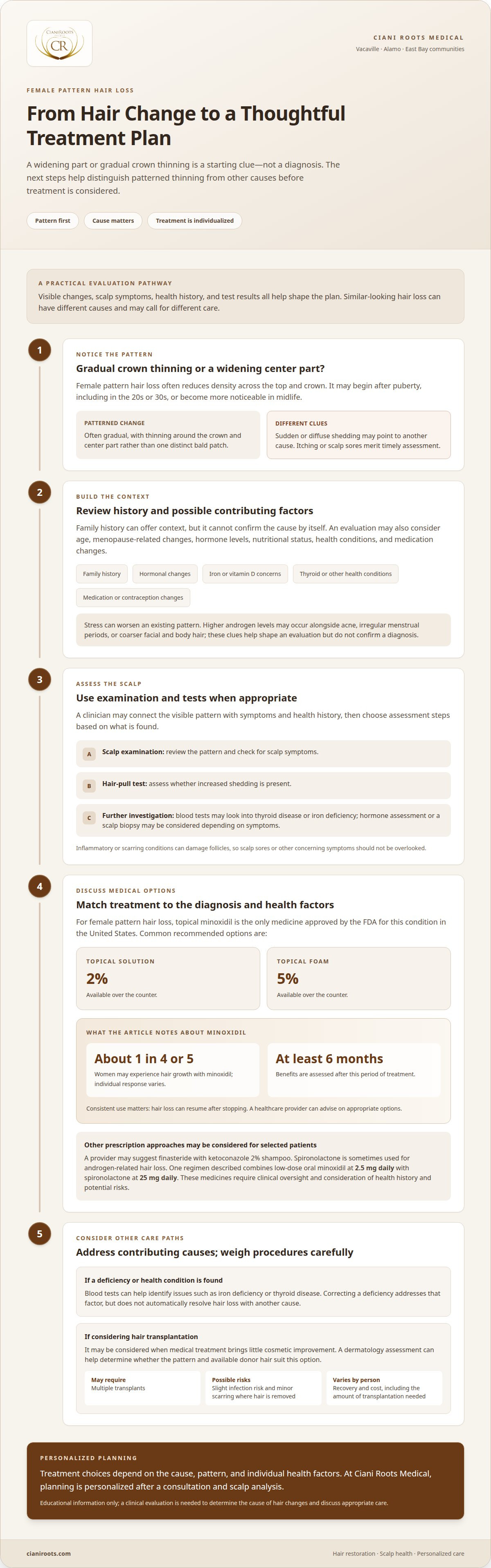
This inherited and hormone-influenced condition gradually reduces hair density, often across the top and crown. A widening center part can be an early visible change. It can begin after puberty, including in the 20s or 30s, or become more noticeable in midlife.
Female pattern hair loss is also called androgenetic alopecia. Because other conditions can look similar, recognizing the pattern is a starting point, not a diagnosis.
Genetic influences
Genetic influence means inherited traits can make hair follicles more susceptible to gradual thinning. A family history of female pattern baldness can provide context, though relatives may experience different degrees of hair change. Thinning often affects the crown and center part rather than forming one distinct bald patch. Family history can help guide an evaluation, but it cannot confirm the cause by itself.
Possible causes and risk factors
Possible risk factors include age, family history, higher androgen levels, declining estrogen, and low vitamin D or ferritin. Menopause may coincide with changes in hair density as estrogen levels fall. Stress can worsen an existing pattern, while changes in hormonal contraception may trigger shedding for some women. Considering these factors together can help distinguish patterned thinning from other causes.
Androgens are hormones that can influence scalp hair and other features. When androgen levels are elevated, thinning may occur alongside acne, irregular menstrual periods, or coarser facial and body hair. These symptoms help shape an evaluation but don’t confirm a diagnosis. This pattern is not usually a sign of an underlying medical disorder.
Other possible causes of hair loss in women include autoimmune disorders, nutritional deficiencies, medications, and hormonal changes. Iron deficiency and thyroid disease are examples clinicians may consider. Starting, changing, or stopping hormonal contraception may trigger shedding for some women, though different formulations can have different hormonal effects.
Timing and scalp symptoms can provide additional clues. Gradual thinning over the crown may fit a patterned change, while sudden or diffuse shedding may point to another cause. Itching and scalp sores are generally absent in female pattern baldness. Inflammatory or scarring conditions can damage follicles, so these symptoms merit timely assessment.
Evaluation may begin with a scalp examination and a review of the hair-loss pattern. A hair-pull test can assess shedding, and blood tests may investigate thyroid disease or iron deficiency. Depending on symptoms, clinicians may assess hormone levels or use a scalp biopsy to investigate skin disorders.
These distinctions matter because pattern hair loss, excessive shedding, autoimmune conditions, and scarring alopecias can look alike but require different approaches. A thorough assessment connects the visible pattern with family history, menopause, medication changes, and symptoms before treatment decisions are made.
Medications and other treatments
Treatment depends on the cause, pattern, and health factors involved. Accurate diagnosis helps distinguish patterned thinning from shedding that needs another approach.
Hair transplantation may be considered when medical treatment brings little cosmetic improvement. It carries a slight risk of skin infection and minor scarring where hair is removed, and may require multiple transplants. Recovery varies with the procedure and individual healing rather than following one fixed timetable. Costs depend partly on the amount of transplantation needed.
Minoxidil and prescription medications
Minoxidil is a topical medicine used to support hair growth in women with pattern loss. In the United States, it is the only medicine approved by the FDA for this condition. Common recommended options are a 2% solution or 5% foam, and topical minoxidil is available over the counter. A healthcare provider can advise on appropriate treatment options. Consistent use matters because hair loss can resume after stopping.
Minoxidil may help hair grow in about 1 in 4 or 5 women. Benefits are assessed after at least six months of treatment. Prescription options may also be considered for selected patients. A healthcare provider may suggest finasteride with ketoconazole 2% shampoo; medication choices depend on diagnosis and individual health considerations.
Other medicines and therapies
Other medicines and therapies address different pathways or support a broader treatment plan. Spironolactone is a prescription medicine sometimes used for androgen-related hair loss. A regimen described for women combines low-dose oral minoxidil at 2.5 mg daily with spironolactone at 25 mg daily. These medicines require clinical oversight, including consideration of health history and potential risks.
Hair transplantation moves follicles from one area of the scalp to thinning areas. It may be considered when medical treatment hasn’t produced meaningful cosmetic improvement. The number of transplants needed affects both the scope of the procedure and its cost. A dermatology assessment can help determine whether the hair-loss pattern and available donor hair suit this option.
Nutritional deficiencies and medication
Nutritional deficiencies and medication effects can cause or contribute to hair loss in women. Iron deficiency is one possible factor, while thyroid disease and other health conditions may also need evaluation. Blood tests can help identify issues that require treatment. Correcting a deficiency addresses that factor, but doesn’t automatically resolve hair loss with another cause.
Reviewing medications is another useful assessment step. Starting, changing, or stopping hormonal contraception may trigger shedding for some women. Don’t change prescribed medication without discussing it with the prescriber. A careful history can help connect changes in shedding with medication timing and other health events.
Female pattern hair loss can’t be reliably prevented, but treatment may help slow its progression. Gentle hair care can reduce avoidable strain: limit tight hairstyles, handle wet hair carefully, and avoid harsh brushing. These steps support hair care but don’t replace diagnosis or treatment.
If persistent thinning or medication questions leave you uncertain, a personalized hair-loss assessment can help clarify appropriate next steps.
What is the normal hair growth cycle?
Scalp hair grows in repeating phases, so shedding some hairs each day is expected. A typical scalp has about 100,000 hair follicles, and each follicle cycles independently. This staggered timing means most hairs keep growing while others rest and shed. A single hair in a brush cannot show whether the overall cycle has changed.
The cycle has three main phases. During anagen, the active growth phase, a hair may grow for 2-8 years. About 85%-90% of scalp hairs are in this phase. Catagen is a brief transition lasting about 2 weeks, when 1%-3% of follicles shrink. Telogen is the resting phase, lasting two to three months; about 9% of scalp hairs are in it.
As telogen ends, a resting hair sheds and a new hair can begin growing from that follicle. Losing 50-100 hairs a day is normal. The count can appear higher on wash days because loose strands collect between washes. What matters more is a lasting change in density, part width, or the amount shed over time.
Consistently shedding more than 100 strands can be a warning sign, while a consistent loss of 150 hairs or more per day is considered significant. These figures are guides, not a diagnosis. A widening center part, a thinner ponytail, or gradual crown thinning may signal a pattern change even without dramatic shedding. Tracking those visible changes can add context to an assessment.
In female pattern hair loss, follicles progressively produce finer hairs, so scalp coverage decreases gradually. Scalp hairs commonly grow in tufts of 3-4, and androgenetic alopecia can reduce the number of hairs in each tuft. The result may be diffuse thinning over the crown rather than one clearly defined bald patch. Unlike male pattern loss, it usually doesn’t progress to total or near-total baldness.
Changes may also occur in phases: hair loss can accelerate for 3-6 months, followed by stable periods lasting 6-18 months. A separate process, telogen effluvium, can follow physical or emotional stress, often beginning about 3 months afterward. After this type of shedding, hair may slowly return toward normal after about 6 months. The timing helps distinguish shedding from gradual pattern loss.
Scalp symptoms offer another clue. Itching and sores are generally absent with female pattern hair loss. Inflammatory or scarring alopecias can damage follicles permanently, making early diagnosis important. A clinician may examine the scalp and hair pattern for signs that point beyond routine shedding. Blood tests or a scalp skin biopsy may help investigate underlying conditions when indicated.
Emotional and psychological effects
Changes in hair density can affect how a person feels about their appearance and identity. A widening part, visible scalp, or altered hairline may draw attention during ordinary routines, such as styling hair or taking photographs. These experiences differ from person to person. Hair loss is a physical condition, but its effects can reach beyond the scalp.
Some women describe self-consciousness, frustration, sadness, or anxiety as thinning progresses. A social event, bright overhead lighting, or a familiar hairstyle that no longer feels comfortable can make the change more noticeable. These reactions aren’t evidence of vanity or weakness. They reflect the personal meaning hair can carry in daily life, relationships, and self-expression.
Uncertainty itself can be difficult. If shedding begins after a medication change or hormonal shift, it can be hard to know whether the change is temporary. Telogen effluvium and androgenetic alopecia have different patterns and outlooks. Clinical assessment can help clarify the suspected cause, replace guesswork with better information, and frame realistic next steps.
Prognosis depends on the underlying condition. Pattern hair loss often develops gradually and usually doesn’t progress to total or near-total baldness. Even so, it can feel significant if the crown becomes more visible or the center part widens. By contrast, shedding linked to telogen effluvium can follow a trigger and change over time. A clinical explanation can help distinguish these patterns without treating every shed hair as a sign of worsening loss.
A focused appointment can address both the scalp and your questions. Useful topics include when thinning began, whether the hairline or crown has changed, and how the change affects daily activities. A clinician can assess the scalp, review the pattern, and discuss whether further evaluation is appropriate. Bringing a short timeline of visible changes can make the conversation more specific.
Emotional support can complement medical care. Talking with a trusted person, counselor, or clinician may help when worry affects sleep, social plans, or confidence. Practical choices can also ease daily stress: choose a hairstyle that feels comfortable, plan for lighting at important events, or limit repeated mirror checks. These steps don’t diagnose or treat the cause, but they may make routines more manageable.
Hair changes deserve attention when they affect well-being, even if scalp symptoms seem mild. If distress persists or interferes with work, relationships, or usual activities, mention that impact during a clinical visit. Naming the emotional burden helps make care more complete. Understanding the condition, its expected course, and available options can support decisions at a manageable pace.
Definition and prevalence of female-pattern baldness
Androgenetic alopecia is the most common type of hair loss in women. It gradually reduces hair density, often across the crown and center part, rather than creating the receding hairline commonly associated with male pattern baldness. Follicles remain present, but affected hairs may become finer over time.
Its prevalence is substantial across the United States. Approximately 30 million women have this condition, and it affects about one-third of women during their lives. These estimates describe different aspects of the issue: the number affected and the likelihood of experiencing hair changes over a lifetime.
Age offers another way to understand how often visible changes occur. Around 40% of women show signs of hair loss by age 50. Fewer than 45% reach age 80 with a full head of hair. These figures describe hair changes broadly, not a diagnosis for any individual woman.
Menopause is another important life stage. After menopause, about two-thirds of women have thinning hair or total hair loss. That figure includes different degrees and causes of hair change, so it doesn’t mean every case is androgenetic alopecia. Each person’s symptoms and pattern still need individual assessment.
Classification scales describe visible changes in crown density. The Ludwig Scale groups female pattern hair loss into three degrees, from less visible thinning to more extensive crown involvement. The Savin illustrations show eight degrees of crown hair density. Both systems describe appearance, not the underlying cause.
That distinction matters. A scale can help communicate whether the part is widening or crown coverage has changed, but it cannot distinguish pattern loss from excessive shedding, autoimmune disease, or scarring alopecia. These conditions may look similar while requiring different approaches. An examination considers distribution, timing, scalp appearance, and other symptoms.
Hair shedding also differs from gradual density loss. A sudden increase in loose hairs may have another explanation, while progressively finer hairs and a widening part can fit a patterned change. Women can experience both processes at once. Identifying whether the main change is shedding, thinning, or both provides a clearer starting point for clinical discussion.
For readers weighing visible changes against population figures, an individualized review offers more useful context than a statistic alone.
Ciani Roots Medical
Ciani Roots Medical helps women explore hair thinning through personalized assessment and treatment planning in Vacaville and Alamo. A consultation and scalp analysis can help clarify the pattern of change and guide discussion of appropriate next steps. Depending on individual needs, options may include regenerative hair loss treatments or KeraLase HAIR Therapy with LaseMD Ultra and KeraFactor.
For those considering regenerative care, Ciani Roots Medical offers a personalized regenerative product created from the patient’s own stored cells or biology. Treatment choices are tailored to individual needs rather than applied as a standard plan. This may be worth discussing when changes in density, shedding, or scalp appearance raise questions about suitable approaches.
To discuss your hair concerns and possible next steps, contact Ciani Roots Medical.
Take the Next Step With Clarity
Noticing a change in your hair can raise questions about what it means and what to do next. You don’t have to make every decision at once. Start by noting what has changed and what you most want help understanding. That can make a conversation about female pattern baldness more focused and useful.
Because hair-loss patterns and treatment responses vary, care should begin with an individualized assessment. Ciani Roots Medical can help you discuss your concerns and consider an approach suited to your needs, including regenerative care where appropriate. The aim is to support informed decisions, not rush you toward a particular treatment.
When you’re ready, EXPLORE YOUR OPTIONS and take a thoughtful next step toward understanding your hair health. You deserve care that treats your questions with attention and respect.
Frequently Asked Questions
What Causes Hair Loss in Women?
Hair loss in women can have several causes, including inherited follicle sensitivity, hormonal shifts, nutritional deficiencies, medications, and autoimmune conditions. For example, gradual thinning around the crown may have a different explanation from sudden shedding after an illness or medication change. Menopause, thyroid disease, and iron deficiency may also be relevant. Because causes can overlap, the pattern, timing, symptoms, and health history all help guide evaluation.
Do supplements help with hair loss?
Supplements may be useful when an evaluation identifies a nutritional deficiency, but they aren’t a universal treatment for thinning. Iron, vitamin D, or ferritin levels may be considered in some assessments. Taking supplements without knowing whether a deficiency exists may not address the cause of hair changes. A clinician can help determine whether testing or dietary changes are appropriate before you add supplements to your routine.
How do you tell the difference between hair shedding and hair loss?
Shedding describes hairs falling out, while hair loss can also mean that overall density is decreasing. Notice whether the change is mainly loose strands on clothing or a gradual shift in coverage, such as more scalp showing in photographs. Both can happen together. A clinician can compare the distribution of thinning with its reported timing and examine the scalp to clarify the pattern.
How long does it take for FPHL to progress?
There isn’t one timeline that applies to everyone. Pattern hair changes may progress gradually, with periods when thinning seems more noticeable and other stretches when it appears stable. The pace can depend on the underlying cause and individual factors. Dated photographs taken under similar lighting can help show changes over time and give a clinician a clearer picture than day-to-day checking.
Should I have any hormone tests done?
Hormone testing may be considered when the hair pattern and other symptoms suggest a hormonal contributor. For example, thinning alongside irregular periods, acne, or increased facial hair can help shape the clinical questions. Evaluation may include sex hormone levels and thyroid function. Testing is selected according to individual symptoms and health history, rather than automatically required for everyone noticing hair changes.
When should I see a healthcare provider?
Arrange an evaluation if hair loss continues, changes quickly, or comes with itching, scalp irritation, sores, or other symptoms. A sudden change after a new medication or hormonal shift is also worth discussing. Early assessment can help distinguish routine shedding from conditions that need different care. Bring a simple timeline of when changes began and any related health or medication changes.
What are the early signs and stages of female pattern hair loss?
Early signs can include a widening center part, less volume at the crown, or a ponytail that feels thinner than before. Changes may be subtle at first and easier to notice in consistent photographs. Clinicians may describe visible extent using the Ludwig Scale, which has three broad degrees. The scale describes appearance, not cause, so it doesn’t replace assessment.
How is female pattern baldness diagnosed, and what other conditions can cause hair loss in women?
Diagnosis usually draws on scalp appearance, the distribution of thinning, symptom timing, and health history. A hair-pull test, blood work, or scalp biopsy may help investigate specific concerns. Conditions that can resemble patterned thinning include excessive shedding, autoimmune disorders, nutritional deficiencies, and inflammatory or scarring scalp conditions. Distinguishing them matters because similar-looking changes may call for different treatment approaches.

Article by
Adriane McDonald BSN,RN
Adriane McDonald, BSN, RN, is a hair restoration specialist with nearly 40 years of experience working with men and women experiencing hair loss and thinning. As the Founder and Practice Director of Ciani Roots Medical, she works alongside the practice’s Medical Director to provide personalized hair restoration, scalp health, regenerative therapies, and advanced skin rejuvenation.
Her approach combines extensive hands-on experience with detailed scalp analysis, medical collaboration, and individualized treatment planning. Adriane is currently completing advanced training toward certification in trichology, further expanding her expertise in hair and scalp health.
Disclaimer
This content is provided for general educational and informational purposes only and is not intended to serve as medical advice, diagnosis, or treatment. Individual needs, treatment recommendations, and results vary. A consultation and appropriate evaluation are necessary to determine which treatment options may be suitable for you. Viewing or interacting with this content does not establish a healthcare professional-patient relationship with Ciani Roots Medical.
Individual results may vary, and no specific outcome can be guaranteed. Before-and-after images, testimonials, or treatment experiences represent individual results and should not be considered a guarantee of similar results.


