

If thinning or shedding continues despite regular use, it’s understandable to wonder what to do when minoxidil stops working, and whether you should stop, adjust your routine, or consider another approach. A perceived plateau doesn’t always mean the treatment has lost its effect. Ongoing pattern hair loss, inconsistent application, or another cause of shedding may all affect what you’re seeing.
Before making a change, review how long you’ve used minoxidil, how consistently you apply it, and when you noticed a shift. A clinical assessment can put those details in context and help distinguish a change in response from progression or another type of hair loss. At Ciani Roots Medical, detailed scalp analysis informs a personalized discussion, but it isn’t a diagnosis on its own.
This guide covers why minoxidil may seem less effective, what information to bring to a consultation, and which medically supervised options may be considered. Depending on your needs, those could include medication management, Bio-Enhanced PRP, or KeraLase® with LASEmd® Ultra and KeraFactor MD. The goal is a thoughtful next step, not a promise of regrowth.
Key Takeaways
- A perceived plateau, renewed shedding, and a new pattern of thinning can point to different concerns. Note what has changed before drawing conclusions.
- To assess what to do when minoxidil stops working, gather your product details, start date, application routine, progress photos, and relevant health changes.
- Reviewing your routine and the possible cause of hair loss can help guide a clinical discussion about next steps.
- Options may include continued management, a medication review, or a discussion of regenerative treatments, depending on your individual assessment.
- A detailed scalp analysis can inform a personalized treatment plan, but it isn’t a diagnosis by itself or a promise of regrowth.
When Does It Mean Minoxidil Has Stopped Working?
Noticing little change after starting minoxidil, or seeing renewed shedding after a period of stability, can feel discouraging. But a change in how your hair looks doesn’t automatically mean the treatment has stopped helping. Hair can change for different reasons, and the pattern and timing matter. Before deciding what to do when minoxidil stops working, distinguish a perceived plateau from continued thinning, increased shedding, or a new pattern of hair loss.
Plateau, ongoing thinning, or renewed shedding?
A plateau means you aren’t seeing further visible improvement. That can be disappointing, especially if you expected more regrowth, but maintaining a result may look different from seeing obvious new growth. A plateau alone doesn’t establish whether minoxidil is still having an effect.
Continued thinning describes a gradual change in density or coverage over time. Shedding means noticing more hairs coming out than usual. These aren’t interchangeable: increased shedding alone doesn’t show whether overall density has changed. A new pattern, such as loss appearing in a different area or shape, can also raise questions about whether the original explanation still fits.
Rather than relying on day-to-day impressions, compare photos taken at consistent intervals, from similar angles and in similar lighting, with the same hair part and styling. This makes gradual changes easier to discuss. Follow the product label and clinical guidance for use and expectations; don’t assume a particular response timeline applies to everyone.
Why one observation cannot confirm treatment failure
Hair changes can have more than one contributing factor. The timing of shedding, the distribution of thinning, changes in your routine, and your broader health context all help a clinician interpret what you’re seeing. Missed or altered applications can also make it harder to assess the treatment’s effect. If you’re unsure about application, refer to your product’s instructions rather than guessing.
Minoxidil is understood to influence hair growth through effects on follicles, but it doesn’t address every cause of hair loss. For background on its proposed effects and uses, see Minoxidil's Mechanism of Action. A clinician can consider whether your current pattern fits the concern being treated or whether other factors warrant assessment.
A perceived plateau is a reason to review the pattern and context, not proof by itself that minoxidil has failed. A photo showing gradual thinning over time may call for a different discussion than a brief period of increased shedding or a newly affected area. If the change is persistent, sudden, or concerning, seek clinical guidance before stopping or changing your routine. An assessment can help put your observations in context and inform what to consider next.
Why Might Minoxidil Seem Less Effective Over Time?
A change in your hair doesn’t always mean minoxidil itself has changed. Your routine may have shifted, the original pattern of hair loss may be progressing, or another factor may be influencing shedding. Understanding what changed and when can make a clinical discussion more useful than making a quick adjustment based on one observation.
Routine, application, and expectations
Small routine changes can make it harder to assess a treatment fairly. You might have missed applications while traveling, switched product types, or changed where or how you apply it. These details don’t establish the cause of a change, but they help clarify your treatment history. For example, note a change in application routine that happened around the same time as increased shedding without assuming one caused the other.
Before discussing your experience with a clinician, note the product name and type, when you started, your usual routine, missed applications, and any changes you made. Follow the product label and clinical guidance. Don’t increase the amount, change the frequency, or switch formulations on your own. A brief dated record can make the pattern easier to describe than relying on memory.
A different or additional cause of hair loss
Androgenetic alopecia, often called pattern hair loss, and telogen effluvium are distinct clinical considerations. Telogen effluvium describes a pattern of increased shedding that can occur when the hair-growth cycle is disrupted. Stress, hormonal changes, or other health changes may be relevant context for a clinician, but shedding alone can’t identify its cause. Similar-looking changes can have different explanations.
Consider the timing and pattern: did shedding begin after a health or life change, or has thinning continued in areas affected before? Note changes in medication, illness, nutrition, or significant life circumstances to discuss during a clinical assessment. These details can guide the evaluation, but they aren’t enough to diagnose yourself. More than one factor may be involved, and the explanation for hair loss can become more complex over time.
Ongoing hair loss can be a reason to reassess both the diagnosis and the treatment plan. A clinician can consider your history, the areas affected, changes in your routine, and relevant health context before discussing next steps. This can be especially useful if the pattern has shifted or shedding has continued despite following product directions.
If you’re considering what to do when minoxidil stops working, don’t treat a dose change or new product as the automatic answer. Bring your notes about product use and hair changes to a qualified clinician. The aim is to understand what may be contributing before deciding whether an adjustment is appropriate.
What Are the Options if Minoxidil Is Not Meeting Your Goals?
If your progress doesn’t match your expectations, the next step isn’t automatically to replace minoxidil or add another treatment. A clinician can review your routine, the pattern of hair changes, your health context, and what you hope to address. These details can frame a discussion about possible pathways rather than assuming one approach is right for everyone.
| Discussion pathway | What it may involve |
|---|---|
| Continued management | Reviewing your current routine and observations before deciding whether to continue as directed. |
| Medication review | Discussing whether medication management is appropriate in light of your diagnosis, health context, and goals. |
| Regenerative treatment discussion | Considering options such as Bio-Enhanced PRP, KeraLase®, or Acorn Secretome as part of an individualized plan. |
Medication review and continued management
A review may clarify whether your routine follows product directions and whether the current pattern fits the original assessment. A clinician may also consider how long you’ve used the treatment, what changes you’ve noticed, and whether other health or medication factors could matter. A review doesn’t mean a change is always needed; it can help establish whether continued management or another discussion is appropriate.
Medication decisions depend on individual circumstances and medical guidance. Don’t start, stop, combine, or change medications based on general information alone. Bring your questions and product details to the discussion so recommendations can account for your situation, including concerns about tolerability and how your current routine fits your goals.
How regenerative options may enter the conversation
Regenerative care is a distinct discussion, not a guaranteed substitute for minoxidil or medication management. Bio-Enhanced PRP and KeraLase® with LASEmd® Ultra and KeraFactor MD are different options that may be considered in an individualized plan. Acorn Secretome may also be discussed when appropriate. Suitability depends on clinical evaluation, and none should be assumed to produce a particular result.
These approaches aren’t interchangeable, and one shouldn’t be considered universally superior. Useful questions include what concern an option is intended to address, what its limitations are, and how it might fit your goals and health context. A considered plan weighs those factors rather than adding treatments simply because progress feels slower than expected.
At Ciani Roots Medical, treatment planning may include medication management when appropriate and discussion of individualized regenerative options. To explore a next step with our care team in Vacaville or Alamo, schedule a complimentary hair consultation.
What Should You Do Before Changing Your Minoxidil Routine?
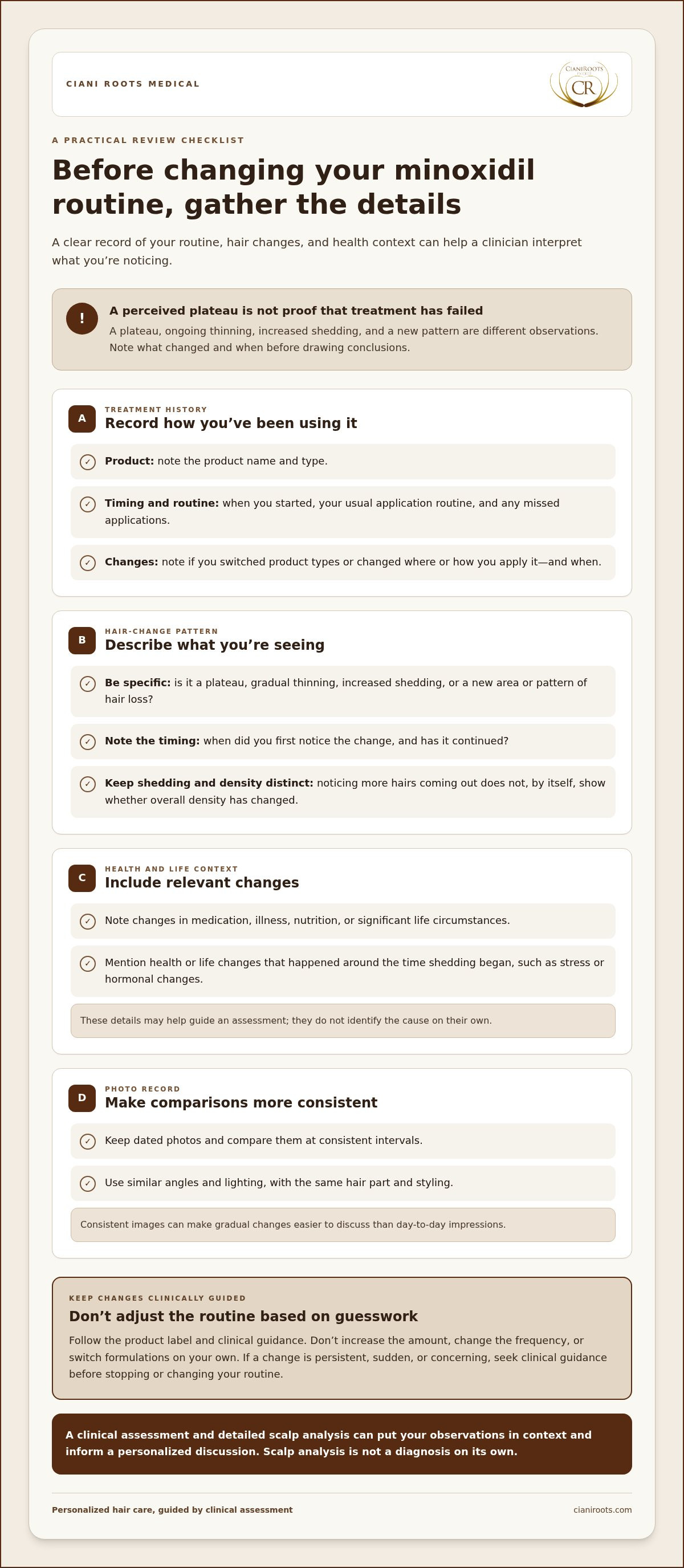
If you’re concerned about a change in your hair, pause before altering your routine. A brief, organized record can make it easier to explain what you’ve noticed and when it began. Document the changes, review your routine against the product label, arrange a clinical assessment, and discuss possible options. This can help prevent a rushed adjustment from obscuring useful information about your experience.
Prepare a useful record of your hair changes
Note when thinning or shedding changed, which areas are affected, and whether the change seemed gradual or sudden. If you take comparison photos, use consistent lighting, angles, distance, and hair parting. Photos taken with a different part or in harsher light may make density appear different, so consistency makes comparisons more useful.
Bring the minoxidil product or write down its name and formulation, when you began using it, and how you apply it. Include missed applications or routine changes, along with relevant medication, health, or life changes. You don’t need to decide what caused the change. A clear timeline can help a clinician understand what was happening before and after you noticed a difference.
Plan a medically guided next conversation
Use a simple sequence to prepare:
- Document changes: Record when they began and which areas are affected.
- Review your routine: Compare your use with the product labeling and note missed applications or changes.
- Arrange an assessment: Share your observations, product details, and relevant health context.
- Discuss options: Ask about the potential benefits, limitations, risks, and follow-up for each approach under consideration.
Don’t increase or change your dose, stop abruptly, or add another medication or treatment without clinical guidance. Follow the product labeling, and discuss concerns about continuing use with a clinician. If you have sudden or patchy hair loss, scalp pain, or inflammation, seek prompt clinical assessment rather than assuming minoxidil is responsible.
Specific questions can make the conversation more useful. Ask what the observed pattern could mean, whether your current routine is appropriate, and what would be monitored if a change is recommended. Ciani Roots Medical offers medically directed, individualized hair-restoration planning. EXPLORE YOUR OPTIONS.
How Ciani Roots Medical Personalizes Hair Care When Minoxidil Seems Less Effective
If minoxidil no longer seems to meet your goals, the next step is a closer look at your individual hair and scalp concerns, not a one-size-fits-all protocol. At Ciani Roots Medical, care begins with a complimentary consultation and detailed scalp analysis. The analysis informs a clinical discussion, but it isn’t a diagnosis on its own.
From scalp analysis to an individualized plan
Your concerns, scalp findings, hair-loss history, previous treatment experience, and goals all help shape the conversation. A change in overall density, for example, may prompt different questions than thinning concentrated in a particular area. The aim is to understand the pattern and context before discussing possible care, rather than assuming everyone with ongoing thinning has the same needs.
When appropriate, a plan may include medication management alongside other options. Regenerative care may also be discussed, including Bio-Enhanced PRP or KeraLase® with LASEmd® Ultra and KeraFactor MD. Acorn Secretome may be considered as a personalized regenerative product created from the patient’s own stored biology. These are distinct approaches, and their suitability depends on individual clinical evaluation. None should be presented as a guaranteed replacement for minoxidil or a promise of regrowth.
A local consultation focused on informed choices
Ciani Roots Medical provides medically directed hair care in Vacaville and Alamo. During a consultation, you can discuss what you’ve noticed, what matters most to you, and your questions about potential next steps. A thoughtful plan considers your circumstances and preferences, with room to discuss the potential benefits and limitations of each approach.
Personalization also means recommendations can differ from one patient to another. An option that may be relevant for one pattern of hair loss may not suit another. Consultation and scalp findings help guide the discussion, while clinical judgment and your health context inform whether medication management, a regenerative treatment, or another direction is appropriate. Expected outcomes are individual, so treatment planning should remain realistic and responsive to your needs.
If you’re considering what to do when minoxidil stops working, a conversation can help you understand your options without rushing into a change. EXPLORE YOUR OPTIONS.
Take the Next Step With a Clearer Plan
Uncertainty about your progress can make it tempting to change your routine quickly. Instead, use your observations to guide a thoughtful conversation about what may be affecting your hair and which next steps fit your circumstances. You don’t have to decide on a new treatment before understanding the pattern of change.
A complimentary consultation and detailed scalp analysis at Ciani Roots Medical can help inform an individualized, medically directed hair-restoration plan. In Vacaville and Alamo, care discussions are shaped around your concerns, scalp findings, history, and goals. The aim is to support informed choices with realistic expectations, not to promise a particular outcome.
Bring your questions and notes to a complimentary consultation at Ciani Roots Medical. We welcome patients from Fairfield, Dixon, Suisun City, Benicia, Vallejo, Napa, Winters, Davis, Woodland, Solano County, Yolo County, Napa Valley, Danville, Walnut Creek, San Ramon, Blackhawk, and Lafayette. Schedule a complimentary consultation to discuss your hair and scalp concerns.
Frequently Asked Questions
Can minoxidil stop working after it has helped?
It can seem less effective, but that doesn’t necessarily mean your body has stopped responding to it. You may have maintained coverage without noticing visible regrowth, while the underlying pattern of hair loss continues to change. A clinician can review the timing and distribution of changes alongside your treatment history. Don’t assume that a perceived plateau means the product has become ineffective or needs to be replaced.
Should I stop using minoxidil if my hair is still thinning?
Don’t stop or change your routine solely because thinning continues without first reviewing your situation with a clinician. If you’re concerned about side effects or unsure whether to continue, check the product labeling and seek medical guidance. Before your appointment, note when you began using it and any changes in application. That context can help distinguish a concern about tolerability from a concern about progress.
How do I know whether minoxidil is working?
Look for a pattern over time rather than judging by a single day’s shedding or one photograph. Consistent photos can help you compare the same part line, hair length, angle, and lighting. You might also note whether the areas of concern seem stable, more visible, or different from before. These observations don’t confirm treatment response on their own, but they give a clinician concrete information to consider alongside your history.
Can I use another hair-loss treatment with minoxidil?
Sometimes treatments may be considered together, but whether that’s appropriate depends on the cause of hair loss, your health context, and the treatments involved. Don’t add another medication, combine products, or change how you use minoxidil without clinical guidance. Bring the names of any prescriptions, over-the-counter products, and supplements you use to a clinician. This helps them consider potential interactions and whether another plan should be discussed.
What should I do if I have sudden or patchy hair loss while using minoxidil?
Arrange prompt clinical assessment for sudden or patchy hair loss, especially if the scalp is painful, red, or inflamed. These changes deserve evaluation rather than an assumption that minoxidil caused them. Note when the change began, which areas are affected, and whether you’ve noticed other symptoms or recent health changes. If symptoms are severe or rapidly worsening, seek urgent medical care. Don’t delay assessment while trying additional products.
Are PRP or KeraLase alternatives to minoxidil?
PRP and KeraLase® are different treatment discussions, not automatic substitutes for minoxidil. Whether either may be relevant depends on your diagnosis, goals, and a clinician’s evaluation. Bio-Enhanced PRP and KeraLase® with LASEmd® Ultra and KeraFactor MD may be considered within individualized care, but neither should be viewed as a guaranteed outcome. Ask about the approach’s purpose, limitations, potential risks, and how it fits with your overall plan.
Can a scalp analysis explain why minoxidil seems less effective?
A scalp analysis can contribute useful information, but it can’t explain the full picture or establish a diagnosis by itself. A clinician may consider the findings alongside your hair-loss history, routine, symptoms, and relevant health changes. At Ciani Roots Medical, consultations and scalp analysis inform individualized planning for patients in Vacaville, Alamo, Fairfield, Dixon, Suisun City, Benicia, Vallejo, Napa, Winters, Davis, Woodland, Solano County, Yolo County, Napa Valley, Danville, Walnut Creek, San Ramon, Blackhawk, and Lafayette.

Article by
Adriane McDonald BSN,RN
Adriane McDonald, BSN, RN, is a hair restoration specialist with nearly 40 years of experience working with men and women experiencing hair loss and thinning. As the Founder and Practice Director of Ciani Roots Medical, she works alongside the practice’s Medical Director to provide personalized hair restoration, scalp health, regenerative therapies, and advanced skin rejuvenation.
Her approach combines extensive hands-on experience with detailed scalp analysis, medical collaboration, and individualized treatment planning. Adriane is currently completing advanced training toward certification in trichology, further expanding her expertise in hair and scalp health.
Disclaimer
This content is provided for general educational and informational purposes only and is not intended to serve as medical advice, diagnosis, or treatment. Individual needs, treatment recommendations, and results vary. A consultation and appropriate evaluation are necessary to determine which treatment options may be suitable for you. Viewing or interacting with this content does not establish a healthcare professional-patient relationship with Ciani Roots Medical.
Individual results may vary, and no specific outcome can be guaranteed. Before-and-after images, testimonials, or treatment experiences represent individual results and should not be considered a guarantee of similar results.


