
When you notice thinning or increased shedding, the most helpful first step may be understanding what is contributing to the change—not choosing a treatment right away. Hair loss can feel unsettling, especially when treatment claims promise quick results. A useful clinical conversation begins with your experience, questions, and health history rather than a one-size-fits-all solution.
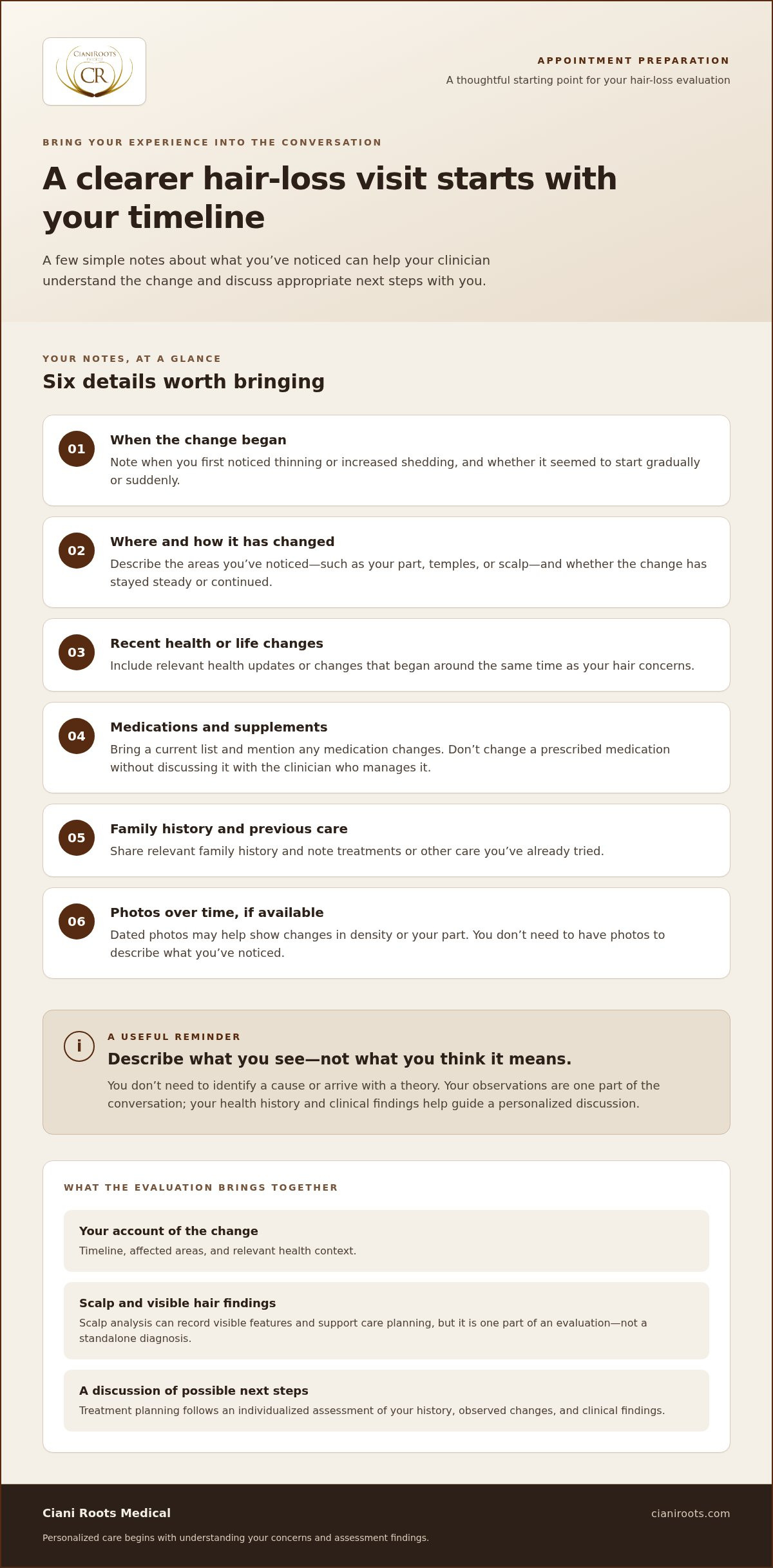
A few simple details can help your clinician understand what is happening. Write down when you first noticed the change, whether it developed gradually or suddenly, any recent health or life changes, your medications and supplements, your family history, and treatments you have tried. Photos taken over time may help show changes in density or your part. During an evaluation, your health history and scalp findings help guide which options may be appropriate and what expectations are realistic. This guide explains what to bring, what an evaluation may involve, and how to leave with a clearer next-step plan. At Ciani Roots Medical, personalized care begins with understanding your concerns and assessment findings before discussing treatment options.
Key Takeaways
- The best hair loss treatment for women depends on individual history and clinical findings; there is no single approach that fits everyone.
- Scalp analysis can record visible features, but it is only one part of a complete evaluation.
- Medical management, PRP, KeraLase Hair Therapy, and regenerative options serve different purposes. Discuss how each may—or may not—fit your needs.
- Bring a brief record of when your hair changes began, relevant health updates, medications, supplements, and previous care.
- Ask why an option is being recommended, what considerations apply, how progress will be assessed, and when follow-up will occur.
Hair loss treatment for women begins with the right questions
Noticing more hair in your brush or a change in your part can feel personal. You may wonder whether the change is temporary, what could be contributing to it, or whether treatment might help. Those questions deserve a thoughtful conversation rather than a quick assumption. Hair changes can have different explanations, and similar-looking patterns may require different clinical considerations.
Individualized hair-loss treatment for women is guided by health history, observed hair changes, and clinical findings—not by a one-size-fits-all remedy. Your observations provide useful context, but they cannot establish the cause on their own. An evaluation helps organize the information and support a discussion of appropriate next steps without promising a particular result.
What details about thinning or shedding are useful to notice?
Start by noting when you first noticed a change and whether it developed gradually or suddenly. Record where you see it, such as along your part, near your temples, or across your scalp. Has shedding increased, decreased, or fluctuated? Has the overall appearance stayed steady or continued to change? Dated photos, if you have them, may help show how your hair has changed over time.
Keep your notes descriptive rather than diagnostic. You don’t need to label the pattern or decide what’s causing it. A clear timeline, the areas affected, and what you’ve observed can make the appointment more focused.
Why can women's hair-loss concerns have different explanations?
Genetics, changes in health, medications, and life-stage factors may all be relevant topics to discuss. Pattern hair loss is one recognized form of hair thinning; the overview of Pattern hair loss describes its features and possible treatment approaches. However, seeing a particular pattern does not establish that this—or any other explanation—applies to you.
Different causes can look similar, while the details that guide care may be different. A clinician can consider your description together with relevant health information and examination findings. Tell them about medication changes, recent health changes, or symptoms that began during a particular life stage. Do not change a prescribed medication because of hair changes without discussing it with the clinician who manages it. Your goal is to bring clear observations and questions to the evaluation, then use the findings to inform an individualized discussion of hair loss treatment for women.
How a women's hair-loss evaluation informs treatment options
A useful evaluation brings several types of information together. A clinician may ask about your hair changes, examine your scalp and visible density patterns, and discuss relevant health context. Each part adds perspective. Scalp observations can describe what is visible, but they are not a diagnosis on their own and may not explain why your hair is changing.
Treatment planning should follow evaluation because the appropriate next step depends on the pattern of change, broader health context, and findings considered together. This approach makes the discussion more personal and helps clarify what an option is intended to address and what expectations are realistic. A clinical review of current treatment concepts also illustrates why evaluation and treatment considerations belong together.
What might a clinician ask during a hair-loss visit?
Expect questions about when the change began, whether it has been gradual or sudden, and which areas seem affected. A clinician may also ask about recent health changes, current or past medications, and relevant family history. Together, these details help put the hair concern in context rather than treating one visible sign as the whole story.
You don’t need to arrive with a theory. If you’re unsure when shedding started or whether a medication could be relevant, say so. An accurate account of what you know, and what you don’t, is more useful than trying to interpret every detail yourself.
How can scalp analysis support a care plan?
Scalp analysis can record visible features, such as scalp condition and areas where hair appears less dense. When considered alongside your history and other examination findings, it may help identify which options are worth discussing and what to monitor over time. It is one source of information—not a standalone diagnosis or a guarantee of how treatment will work.
For a closer look at this step, see How Scalp Analysis Supports Hair Care Planning. Findings can also help focus follow-up conversations: whether the approach still fits, what changes to track, and when the plan may need review. Ciani Roots Medical uses scalp analysis as part of its medically directed hair-restoration care, which may include PRP, KeraLase Hair Therapy, medication management, or Acorn stem cell-derived secretomes. Explore Ciani Roots Medical’s hair restoration care.
Comparing women's hair-loss treatments without expecting one universal answer
Different treatment categories have different purposes, and a familiar treatment name does not show whether it fits your situation. Medical management, PRP, KeraLase Hair Therapy, and regenerative options may come up in a hair-loss discussion, but suitability depends on individual assessment. Use the comparison below to prepare practical questions, not to rank treatments or predict results.
| Option | What it may be discussed for | What may be considered | Question to ask |
|---|---|---|---|
| Medical management | Review medication-based approaches in light of your hair concern and health context. | Relevant history, current medications, and individual considerations. | What is this option intended to address, and what should be monitored? |
| PRP | Discuss a regenerative approach using platelet-rich plasma. | Scalp findings, treatment goals, and whether it fits the overall plan. | Why might PRP be considered in my case? |
| KeraLase Hair Therapy | Explore a treatment option focused on scalp care. | Assessment findings and how it may fit alongside other care. | What role would this have in my individualized plan? |
| Regenerative options | Discuss options such as Acorn stem cell-derived secretomes. | Clinical context, goals, and the rationale for considering the option. | What should I understand about the approach and follow-up? |
What should women understand about medical management and PRP?
Medication management and PRP are clinician-guided topics, not self-prescribed solutions. A review from Harvard Medical School, Treating female pattern hair loss, discusses common medical approaches in the context of female pattern hair loss. Whether medication or PRP is worth discussing for you depends on your evaluation and health history. Ask about the intended role, relevant considerations, and how progress would be reviewed. Don’t start, stop, or change medication without guidance from the clinician managing it.
Where may KeraLase and secretome options fit?
At Ciani Roots Medical, KeraLase Hair Therapy and Acorn stem cell-derived secretome options are part of medically directed hair-restoration care. Their role depends on your assessment and the goals of an individualized plan; neither is a universal fit. For more detail, explore Hair Loss Treatment Options: What to Consider and the information on KeraLase and secretome treatment. Response and timelines vary, so discuss realistic expectations and follow-up rather than assuming a guaranteed outcome.
Prepare for a hair-loss treatment appointment with this checklist
A few notes can make it easier to explain what you have noticed and keep the appointment focused. You do not need to arrive with a diagnosis or have every answer. Use the checklist below to gather information that may help you and your clinician have a more useful discussion.
- Write a brief timeline. Note when you first noticed a change, whether it began gradually or suddenly, and whether it has fluctuated. Describe the areas affected and your concerns in your own words.
- Gather relevant health information. List current medications and supplements, relevant health changes, and medical history you think may be useful. Include family history if it seems relevant, even if you are unsure how it connects.
- Record previous hair or scalp care. Note treatments you have tried, when you used them, and what you observed. Include questions or concerns about those experiences.
- Bring photos if they help. Existing photos taken over time may make changes easier to describe. You do not need to create a photo record if you do not have one.
- Choose questions and goals. Think about what you hope to understand or improve, along with your preferences and practical considerations. Sharing what matters to you helps make the discussion more personal.
Questions to help guide the conversation
Consider asking: What do the assessment findings show, and what remains uncertain? Why might this option fit my situation? What potential risks or practical commitments should I understand? What will follow-up involve, and how will we review progress? These questions help you understand the reasoning behind a plan without assuming that one treatment is right for everyone.
It’s reasonable to discuss realistic goals openly. Ask what changes may be possible, how progress will be assessed, and what factors could affect the plan. If a detail is unclear, ask for an explanation in everyday language. A useful conversation should leave room for your questions and preferences.
Preparing this way can help you take part in a focused discussion of hair loss treatment for women. For medically directed, individualized hair-restoration care, explore personalized hair restoration care.
How Ciani Roots Medical personalizes women's hair-loss treatment
Hair changes can have different underlying explanations, so a useful care discussion connects what you have noticed with clinical findings. At Ciani Roots Medical, medically directed hair restoration and scalp care are individualized. Assessment findings help inform which approaches may be relevant instead of placing everyone on the same path. The goal is a clear conversation about options, their purpose, and realistic expectations—not a promise of a particular outcome.
What can readers expect from a personalized care discussion?
Your observations and health context are considered alongside scalp analysis to shape the discussion. Ciani Roots Medical’s CR Signature regenerative hair-loss program combines in-depth scalp analysis, PRP therapy, KeraLase Hair Therapy, medication management, and Acorn stem cell-derived secretomes. The care plan is individualized, so including an option in the program does not mean it is automatically suitable for every person.
Medical director oversight supports Ciani Roots Medical’s medically directed approach. The practice was founded by Adriane McDonald, BSN, RN, whose hair-restoration experience spans nearly 40 years. A personalized conversation leaves room for questions, preferences, and shared decision-making. Discuss what matters most to you, what the proposed approach is intended to address, and how progress and expectations will be reviewed. Individual responses vary, so treatment planning should remain grounded in your assessment and ongoing discussion.
How can local women take the next step?
Ciani Roots Medical provides hair restoration and scalp care in Vacaville and Alamo, California. Women in Vacaville, Sacramento, Davis, Solano County, Contra Costa County, and the San Francisco Bay Area can explore the practice’s medically directed care. If you are considering hair loss treatment for women, bring notes about your changes, health history, medications, and previous care. Your questions can make the conversation more useful, whether you are discussing findings, treatment rationale, or follow-up.
You don’t need to arrive with a diagnosis or a predetermined treatment choice. Begin with what you’ve noticed and what you’d like to understand. Explore hair restoration care at Ciani Roots Medical as a next step toward an individualized, medically directed discussion.
Take your next step toward a personalized care plan
A prepared visit can turn uncertainty into a more focused conversation. Bring your notes and questions, and remember that your pattern of hair changes, personal health history, and clinical findings all help inform which options may be appropriate. There is no universal answer; a thoughtful plan should include realistic expectations and room to discuss your preferences.
Ciani Roots Medical provides medically directed hair restoration and scalp care in Vacaville and Alamo, California. Its approach includes medical director oversight, and founder Adriane McDonald, BSN, RN, brings nearly 40 years of hair-restoration experience. An individualized assessment can guide a discussion of hair loss treatment for women and possible next steps without promising a particular outcome.
You don’t need every answer before you begin. Start with what you’ve noticed and what you hope to understand. Explore personalized hair restoration care at Ciani Roots Medical and take a considered next step toward care that reflects your needs.
Frequently Asked Questions
Is hair loss treatment different for women?
It can be, because the appropriate approach depends on the cause of the hair changes and your health context, not gender alone. A clinician may consider the pattern of thinning, medical history, medications, and life-stage factors before discussing care. Some treatments are used for certain types of hair loss, while others may be considered based on individual findings. An evaluation helps clarify which options are relevant and what they involve.
Can women's hair loss grow back with treatment?
Hair may improve with treatment in some cases, but regrowth is not assured. Results depend on the underlying cause and individual response. Some goals may involve supporting density or scalp health rather than restoring all previous hair. A clinician can discuss realistic changes, how progress could be monitored, and when a plan may need review. Ask how the purpose of an approach relates to your assessment rather than relying on promises alone.
What treatments may be considered for women's hair loss?
Options may include clinician-guided medication management, PRP, KeraLase Hair Therapy, and regenerative approaches such as Acorn stem cell-derived secretomes. Which options are appropriate depends on assessment findings, health history, and goals. At Ciani Roots Medical, medically directed care includes scalp analysis and individualized treatment planning. Women in Vacaville, Alamo, Sacramento, Davis, Solano County, Contra Costa County, and the San Francisco Bay Area can explore care relevant to their needs.
How should I prepare for a hair loss treatment appointment?
Write down when you noticed the change, where it appears, and whether it has shifted over time. Bring a list of medications, supplements, relevant health changes, and previous hair-loss care. Photos taken over time may help illustrate what you have observed. Prepare questions about assessment findings, why an option may fit, potential risks, practical commitments, and follow-up. You do not need to arrive with a diagnosis or a treatment choice.
When should a woman seek professional advice about hair loss?
Consider seeking professional advice if you notice persistent or increasing thinning, a sudden change, or hair loss that concerns you. It is also sensible to discuss changes accompanied by scalp symptoms or those that begin around a health or medication change. A clinician can review the pattern alongside your history and help determine appropriate evaluation or next steps. Do not stop or change prescribed medication without discussing it with the clinician managing it.
Does PRP work for women's hair loss?
PRP may be considered as one option in a clinician-guided hair-restoration discussion, but it is not suitable for everyone and results can vary. Whether it makes sense depends on your assessment, health context, and treatment goals. Ask what PRP is intended to address in your case, what considerations apply, and how progress would be reviewed. Evaluation helps place PRP within an individualized plan rather than treating it as a universal solution.
How long does hair loss treatment take to show results?
There is no single timeline that applies to every treatment or person. The time needed to assess progress can depend on the type of care, the reason for the hair changes, and individual response. Before starting, ask what changes to monitor and when follow-up will help review them. Consistent notes or photos may support that conversation. Your clinician can explain realistic expectations for the approach being discussed and when the plan may be reassessed.
Article by
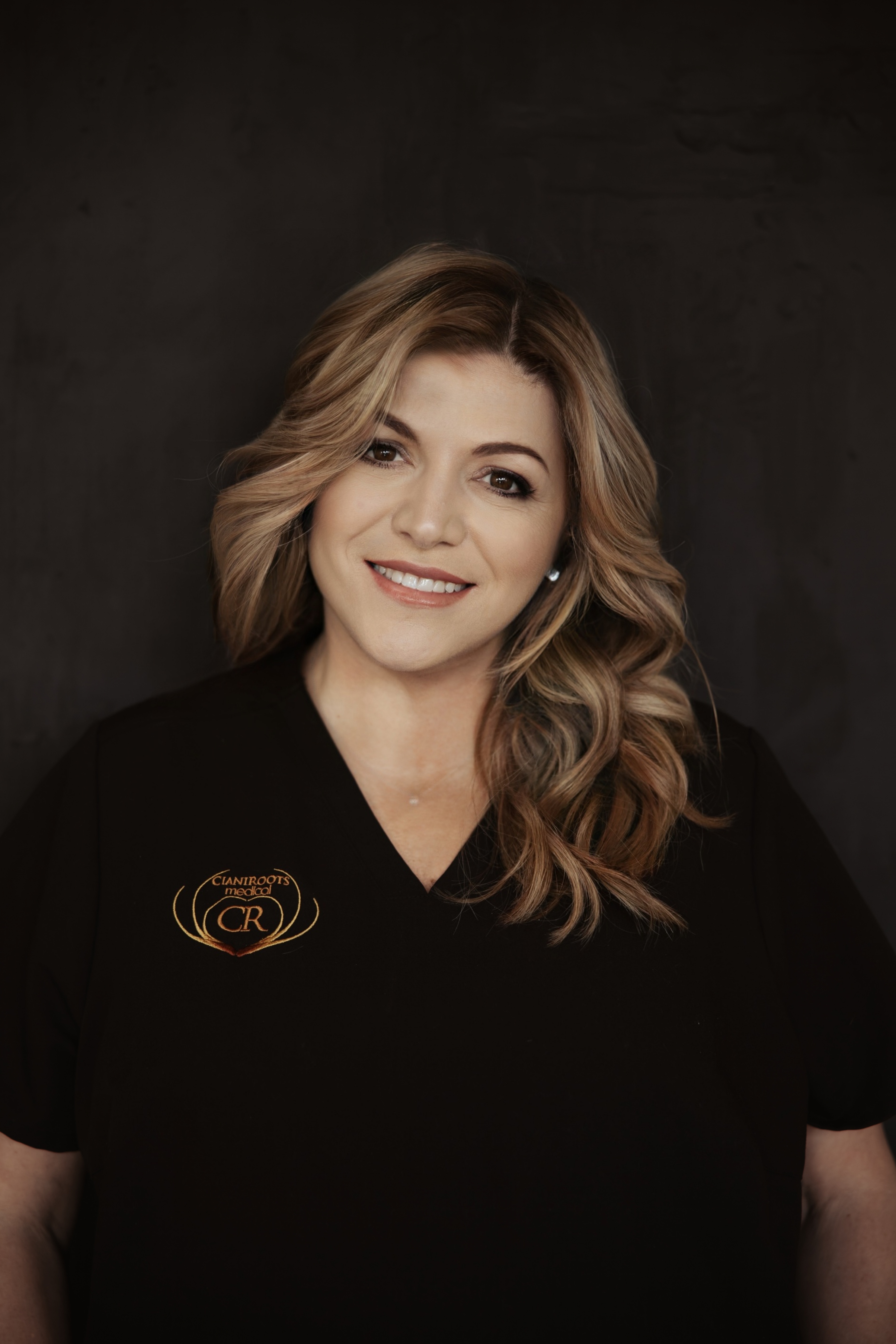
Adriane McDonald BSN,RN
Adriane McDonald, BSN, RN, is a hair restoration specialist with nearly 40 years of experience working with men and women experiencing hair loss and thinning. As the Founder and Practice Director of Ciani Roots Medical, she works alongside the practice’s Medical Director to provide personalized hair restoration, scalp health, regenerative therapies, and advanced skin rejuvenation.
Her approach combines extensive hands-on experience with detailed scalp analysis, medical collaboration, and individualized treatment planning. Adriane is currently completing advanced training toward certification in trichology, further expanding her expertise in hair and scalp health.
Disclaimer
This content is provided for general educational and informational purposes only and is not intended to serve as medical advice, diagnosis, or treatment. Individual needs, treatment recommendations, and results vary. A consultation and appropriate evaluation are necessary to determine which treatment options may be suitable for you. Viewing or interacting with this content does not establish a healthcare professional-patient relationship with Ciani Roots Medical.
Individual results may vary, and no specific outcome can be guaranteed. Before-and-after images, testimonials, or treatment experiences represent individual results and should not be considered a guarantee of similar results.


