
Could a receding hairline or thinning crown mean male pattern baldness, or might another factor be affecting your hair? When changes happen gradually, it’s understandable to wonder whether you’re seeing a familiar inherited pattern and whether waiting could make it harder to respond. Yet appearance alone can’t confirm the cause.
This article explains common signs of male pattern baldness, how inherited hair loss may differ from sudden or diffuse shedding, and why the next step is careful evaluation rather than assuming one treatment fits everyone. You’ll learn what to observe around your temples and crown, what other contributors may be worth discussing, and how a personalized scalp analysis and consultation can help clarify what may be happening. At Ciani Roots Medical, care in Vacaville and Alamo starts with understanding your individual hair and scalp. Treatment planning may then consider medical management or regenerative options when appropriate. The goal is a clearer, more informed path forward, tailored to your needs.
Key Takeaways
- Temple recession and crown thinning can be common signs of male pattern baldness, but appearance alone can’t confirm the cause.
- Inherited traits and sensitivity to hormones can influence hair changes, while other causes may lead to more sudden or diffuse shedding.
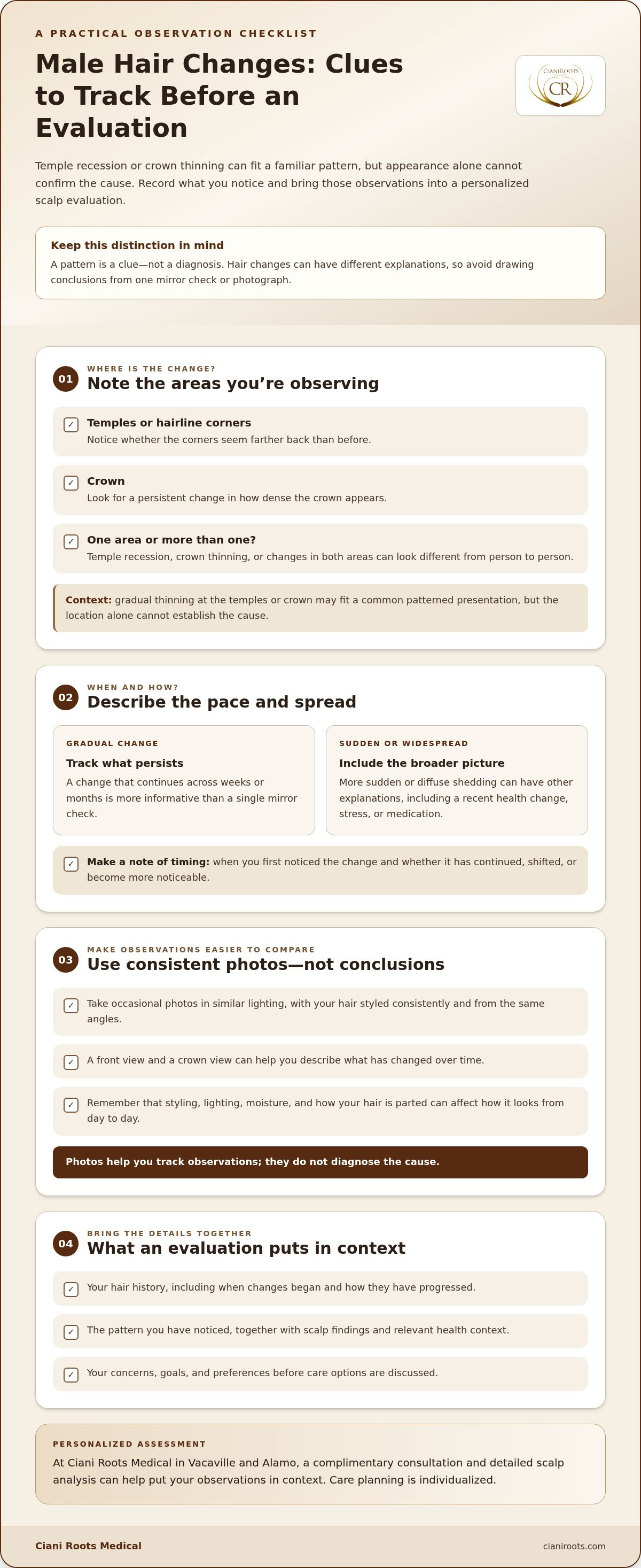
- Note when thinning began, where you see it, and how it has changed. These details can help put your concerns in context during an evaluation.
- A thoughtful assessment considers your hair history, scalp, goals, health context, and preferences before care options are discussed.
- At Ciani Roots Medical in Vacaville and Alamo, a complimentary consultation and detailed scalp analysis can help guide an individualized plan.
What Is Male Pattern Baldness, and What Does It Usually Look Like?
Male pattern baldness, or androgenetic alopecia, is a common form of hair loss in which hair gradually becomes thinner in a pattern influenced by inherited traits and sensitivity to hormones. It often appears as a receding hairline at the temples, thinning near the crown, or both. These changes can suggest a familiar pattern, but they don’t confirm a diagnosis on their own.
The Pattern hair loss overview describes common ways this gradual change may appear. Individual experiences vary: the first signs, how noticeable they are, and how they develop over time aren’t the same for everyone. Looking at where thinning occurs and whether it persists can help you describe what you’ve noticed, but it cannot establish the cause.
Which early signs of male pattern baldness may appear first?
You might notice the corners of your hairline sitting farther back than before, or the crown looking less dense under bright light. The change can be subtle at first. Hair may also look different from day to day because of styling, lighting, moisture, or how it’s parted. A persistent change across weeks or months is more informative than one mirror check.
If you’re concerned, consider taking occasional photos in similar lighting, with your hair styled consistently and from the same angles. A front view and a view of the crown can help you describe changes over time without relying on memory. Avoid drawing conclusions from a single image or a temporary difference in appearance. Photos are a way to track what you observe, not a way to diagnose yourself.
Does male pattern baldness look the same for everyone?
No. Some people first notice temple recession, while others see reduced density at the crown or changes in both areas. The pace and visibility of hair changes also differ. There’s no single timeline that applies to everyone, and the same-looking hairline can have different explanations.
Family history can provide useful context, but it can’t predict exactly whether or how hair loss will affect you. A relative’s pattern or timing isn’t a reliable forecast for your own. If changes are concerning, a professional evaluation can consider the pattern alongside your hair history and scalp rather than treating appearance as proof.
Why Male Pattern Baldness Develops: Genetics, Hormones, and Follicle Changes
Hair loss with a familiar pattern can have a biological basis, but it isn’t usually explained by one simple cause. In male pattern baldness, inherited traits can influence how sensitive certain hair follicles are to androgens, hormones that include testosterone and its more potent derivative, dihydrotestosterone (DHT). A person’s overall hormone levels alone don’t tell the full story.
How do genetics and androgens relate to patterned hair loss?
Genes can affect how follicles respond to androgens, including DHT, which is produced from testosterone. MedlinePlus Genetics describes androgenetic alopecia as involving genetic factors and androgen activity; in susceptible follicles, DHT can contribute to changes in hair growth over time. The Androgenetic alopecia overview explains these genetic and hormonal influences. Family history may add context, but it can’t establish why your hair is changing or predict the pattern or pace you’ll experience.
What does follicle miniaturization mean?
In areas affected by patterned hair loss, follicles may gradually become smaller, a process called miniaturization. The hairs they produce can become finer and shorter over successive growth cycles, making the area look less dense. One way to picture it is a plant producing progressively smaller leaves, though this comparison is only an analogy and can’t be used to diagnose a scalp.
In susceptible follicles, inherited differences in androgen-receptor response can allow DHT, a hormone formed from testosterone, to contribute to shorter hair-growth cycles and gradual follicle miniaturization, in which hairs become finer and shorter. This summarizes a proposed mechanism described in MedlinePlus Genetics, but it doesn’t mean every person with hair loss has the same underlying process or response.
These changes aren’t something you can reliably confirm by looking at your hairline or knowing which relatives have thinning. Hair changes may have other explanations, and an individual’s pattern can’t be predicted from family history alone. A clinical assessment can put the visible pattern in context alongside your history and scalp findings.
If you’re trying to understand what may be contributing to your own hair changes, a complimentary consultation and scalp analysis at Ciani Roots Medical can help inform a personalized discussion of next steps.
Male Pattern Baldness or Another Cause? Clues That Help Put Hair Changes in Context
A change in hair density can follow different patterns, and the pattern is only one part of the picture. Gradual thinning at the temples or crown may fit the typical presentation of male pattern baldness. More sudden or widespread shedding can have other explanations, including a recent health change, stress, or medication. These clues help shape a conversation, but they can’t establish the cause on their own.
The Male Pattern Baldness Overview from MedlinePlus describes the common patterned presentation. A clinician considers more than appearance, including when the change began, how it has progressed, relevant health context, and the condition of the scalp. For a useful discussion, note whether the change was gradual or sudden, which areas are affected, and whether you noticed other changes at the same time.
What features may differ between gradual pattern loss and shedding?
Use the comparison below to organize your observations, not to diagnose yourself. Timing and distribution can help guide an evaluation, but neither is conclusive by itself.
| What you notice | Possible context to discuss |
|---|---|
| Gradual change around the temples or crown | A patterned change may be considered alongside hair history and scalp findings. |
| More sudden or widespread shedding | Recent illness, stress, health changes, or medication changes may be relevant context. |
| Thinning with scalp discomfort or visible irritation | Scalp symptoms are worth describing during an assessment, as they add context beyond the hair pattern. |
For example, noticing more hair in the shower after a stressful period doesn’t, by itself, reveal the cause. Likewise, a gradually changing hairline doesn’t rule out other factors. Write down when you first noticed the change and whether anything else in your health or routine changed around that time. This gives you concrete details to discuss instead of having to rely on memory during an appointment.
When is a professional assessment worth considering?
An assessment can be helpful if shedding feels sudden, continues over time, causes distress, or remains difficult to interpret. Bring up any recent health changes, new or adjusted medications, stressors, and scalp concerns such as itching, tenderness, or irritation. You don’t need to know which details matter most; sharing what you’ve noticed gives the clinician useful context.
A detailed scalp review and discussion of your history can help distinguish visible clues from a confirmed explanation. At Ciani Roots Medical, a complimentary consultation and scalp analysis can support a personalized conversation about your hair changes and possible next steps.
How Male Pattern Baldness Is Evaluated and How Care Options Differ
A useful evaluation is more than a quick look at the hairline. Male pattern baldness is considered in the context of your hair history, scalp characteristics, health background, and goals. This helps shape a plan around your needs rather than assuming one approach suits everyone.
What may a scalp analysis and consultation help clarify?
A consultation can begin with when you first noticed changes, how they’ve developed, and any relevant health or medication history. A detailed scalp analysis can document visible features such as density and the distribution of thinning. You can also discuss what matters to you, whether that’s understanding the changes, exploring care options, or setting realistic goals.
To make the conversation more focused, consider noting when you first saw a change, which areas look different, and whether the change has continued. Bring up relevant health or medication changes and any scalp discomfort or irritation. Assessment informs planning, but it can’t guarantee a particular outcome. If the hair changes or scalp findings suggest that more evaluation is needed, that can be part of the discussion too.
How do nonsurgical hair restoration approaches differ?
Options vary in what they involve and how they fit into an individual plan. Medication management is a medical approach that may be considered when appropriate, based on health context and a clinician’s guidance. In-clinic approaches are distinct: Bio-Enhanced PRP is a hair restoration treatment, while KeraLase® combines LASEmd® Ultra with KeraFactor MD. Personalized Acorn Secretome care uses a regenerative product created from a patient’s own stored cells or biology.
These approaches aren’t interchangeable, and a treatment’s suitability depends on assessment, health considerations, and personal preferences. A consultation can help clarify how the options differ, which may be relevant to your goals, and what questions to consider before deciding. A plan may consider one approach or a combination, depending on your individual assessment.
At Ciani Roots Medical, medically directed care connects scalp analysis with individualized planning, including medication support when appropriate and nonsurgical treatment options. For people considering hair restoration in Vacaville or Alamo, the first step is understanding the pattern and the person behind it.
Personalized Male Hair-Loss Care in Vacaville and Alamo: What Happens Next?
Recognizing a possible pattern is only the beginning. A complimentary consultation can help you talk through what you’ve noticed, what matters to you, and what an individualized next step might look like. At Ciani Roots Medical, medically directed hair restoration begins with understanding the person and scalp, not selecting a standard plan based on appearance alone.
What can readers expect from an individualized care discussion?
The conversation may cover when your hair changes began, how they’ve developed, relevant health or medication history, and the goals you’d like care to address. A detailed scalp analysis adds observations about your scalp and hair to that discussion. Together, this information can help guide which options may be appropriate and what questions deserve further attention.
Medication management may be considered when appropriate, alongside in-clinic hair restoration or regenerative care options. The right direction depends on your assessment, health context, and preferences. A plan is tailored to your needs rather than built around a one-size-fits-all package, and an evaluation can’t promise a particular result.
How does Ciani Roots Medical approach hair restoration in Vacaville and Alamo?
Ciani Roots Medical provides medically directed hair restoration and regenerative care for people in Vacaville, Alamo, and surrounding communities. The practice was founded by Adriane McDonald, BSN, RN, who brings nearly 40 years of hair restoration experience. A consultation and scalp analysis offer space to discuss whether the changes could fit male pattern baldness or whether other context should inform the conversation.
There’s no need to arrive with a diagnosis or a decision already made. Consider noting when you first observed changes, what you’ve noticed since, and any questions about your goals or care options. Sharing those details can make the conversation more focused and help shape a plan around your individual needs.
Take a Thoughtful Next Step for Your Hair
Gradual temple recession or crown thinning may fit a familiar pattern, but appearance alone can’t confirm male pattern baldness. Other factors can contribute to hair changes, so timing, distribution, health context, and scalp findings all matter. A careful evaluation can bring these clues together before you consider care options.
At Ciani Roots Medical, a complimentary consultation and detailed scalp analysis provide a starting point for discussing your hair history, concerns, and goals. Treatment planning is personalized, with medication management considered when appropriate. Founded by Adriane McDonald, BSN, RN, the practice brings nearly 40 years of hair restoration experience to its medically directed approach.
If you’re exploring hair restoration in Vacaville or Alamo, you don’t need to have every answer before starting a conversation. A clearer understanding of your hair and scalp can help you make informed decisions at your own pace. EXPLORE YOUR OPTIONS
With thoughtful guidance, you can move forward with greater clarity and a plan shaped around your individual needs.
Frequently Asked Questions
What is the main cause of male pattern baldness?
The main cause is an inherited sensitivity of certain hair follicles to androgens, including dihydrotestosterone (DHT), rather than one hormone level alone. In susceptible follicles, this sensitivity can contribute to gradual changes in hair growth. Family history may offer context, but it can’t confirm the cause of your hair changes or predict how they’ll develop. A scalp assessment and discussion of your history can help clarify what may be relevant in your case.
Can male pattern baldness start in your 20s?
Yes, patterned hair loss can begin in early adulthood, including in your 20s. The timing and visibility vary, so noticing a changing hairline or crown at a younger age doesn’t establish the cause. If you’re seeing a persistent change, note when you first noticed it and whether it has continued. A professional assessment can consider the pattern, your hair history, and scalp findings without relying on age alone.
How can you tell if hair loss is male pattern baldness?
You can’t reliably confirm male pattern baldness by appearance alone. Gradual recession at the temples or reduced density at the crown may fit a common pattern, but other causes can produce thinning or shedding. An evaluation can consider when the change began, where it appears, relevant health or medication history, and scalp characteristics. Photos taken over time in similar lighting may help you describe changes, but they aren’t a diagnosis.
Is male pattern baldness the same as general hair shedding?
No. Patterned hair loss usually describes gradual changes in specific areas, while general shedding may feel more widespread or begin more suddenly. These differences can help guide a clinical conversation, but they don’t identify the cause on their own. Stress, health changes, medications, and scalp concerns may also be relevant. If shedding feels persistent or unclear, share its timing and any changes in your health or routine during an assessment.
Can male pattern baldness be treated without surgery?
Yes. Nonsurgical care options can include medication management when appropriate, Bio-Enhanced PRP, KeraLase® hair therapy, and personalized regenerative care. These approaches differ, and not every option suits every person. A consultation and detailed scalp analysis can help connect your hair pattern, health context, and preferences with possible next steps. Treatment planning should be individualized, and no approach can guarantee a particular result.
Does male pattern baldness always progress at the same rate?
No. The timing and pace of patterned hair changes differ from person to person. Family history can provide context, but it can’t predict an individual’s course, and a short-term change in appearance may be affected by lighting or styling. If you’re concerned about a persistent change, keeping occasional photos under similar conditions can help you describe what you’ve observed during a consultation.
Can I get a male hair-loss consultation in Vacaville or Alamo?
Yes. Ciani Roots Medical offers complimentary consultations and detailed scalp analysis in Vacaville and Alamo. The medically directed practice provides personalized hair restoration and regenerative care, with medication management considered when appropriate. Founded by Adriane McDonald, BSN, RN, it serves people across Solano County, Napa Valley, and the East Bay, including Fairfield, Dixon, Suisun City, Benicia, Vallejo, Napa, Winters, Davis, Woodland, Danville, Walnut Creek, San Ramon, Blackhawk, and Lafayette. Schedule a complimentary consultation to discuss your hair concerns and possible next steps.
Article by
Adriane McDonald
Adriane McDonald, BSN, RN, is a hair restoration specialist with nearly 40 years of experience working with men and women experiencing hair loss and thinning. As the Founder and Practice Director of Ciani Roots Medical, she works alongside the practice’s Medical Director to provide personalized hair restoration, scalp health, regenerative therapies, and advanced skin rejuvenation.
Her approach combines extensive hands-on experience with detailed scalp analysis, medical collaboration, and individualized treatment planning. Adriane is currently completing advanced training toward certification in trichology, further expanding her expertise in hair and scalp health.
Disclaimer
This content is provided for general educational and informational purposes only and is not intended to serve as medical advice, diagnosis, or treatment. Individual needs, treatment recommendations, and results vary. A consultation and appropriate evaluation are necessary to determine which treatment options may be suitable for you. Viewing or interacting with this content does not establish a healthcare professional-patient relationship with Ciani Roots Medical.
Individual results may vary, and no specific outcome can be guaranteed. Before-and-after images, testimonials, or treatment experiences represent individual results and should not be considered a guarantee of similar results.
