
Could a treatment intended to support hair growth also cause side effects? That’s a reasonable concern when you’re considering regenerative hair therapy in Suisun City, especially when options may include PRP, medication, or follicle stimulation.
Hair loss has different causes, so an approach that may suit one person may not suit another. PRP and other regenerative therapies are distinct options, and medication may be considered alongside them when appropriate. Each has its own process and potential effects, which should be discussed before treatment begins.
This article explains how these approaches work, what can shape an individualized plan, and what to know about possible side effects. You’ll also learn how scalp analysis can guide treatment choices and why progress varies from person to person.
Key Takeaways
- Understand how PRP and regenerative approaches differ before considering which may fit your hair-loss concerns.
- Set realistic expectations: visible changes can take time, and treatment response varies from person to person.
- Learn what to discuss about possible side effects when weighing treatment options or combining approaches.
- See how medication management and follicle stimulation may be considered as part of an individualized plan.
- A scalp analysis can help connect your hair-loss pattern and goals with suitable treatment options.
How does PRP/Stem Cell Therapy treat unwanted hair loss?
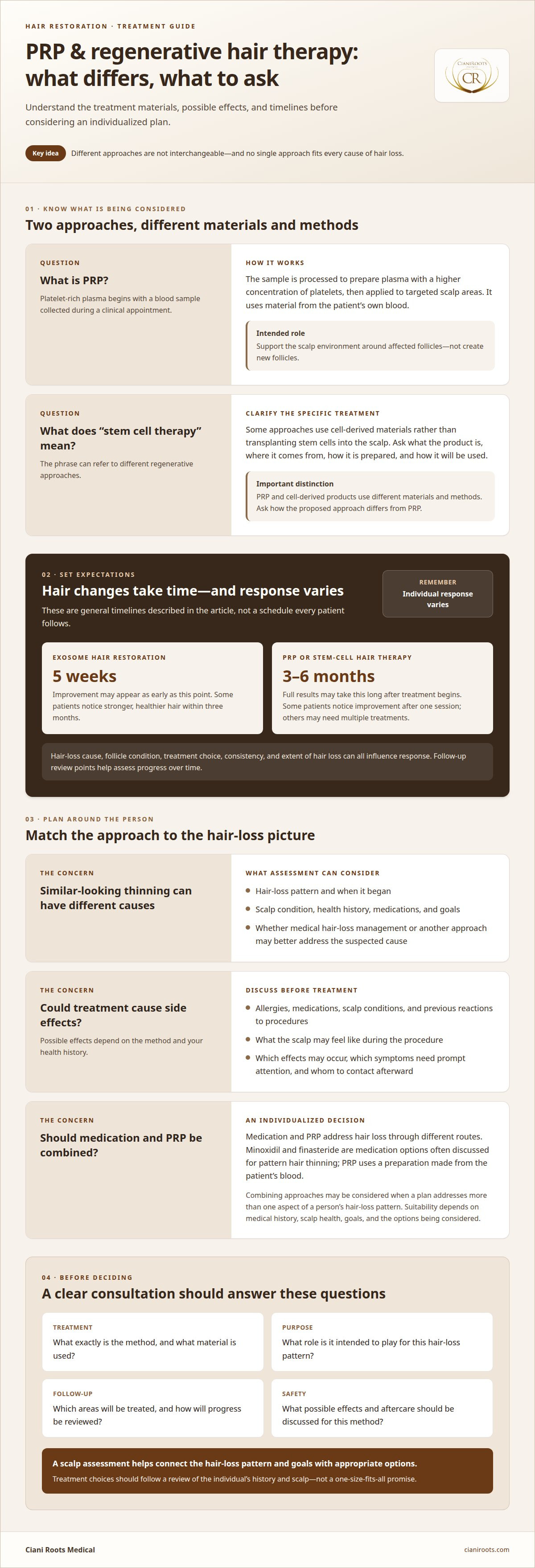
PRP and other regenerative treatments are intended to support the scalp environment around existing follicles. They are not interchangeable: PRP and stem-cell-derived approaches use different materials and methods. A clinician should explain what a proposed treatment involves, its intended role, and how it relates to your pattern of hair loss. The goal is to support existing follicles, not promise a particular result.
Visible changes take time because hair growth is gradual. Improvement after exosome hair restoration may appear as early as five weeks, while some patients notice stronger, healthier hair within three months. These are general timelines, not a schedule every patient follows. Hair-loss cause, current follicle condition, treatment choice, and consistency can all influence the response.
Full results from PRP or stem-cell hair therapy may take 3 to 6 months after treatment begins. Some patients notice improvement after one session; others may need multiple treatments, depending partly on the extent of hair loss. A treatment plan should set review points so progress can be assessed over time, rather than judged by a single early change. Continued shedding or a different response can prompt a reassessment of the approach.
For anyone considering regenerative hair therapy in Suisun City, a consultation can help determine whether a regenerative approach fits their needs. Assessment may include a scalp examination and a discussion of health history, medications, and goals. The clinician can also consider whether medical hair-loss management or another approach better addresses the suspected cause. Treatment decisions should follow that assessment, not a one-size-fits-all promise.
In California, look for a provider with relevant medical training, experience assessing hair loss, and clear medical oversight for treatment planning. Ask for an explanation of the method, expected timeline, possible effects, and follow-up process. Credentials and experience matter because a scalp assessment helps distinguish concerns that may look similar but call for different care.
Insurance coverage for PRP hair restoration and financing options depend on the insurer and the provider’s terms. Discuss coverage and payment arrangements before committing, and don’t assume either is included. The proposed schedule may also affect planning, but an individualized assessment should come first.
To arrange a consultation near Suisun City, contact Ciani Roots Medical to discuss your hair and scalp concerns. Bring a list of current medications and note when shedding or thinning began; these details can help guide the assessment.
PRP and stem cell therapy for hair loss
Platelet-rich plasma, or PRP, starts with a blood sample collected during a clinical appointment. The sample is processed to prepare plasma with a higher concentration of platelets, then applied to targeted scalp areas. This approach uses material from the patient’s own blood. Its purpose is to support the scalp environment around follicles affected by thinning, not to create new follicles.
“Stem cell therapy” can refer to different regenerative approaches, so it’s important to understand the specific treatment. Some use cell-derived materials rather than transplanting stem cells into the scalp. A consultation should clarify the product’s source, how it is prepared, and how the clinician plans to use it. Ask how the proposed method differs from PRP, since these are distinct approaches.
For example, someone with a widening part and gradual thinning needs an assessment of the pattern and scalp before choosing a treatment. The clinician can review when hair loss began, relevant health history, and current medications. This information helps distinguish ongoing patterned thinning from shedding linked to a temporary trigger. PRP or another regenerative approach should be considered in that wider clinical picture, rather than as an answer to every cause.
PRP and cell-derived products differ in preparation and treatment planning. A provider should explain the steps involved, what the scalp may feel like during the procedure, and what follow-up is planned. Ask which areas will be treated and how progress will be assessed. Clear explanations make it easier to understand the procedure and discuss possible effects before deciding.
Possible side effects depend on the method and your health history. Before treatment, discuss allergies, medications, scalp conditions, and any previous reactions to procedures. Ask which effects may occur, which symptoms need prompt attention, and whom to contact after the appointment. A medical consultation can also identify when postponing treatment or considering another approach may be more appropriate.
PRP is not medication, and neither approach addresses every cause of hair loss on its own. A plan can consider diagnosis, scalp condition, treatment goals, and whether medical hair-loss management may complement a procedure. These factors shape the choice of approach and follow-up. A consultation focused on your hair-loss pattern helps clarify the differences between PRP and other regenerative options.
Combination medication and PRP therapy
Medication and platelet-rich plasma (PRP) address hair loss through different routes. Minoxidil and finasteride are medication options often discussed for pattern hair thinning, while PRP uses a preparation made from the patient’s blood. Combining approaches may be considered when a plan addresses more than one aspect of a person’s hair-loss pattern. The choice depends on medical history, scalp health, goals, and suitability for each option.
Medication management requires clarity about the specific drug, how it is used, and what follow-up involves. Two FDA-approved options for hair loss require daily use for months before results might appear. That makes consistency and a conversation about possible effects important parts of planning. A clinician can review current prescriptions, health history, and the type of thinning before discussing whether medication belongs alongside PRP.
PRP sessions may be planned at intervals of 4-6 weeks. This spacing is a treatment-planning consideration, not a universal schedule for every patient. The number and timing of sessions depend on the approach selected and the scalp’s response. If medication is also being considered, the clinician can map out how each step fits together and when progress will be reviewed.
PRP differs from minoxidil and finasteride because it is a procedure rather than a daily medication. A hair transplant is surgical, unlike the non-surgical PRP and medication-management options discussed here. These approaches aren’t interchangeable: they involve different procedures, commitments, and suitability considerations. During a medical consultation, ask how each option relates to your hair-loss pattern and whether a combined plan has a clear rationale.
For example, someone noticing gradual thinning may discuss medication, PRP, or both after an assessment. Someone experiencing sudden shedding may need the underlying trigger considered before choosing a hair-restoration treatment. A plan should account for the timeline of hair changes, scalp findings, medication use, and personal preferences. This keeps combination treatment focused on the individual rather than adding options without a clear purpose.
Before starting, make sure the plan explains the role of each treatment, the intended schedule, and how follow-up will assess changes. Share medications and relevant health conditions during the consultation, since they can affect planning. Also discuss possible side effects and which symptoms warrant follow-up. A clear record of treatment steps can help distinguish the effects of medication from those of PRP over time.
Combination therapy is not automatically right for everyone. Key factors include the likely cause of thinning, medical suitability, and willingness to follow the proposed plan. A medically guided assessment can help determine whether PRP, medication management, or another approach best fits your goals.
Follicle stimulation and hair regrowth
Follicle stimulation describes approaches intended to support existing hair follicles. It does not create new follicles or replace hair through surgery. A useful first step is identifying where thinning occurs and assessing the scalp. Hair-loss history and treatment goals also help shape an individualized approach. These details matter because a receding hairline, diffuse shedding, and a widening part can reflect different patterns.
Hair-restoration plans may use procedures or medication to address different aspects of a concern. The method should match the treatment goal and the person’s scalp findings. A clinician can explain whether a proposed therapy addresses scalp conditions, supports existing follicles, or forms part of a broader plan. This distinction helps set realistic measures of progress, such as changes in shedding, density, or the appearance of treated areas.
Research findings also need careful context. In the AMP-303 clinical study, participants had more than a 15% increase in non-vellus hair compared with placebo. The study measured that increase 60 days post-treatment. This finding describes that study’s results, not a prediction for every person or every type of follicle-stimulation therapy. PRP, stem-cell-derived approaches, and other interventions should not be assumed to use the same method or produce the same effects.
Tracking can make follow-up more informative. A clinician may document scalp areas, visible density, and the pattern of thinning before treatment. At later reviews, comparing the same areas under similar conditions can help show whether changes are occurring. Shedding alone may not capture the full picture, so observations should be considered alongside the treatment plan and scalp assessment. Discussing these measures before starting gives follow-up a clear purpose.
Hair follicles respond within a broader biological and health context. A clinician’s review can include the timing of hair changes, medication history, scalp symptoms, and relevant health factors. For example, gradual thinning and sudden shedding may lead to different questions during assessment. If a likely trigger remains active, focusing only on follicle stimulation may not address the underlying concern. A plan should account for both the pattern and possible contributing factors.
A personalized discussion should cover the proposed procedure, its intended role, possible effects, and how progress will be reviewed. Ask how the treatment fits your specific pattern, what changes the clinician will monitor, and when reassessment is planned. These questions help distinguish a defined hair-restoration plan from a general promise of regrowth. The AMP-303 finding can inform discussion of study evidence, but individual treatment decisions require consideration of the person’s own scalp and goals.
What regenerative hair therapy treatments are available in Suisun City, CA?
People considering hair restoration near Suisun City can explore several treatment categories, including PRP, regenerative approaches, laser-assisted scalp therapy, and medication management. Each has a different role in a care plan. A consultation and scalp analysis can help relate those options to the person’s hair-loss pattern, health history, and goals. Rather than choosing by treatment name alone, the assessment considers what the scalp and hair changes indicate.
PRP uses a preparation made from the patient’s blood and is applied to selected scalp areas. A consultation can clarify the procedure, its intended role, possible effects, and follow-up. PRP differs from cell-derived regenerative approaches, so it’s useful to understand what material a treatment uses and how the clinician plans to apply it.
Regenerative approaches include distinct methods and products, so clear descriptions matter. Ask what the treatment involves, how it relates to your scalp findings, and what the clinician will review at follow-up. If a cell-derived product is discussed, its source and preparation should be explained in understandable terms. This helps distinguish one regenerative approach from another without assuming they work in the same way.
Laser-assisted scalp therapy is another option to discuss. Ciani Roots Medical offers KeraLase® Hair Therapy, a needle-free laser-assisted hair therapy that creates microscopic channels in the scalp, followed by the application of KeraFactor® MD. Ask how it fits your individual plan and what follow-up is intended to assess.
Medication management may be considered alongside or separately from procedures, depending on the hair-loss pattern and medical history. The discussion can cover current prescriptions, treatment goals, and potential effects. Someone experiencing gradual thinning, for example, may need a different plan from someone whose shedding began after a distinct health or life change. Assessment helps guide that distinction.
A useful consultation should explain the suspected cause of hair changes, the options that relate to the findings, and how progress will be reviewed. It should also clarify whether treatments are being considered separately or together, and why. These points support an informed decision without assuming one approach suits everyone.
For people in Suisun City and nearby communities, a personalized discussion can make treatment choices easier to understand. EXPLORE YOUR OPTIONS and consider which approach aligns with your goals and scalp assessment.
Ciani Roots Medical
Ciani Roots Medical helps people connect hair-loss concerns with treatment options through consultation and scalp analysis. Depending on individual needs, a plan may include CR signature regenerative hair-loss treatments or KeraLase hair therapy with LaseMD Ultra and KeraFactor.
For those considering a regenerative approach, Ciani Roots Medical offers personalized therapy using a regenerative product created from the patient’s own stored cells or biology. A consultation can clarify the options and identify a suitable next step.
Schedule a complimentary consultation with Ciani Roots Medical to discuss your hair-loss concerns.
Take a Thoughtful Next Step
Choosing regenerative hair therapy in Suisun City can begin with a clearer picture of what matters most to you: the changes you’ve noticed, your priorities, and what you hope treatment may address. Bring those concerns to a consultation, so your next step reflects your circumstances rather than a general approach.
Ciani Roots Medical can help connect those questions with a personalized hair-loss treatment plan. A consultation and scalp analysis provide a starting point for discussing appropriate options and follow-up. You can also ask how progress will be assessed as your plan develops.
When you’re ready to explore a suitable path, EXPLORE YOUR OPTIONS. A considered conversation can help you move forward with greater clarity and care.
Frequently Asked Questions
Are there side effects associated with hair loss treatments?
Yes, possible side effects depend on the specific treatment and your circumstances. Before deciding, ask for a plain-language explanation of potential effects, how they differ between options, and what aftercare involves. If you’re considering more than one treatment, ask about each separately rather than assuming their risks are identical. A clear discussion helps you weigh possible effects alongside your goals and preferences.
How is this different from over-the-counter hair loss products?
Over-the-counter products are selected and used by consumers, while regenerative therapies are procedures planned through clinical assessment. To compare them, review a product’s active ingredients and directions, then ask how a proposed procedure differs in purpose and follow-up. Don’t assume that combining several products with a procedure is appropriate. Bring product names or packaging to a consultation so they can be considered in context.
How many PRP or stem cell hair therapy sessions will I need for visible hair growth?
There’s no single session count that applies to everyone. Ask how the proposed plan separates an initial treatment course from later reassessment, and what findings would lead to continuing, changing, or stopping treatment. This makes the decision process clearer than focusing only on a preset number. The clinician can explain how the chosen treatment and your progress inform those decisions.
When will I start seeing results from the treatment?
The timing of visible change varies, so avoid judging progress from daily observations alone. Ask how your clinician will document a starting point and compare later changes. Consistent photographs of the same scalp areas, taken under similar conditions, can make visual comparisons more useful. You can also note changes in styling or part width, then discuss them during follow-up rather than interpreting them in isolation.
Which Suisun City clinics offer PRP or other regenerative hair restoration treatments?
Ciani Roots Medical offers Bio-Enhanced PRP hair restoration and regenerative hair-loss treatments. Consultation and scalp analysis guide an individualized plan; not every patient receives or needs every treatment. If you’re comparing PRP with another regenerative option, ask how each relates to your assessment and what role it would have in your plan. This discussion can clarify which services address your concerns.
What are the risks and side effects of PRP hair treatment?
PRP’s possible risks depend on the procedure and your health circumstances. Before treatment, ask the clinician to explain the steps involved and the aftercare guidance you’ll receive. Share relevant health information and ask how it affects your individual assessment. It’s also reasonable to clarify whom to contact with concerns afterward and how those concerns will be handled.
How many treatment sessions are needed, and what is the maintenance schedule?
The number of sessions and any maintenance plan depend on the approach and your treatment goals. Ask whether maintenance is recommended after an initial course, what clinical findings would prompt it, and how often your plan will be reassessed. These questions help distinguish ongoing evaluation from automatic repeat treatment. A clear plan should explain how future decisions relate to observed progress and your preferences.
Article by
Adriane McDonald BSN,RN
Adriane McDonald, BSN, RN, is a hair restoration specialist with nearly 40 years of experience working with men and women experiencing hair loss and thinning. As the Founder and Practice Director of Ciani Roots Medical, she works alongside the practice’s Medical Director to provide personalized hair restoration, scalp health, regenerative therapies, and advanced skin rejuvenation.
Her approach combines extensive hands-on experience with detailed scalp analysis, medical collaboration, and individualized treatment planning. Adriane is currently completing advanced training toward certification in trichology, further expanding her expertise in hair and scalp health.
Disclaimer
This content is provided for general educational and informational purposes only and is not intended to serve as medical advice, diagnosis, or treatment. Individual needs, treatment recommendations, and results vary. A consultation and appropriate evaluation are necessary to determine which treatment options may be suitable for you. Viewing or interacting with this content does not establish a healthcare professional-patient relationship with Ciani Roots Medical.
Individual results may vary, and no specific outcome can be guaranteed. Before-and-after images, testimonials, or treatment experiences represent individual results and should not be considered a guarantee of similar results.


