
What if the clues to hair thinning make more sense when considered alongside your health history, rather than viewed on the scalp alone? A scalp analysis for hair loss can help organize what you’re noticing, but it isn’t a diagnosis by itself. Visible shedding or a widening part can raise questions, and online advice can make it hard to know which observations matter.
A thoughtful assessment looks at your scalp and hair in context. Your clinician may ask when the changes began, how they’ve progressed, and whether factors such as stress, hormonal changes, or recent weight loss could be relevant. These details help guide interpretation, while further evaluation may be needed to understand the cause.
This article explains what a scalp analysis may observe, what it can’t determine on its own, and how personal history helps shape the conversation. You’ll also learn what to expect during an assessment and how findings may inform individualized hair restoration care in Vacaville, Alamo, and nearby communities.
Key Takeaways
- A scalp assessment helps organize observations about hair and scalp changes alongside your concerns and personal history.
- Scalp analysis for hair loss may highlight patterns or scalp characteristics, but it cannot determine the cause on its own.
- Understanding how an assessment fits into a broader evaluation can help you know what to expect during an appointment.
- Noting when changes began, how they’ve progressed, and what questions you have can make the discussion more useful.
- At Ciani Roots Medical, scalp analysis informs a personalized, medically directed conversation about potential next steps, not a guaranteed outcome.
What Is Scalp Analysis for Hair Loss, and Why Is It Used?
Noticing more hair in your brush, a change in your part, or irritation on your scalp can leave you wondering what it means. A structured assessment helps put those observations in context without assuming that every change points to a particular cause or requires treatment.
Scalp analysis for hair loss is a structured assessment of visible scalp and hair characteristics, considered alongside a person’s concerns, health history, and timeline of change, to inform a clinical discussion. It helps organize what can be observed, but does not establish the cause of hair loss on its own.
What can a scalp analysis help a clinician observe?
An assessment may consider the scalp’s visible condition, including signs such as redness or scaling, along with the location and pattern of thinning. Trichoscopy is a term for examining the scalp and hair with magnification. The observations and methods used depend on the individual’s needs.
These findings are interpreted alongside your experience: when you first noticed a change, whether it has progressed, and where shedding or thinning is most noticeable. That context matters because similar-looking changes can have different explanations. A mirror or a series of photographs may help you notice changes over time, but they can’t provide the same structured assessment or clinical interpretation.
Who may consider scalp analysis for hair loss?
You might consider an assessment if you’ve noticed gradual thinning, increased shedding, or a change in scalp condition and would like to discuss it in a clinical setting. The pattern and timeline help shape that conversation. For example, gradual thinning may prompt different questions from shedding that began more suddenly.
There’s no need to arrive with a diagnosis. Not every change signals a condition that needs treatment, and observations alone may not explain why it’s happening. A scalp assessment is one part of a broader evaluation, helping a clinician consider what the findings may mean in your personal context and whether further discussion or next steps are appropriate.
How Does Scalp Analysis Fit into a Hair-Loss Evaluation?
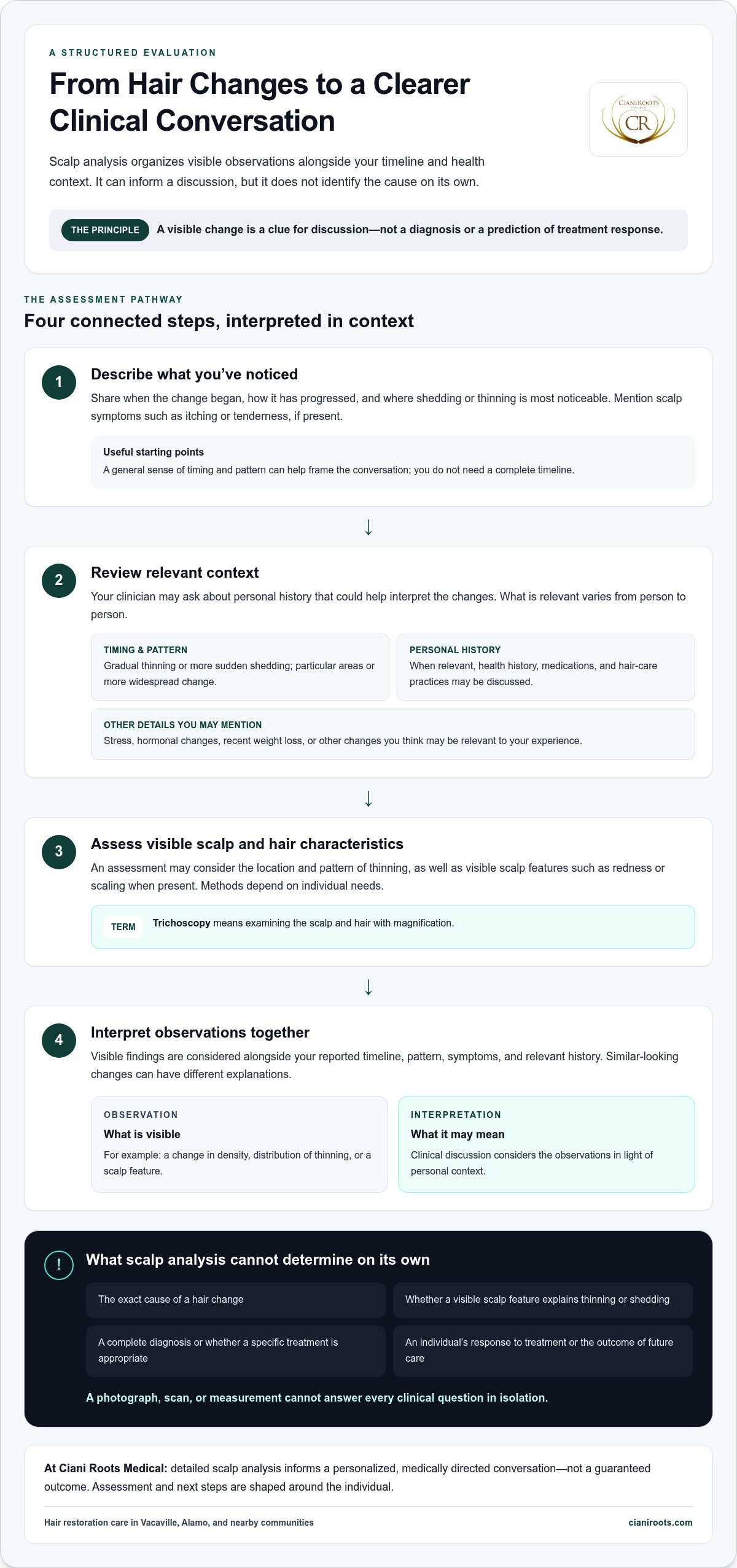
A scalp assessment is most useful as part of a broader evaluation, not as a stand-alone answer. The conversation commonly moves through a few connected steps: discuss what you’ve noticed, review relevant history, assess the scalp and hair, then explain the observations and what they may mean. The appointment flow and assessment methods can vary with individual needs.
Scalp and hair observations should be interpreted alongside personal history because timing, pattern, symptoms, and health context can change what those findings suggest. A similar visible change may lead to different questions depending on whether it developed gradually or appeared after a specific life or health change.
What information may be discussed alongside scalp findings?
Describe changes in your own words: when they began, how long they’ve been noticeable, and whether they affect particular areas or seem more widespread. Mention scalp symptoms such as itching or tenderness if you’ve experienced them. You don’t need a complete timeline; even a general sense of when things changed can help frame the discussion.
Depending on what’s relevant, a clinician may also ask about hair-care practices, medications, or aspects of your health history. These details aren’t a checklist everyone must complete. They provide context and help identify useful follow-up questions. The American Academy of Dermatology’s overview of diagnosing hair loss also describes how examination and personal history can contribute to a broader evaluation.
How are observation and clinical interpretation different?
Observation describes what’s visible, such as a change in density, a particular distribution of thinning, or a scalp feature. Interpretation considers what those observations could mean in light of your timeline and other relevant information. A visible change alone doesn’t identify its cause, and a photograph, scan, or measurement cannot answer every clinical question in isolation.
Context guides the next conversation. A clinician may ask more about the timing or pattern, consider whether additional evaluation is appropriate, or discuss how the findings relate to your goals. At Ciani Roots Medical, detailed scalp analysis is part of personalized, medically directed hair restoration care. If you’re in Vacaville or Alamo and would like to discuss your concerns, you can explore a personalized hair consultation.
What Can Scalp Analysis Reveal, and What Can It Not Tell You?
A detailed assessment can make visible features easier to describe and discuss, but it doesn’t establish the cause of hair changes or predict how someone will respond to care. In scalp analysis for hair loss, observations are clues for clinical interpretation, not conclusions on their own.
| An assessment may help observe | It cannot determine on its own |
|---|---|
| Where thinning appears and whether it seems more noticeable in particular areas | The exact cause of a hair change |
| Visible scalp characteristics, such as redness or scaling, when present | Whether a visible scalp feature explains shedding or thinning |
| Hair and scalp patterns that may help focus follow-up questions | A complete diagnosis or whether a particular treatment is appropriate |
| Observations that can be considered alongside a person’s reported timeline | An individual’s response to treatment or the outcome of future care |
What observations may help guide a hair-loss discussion?
A pattern of thinning may help focus questions about where changes began and how they’ve developed. If scalp changes are also visible, they may be discussed alongside hair changes when relevant. For instance, an assessment might note scaling and thinning in the same area, but that observation alone doesn’t establish that one caused the other. Your experience and relevant history remain essential parts of the discussion.
Why can scalp analysis not predict an individual result?
Scalp analysis is one part of clinical judgment, not a forecast. Different factors can contribute to hair changes, and personal health context varies. Findings need to be interpreted with those factors in mind. Further evaluation may be appropriate depending on the individual situation.
A thorough assessment can support a more informed conversation, but it can’t promise certainty about cause or outcome. A detailed image or measurement also cannot answer every clinical question. If care is considered, next steps should be personalized after consultation and assessment. At Ciani Roots Medical, scalp findings inform a broader, medically directed discussion rather than serving as a stand-alone treatment or a guarantee of response.
How to Prepare for a Scalp Analysis for Hair Loss
Preparing for a scalp analysis for hair loss doesn’t require a detailed log or a perfect account of every change. A few notes can help you explain what you’ve noticed and make room for a focused conversation. The goal isn’t to diagnose yourself, but to share useful context in your own words.
What should you note before an appointment?
Before your visit, consider writing down a few details you can easily recall:
- Timing: When did you first notice shedding, thinning, or a scalp change?
- Progression: Has it seemed steady, changed over time, or appeared more suddenly?
- Pattern: Which areas have you noticed most, if any?
- Scalp symptoms or related changes: Note concerns such as itching or flaking, as well as recent changes you think may be relevant.
- Useful background: Bring or make note of relevant health information, medications, or hair-care practices you already know about.
These are conversation prompts, not a required intake list. You don’t need to interpret what the details mean or decide whether one factor caused another. If you have photographs showing changes over time, you may bring them as context, but they don’t replace an in-person assessment.
What questions can help you understand the findings?
It’s reasonable to ask the clinician to explain observations in clear terms. You might ask: Which findings stand out? How do they fit with the timing and pattern I described? What can the assessment suggest, and what can’t it establish by itself? Is further evaluation or follow-up worth considering?
These questions help distinguish what was observed from what those observations may mean for you. They also create room to discuss next steps without assuming treatment is automatically needed. If a care plan is considered, it should reflect your consultation, assessment, and individual circumstances.
You don’t have to arrive with every detail organized. A simple description of what changed and what concerns you is a useful starting point. To learn more about Ciani Roots Medical’s personalized approach to scalp analysis and hair restoration, explore scalp analysis and hair restoration care.
How Ciani Roots Uses Scalp Analysis to Inform Personalized Hair Restoration
At Ciani Roots Medical, detailed scalp analysis is part of personalized, medically directed hair restoration care. It brings visible scalp and hair observations together with your concerns and relevant personal history to inform a broader clinical conversation. The assessment supports planning; it isn’t a treatment by itself or a promise of a particular result.
How does scalp analysis fit into personalized care?
Scalp analysis for hair loss is considered alongside the wider evaluation, rather than used to select a treatment in isolation. After discussing what you’ve noticed and reviewing relevant context, the clinician can explain which findings may matter and how they relate to your goals. This gives you a clearer basis for discussing potential options and their relevance to your circumstances.
Depending on your evaluation, care discussions may include Bio-Enhanced PRP, KeraLase® with LASEmd® Ultra and KeraFactor MD, or medication management when appropriate. Another option is personalized Acorn Secretome, a regenerative product created from your own stored cells or biology. These approaches aren’t automatically right for everyone. Options are considered in light of the consultation, assessment, and individual needs.
The purpose is to connect observations with a thoughtful plan, not to treat a finding as a complete explanation. A clinician can discuss what the assessment supports, what remains uncertain, and whether further evaluation or a particular care approach may be appropriate.
What can you do after your scalp analysis?
Use the discussion to understand the findings and their limits. Ask which observations are most relevant, how they fit with the timing and pattern you described, and what next steps may make sense for you. If a plan is discussed, it should reflect your clinical evaluation and personal circumstances. You’re not expected to decide on treatment simply because an assessment has taken place.
Ciani Roots Medical provides personalized hair restoration care in Vacaville and Alamo, California. People from Sacramento, Davis, Solano County, Contra Costa County, and the San Francisco Bay Area can begin with a conversation about their concerns and whether detailed scalp analysis may help inform their care.
Take a Clearer, More Personal Next Step
Scalp analysis for hair loss can help organize what’s visible, but its value comes from interpreting those observations alongside your concerns, timeline, and relevant health context. It may guide a clinical discussion, but it can’t determine every cause or predict an individual response to care on its own.
Preparing a few notes and questions can help you feel more comfortable during an assessment. You don’t need to arrive with a diagnosis. A thoughtful evaluation can clarify what the findings may suggest and whether any next steps fit your circumstances.
Founded by Adriane McDonald, BSN, RN, with nearly 40 years of hair restoration experience, Ciani Roots Medical provides personalized care under dedicated medical director oversight. Consultations and scalp analysis help inform individualized hair restoration planning in Vacaville and Alamo, California.
If you’re ready to talk through changes you’ve noticed, schedule a complimentary consultation. Ciani Roots Medical welcomes patients from Vacaville, Alamo, Sacramento, Davis, Solano County, Contra Costa County, and the San Francisco Bay Area. A clear conversation is a practical place to begin, with next steps shaped around you.
Frequently Asked Questions
What is scalp analysis for hair loss?
Scalp analysis for hair loss is a structured assessment of visible scalp and hair characteristics, considered alongside your concerns and personal history. It may help a clinician describe patterns of thinning or scalp changes and guide a discussion about possible next steps. It isn’t a diagnosis on its own. At Ciani Roots Medical, detailed scalp analysis is part of personalized, medically directed hair restoration care.
Can a scalp analysis identify the cause of hair loss?
A scalp analysis may provide useful observations, but it can’t always identify the cause by itself. The clinician considers findings alongside your timeline, pattern of change, scalp symptoms, and relevant health information. For example, seeing thinning in a particular area doesn’t establish why it’s happening. Depending on the overall evaluation, further assessment may be appropriate before discussing an individualized care plan.
What happens during a scalp analysis appointment?
An appointment may begin with a conversation about what you’ve noticed and when the changes began. The clinician may review relevant personal or health history, assess visible scalp and hair characteristics, and explain the observations. The specific methods and flow can vary with individual needs. You can describe changes in everyday language and ask what the findings may suggest, as well as what they can’t determine.
Is scalp analysis painful or invasive?
A visual scalp and hair assessment is generally observational and doesn’t require entering the skin. Assessment methods may vary, so the experience depends on what’s appropriate for your evaluation. If you have concerns about comfort or a particular step, raise them during the appointment. The purpose is to understand visible findings and discuss them in context, not to make assumptions from a single observation.
Can scalp analysis detect hair thinning before it becomes obvious?
An assessment may help identify patterns or changes that are difficult to judge by looking in a mirror, but it can’t guarantee early detection or determine how hair changes will progress. Findings depend on the assessment and individual circumstances. If you’ve noticed a widening part, changes in density, or increased shedding, sharing when and where you first observed it can help guide the clinical discussion.
Should I wash my hair before a scalp analysis?
There isn’t a universal washing rule that applies to every scalp assessment. Follow any appointment instructions you’ve received, and avoid changing your usual hair-care routine solely to influence what the clinician may observe. If you use styling products or have recently changed your routine, mention that during the visit. The aim is to consider your scalp and hair in the context of your usual experience.
Does scalp analysis mean I need hair-loss treatment?
No. Having a scalp analysis doesn’t mean treatment is automatically needed or appropriate. The findings are considered alongside your concerns and broader clinical evaluation. The next step may simply be discussing what was observed or whether further evaluation is useful. Ciani Roots Medical provides personalized hair restoration care in Vacaville and Alamo, California, with any treatment plan shaped by consultation and individual circumstances.
Article by
Adriane McDonald BSN,RN
Adriane McDonald, BSN, RN, is a hair restoration specialist with nearly 40 years of experience working with men and women experiencing hair loss and thinning. As the Founder and Practice Director of Ciani Roots Medical, she works alongside the practice’s Medical Director to provide personalized hair restoration, scalp health, regenerative therapies, and advanced skin rejuvenation.
Her approach combines extensive hands-on experience with detailed scalp analysis, medical collaboration, and individualized treatment planning. Adriane is currently completing advanced training toward certification in trichology, further expanding her expertise in hair and scalp health.
Disclaimer
This content is provided for general educational and informational purposes only and is not intended to serve as medical advice, diagnosis, or treatment. Individual needs, treatment recommendations, and results vary. A consultation and appropriate evaluation are necessary to determine which treatment options may be suitable for you. Viewing or interacting with this content does not establish a healthcare professional-patient relationship with Ciani Roots Medical.
Individual results may vary, and no specific outcome can be guaranteed. Before-and-after images, testimonials, or treatment experiences represent individual results and should not be considered a guarantee of similar results.


